



Guide du moule d’injection: Composants, Types, et comment cela fonctionne
Injection mold systems are precision tools used to shape molten plastic into repeatable production parts. A typical injection mold includes cavities, Couleurs, Conduits de refroidissement, Coureurs, and ejector systems that control part quality, Temps de cycle, et durabilité. Understanding mold components, mold types, Délais d’exécution, and maintenance requirements helps manufacturers reduce defects, Améliorer la cohérence, and make better tooling decisions.
Un moule d’injection affecte bien plus que la forme de la pièce. Cela influence la vitesse de production, Précision dimensionnelle, Coûts de maintenance, and long-term manufacturing stability. A well-built mold can run for years with consistent output, while a poorly designed one can create delays, Défauts, and expensive downtime. Ce guide explique comment fonctionnent les moules d’injection, which components matter most, and what buyers should understand before starting a tooling project.
Qu’est-ce qu’un moule d’injection?
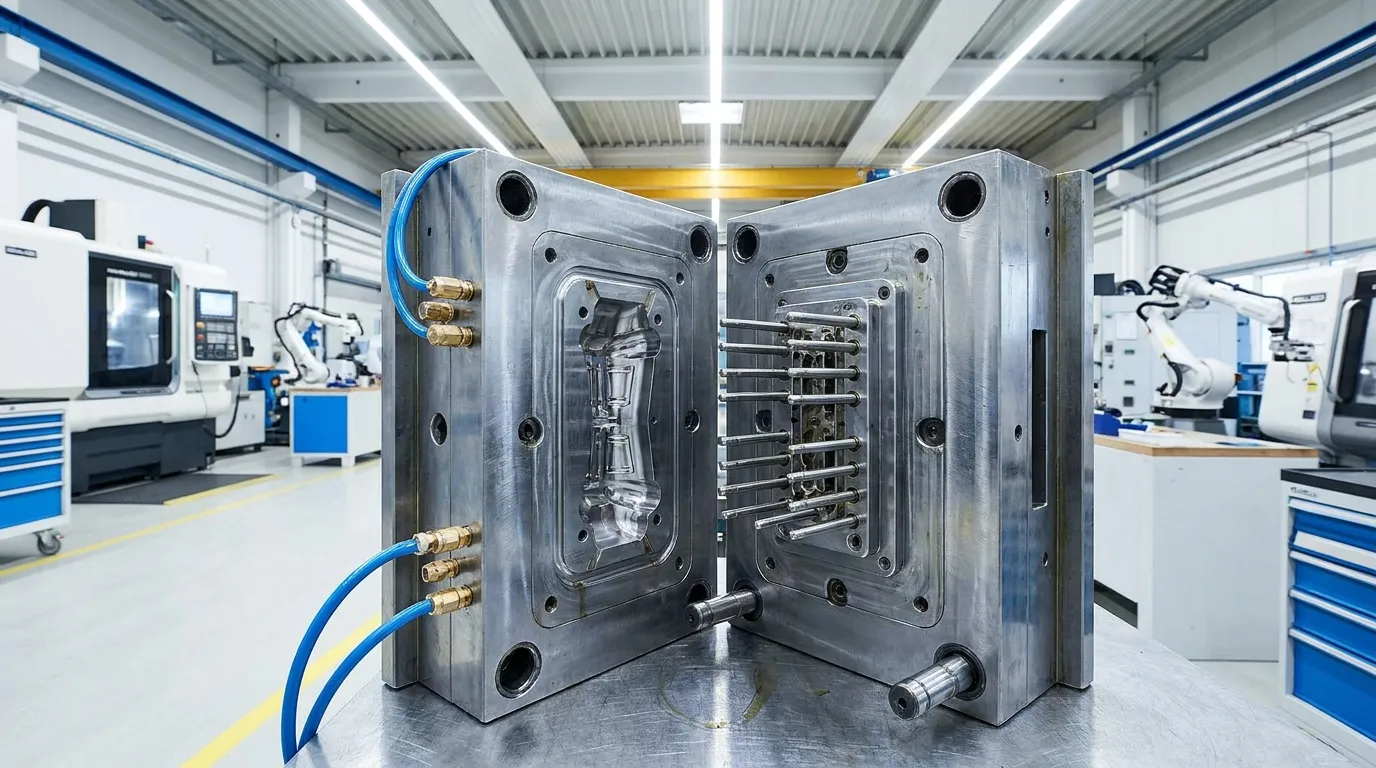
An injection mold is a precision tool used to shape molten plastic into finished parts during the injection molding process. It contains cavities, Couleurs, Conduits de refroidissement, and ejection systems that control part shape, Qualité de surface, et la cohérence de la production.
An injection mold works like a reusable forming system. Molten plastic enters the mold under pressure, fills a cavity shaped like the final part, cools into a solid form, and then gets ejected so the cycle can repeat.
Most molds consist of two primary halves: the core side and the cavity side. When the mold closes, these sections align tightly to create the exact geometry of the plastic component. Small alignment errors can cause flashing, Variation dimensionnelle, ou une usure prématurée.
The mold itself often represents one of the largest investments in a plastic manufacturing project. That’s why manufacturers focus heavily on tooling precision, Efficacité de refroidissement, and material durability. Selon Protolabs, mold design decisions directly affect manufacturability, Temps de cycle, and part quality.
For a broader explanation of the full molding workflow, see this Guide de moulage par injection plastique.
How does an injection mold work step by step?
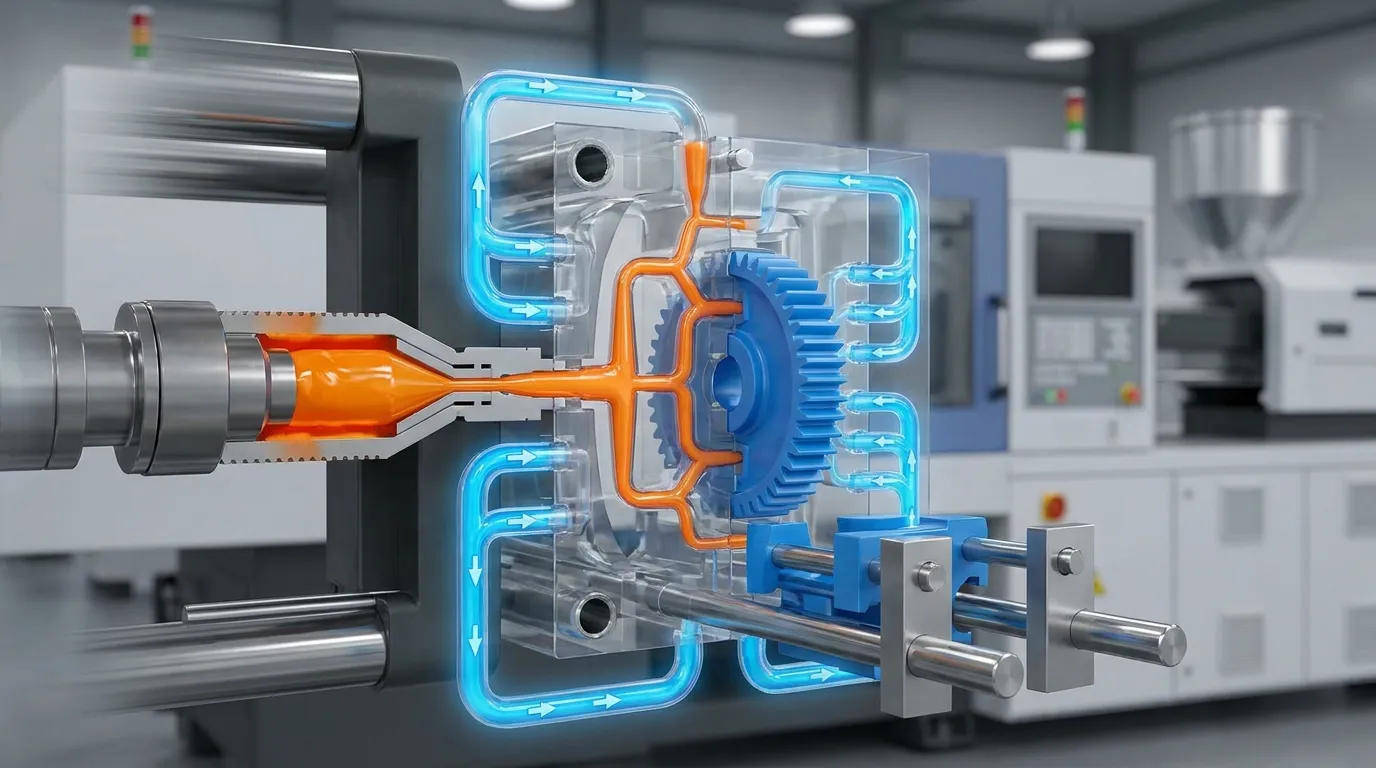
An injection mold works by receiving molten plastic under pressure, shaping the material inside a cavity, cooling it into a solid form, and ejecting the finished part before the cycle repeats. Every stage affects part quality and cycle time.
The process starts when plastic pellets melt inside an injection molding machine. The machine then injects the molten material into the mold cavity at controlled pressure and speed. Once the cavity fills completely, the cooling phase begins.
Étage d’injection
Pendant l’injection, material flows through the sprue, Système de coureurs, and gate before entering the cavity. Proper flow balance matters because uneven filling can create short shots, Marques de naufrage, or air traps.
A consumer electronics supplier producing 100,000 units per year may use a multi-cavity mold to improve throughput. Dans ce cas,, balanced filling becomes even more important because uneven pressure distribution can create part variation between cavities.
Refroidissement et solidification
Cooling channels inside the mold remove heat from the plastic. This stage often controls most of the production cycle time. Poor cooling design increases cycle times and raises the risk of warping or shrinkage problems.
A cooling imbalance can become expensive quickly. If one side of the mold cools slower than the other, operators may need to increase cycle time just to maintain acceptable dimensions. That reduces output and increases production cost per part.
Selon Asahi Kasei, cooling efficiency and material flow behavior strongly affect molding stability and dimensional control.
Éjection de la partie
After the part solidifies, the mold opens and the ejection system pushes the part out safely. Goupilles éjecteurs, Manches, and lifters prevent parts from sticking inside the cavity.
This stage sounds simple, but it creates many production problems. Poor ejection force or worn components can leave marks, crack delicate parts, or slow production cycles.
For examples of industry use cases, Voir ceci Applications dans les moules d’injection.
Quels sont les principaux composants d’un moule d’injection?
The main components of an injection mold include the core, cavité, Système de coureurs, Conduits de refroidissement, Système d’éjection, and alignment components. Ensemble, these parts control material flow, Précision dimensionnelle, Efficacité de refroidissement, and safe part removal.
Every mold component affects part quality differently. Some control geometry, while others manage alignment, Refroidissement, or cycle efficiency. Problems in one area often create defects somewhere else in the process.
| Composant | Fonction principale | Production Impact |
|---|---|---|
| Noyau | Forme la géométrie interne de la pièce | Contrôle la précision dimensionnelle |
| Cavité | Forme la forme de la partie extérieure | Affecte la finition de surface |
| Système de coureurs | Dirige l’écoulement du plastique en fusion | Les impacts remplissent la cohérence |
| Gate | Contrôle le point d’entrée de la cavité | Influence la qualité cosmétique |
| Canaux de refroidissement | Retirer la chaleur | Contrôle du temps de cycle |
| Système d’éjection | Enlève les pièces finies | Empêche le collage et les dommages |
| Goupilles guides et bagues | Maintenir l’alignement | Réduit l’usure et le solinage |
Système de refroidissement
Cooling channels regulate mold temperature during production. Efficient cooling reduces cycle time and improves dimensional stability.
Medical device molds often require tighter thermal control because small dimensional shifts can affect product fit and validation requirements. In these projects, cooling design directly affects both quality and lead time.
Système d’éjection
The ejection system pushes finished parts out of the mold after cooling. Goupilles éjecteurs, Manches, and stripper plates must apply force evenly to avoid damaging the part.
Worn ejector components create visible production problems. Parts may stick, eject unevenly, or develop stress marks during removal.
For a deeper look at component systems, see this Présentation des composants du moule.
Why are guide pins, Silents, and core pins critical?
Goupilles guides, Silents, and core pins maintain alignment and dimensional consistency inside injection molds. Un mauvais alignement augmente l’usure, Défauts de flash, part variation, and maintenance frequency during high-volume production.
Alignment components are easy to overlook because they operate in the background of the molding cycle. Toujours, they directly affect mold lifespan and production consistency. Even small alignment shifts can create uneven cavity pressure and accelerated wear.
Guide pins and bushings help the mold halves close accurately every cycle. Without stable alignment, the mold may develop flashing around part edges or uneven surface finishes. High-volume automotive projects often experience these issues first because repeated cycling increases wear over time.
Core pins form internal holes, Machines à sous, and detailed features inside molded parts. These components must maintain tight tolerances under heat and pressure. A worn core pin can change hole dimensions enough to create assembly problems downstream.
A high-volume automotive trim supplier, par exemple, may experience flashing defects after guide components wear unevenly. Replacing those alignment parts early often costs far less than running unstable production for weeks.
En savoir plus sur Goupilles guides de moule and how they support mold alignment accuracy.
What types of injection molds are commonly used?
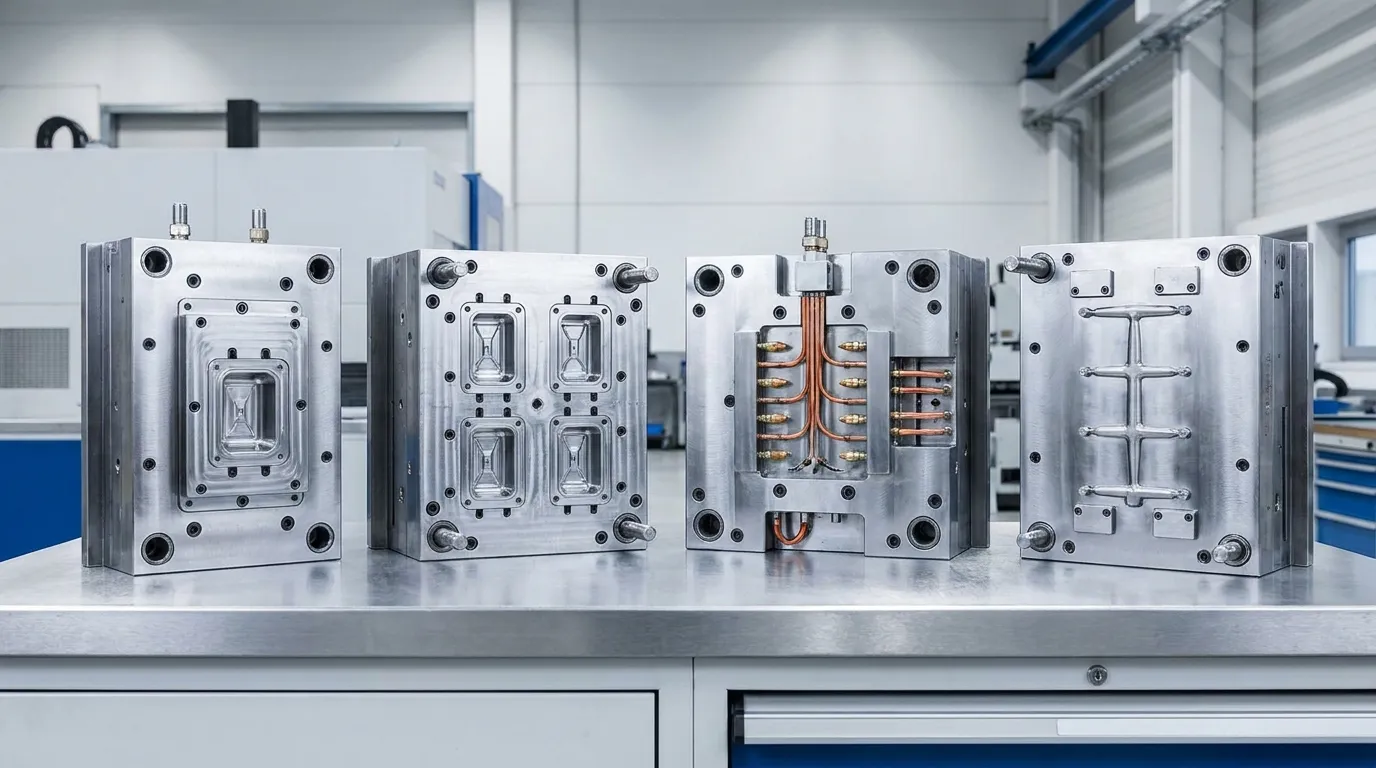
Different injection mold types support different production goals. Single-cavity molds prioritize precision and lower upfront complexity, while multi-cavity and hot-runner molds improve production speed and efficiency for higher-volume manufacturing.
No single mold type works best for every project. Volume de production, Géométrie des pièces, budget, and lead-time goals all influence the right tooling choice.
| Type de moule | Meilleur cas d’utilisation | Principal avantage | Limitation principale |
|---|---|---|---|
| Moule à cavité unique | Volume faible à moyen | Contrôle des procédés plus facile | Puissance inférieure |
| Moule multi-cavités | Production en grande quantité | Débit plus élevé | Complexité d’équilibrage accrue |
| Moisissure familiale | Ensembles de pièces apparentées | Produit plusieurs pièces ensemble | Plus difficile à optimiser de manière uniforme |
| Moule à couloir chaud | Grandes séries de production | Moins de déchets matériels | Coût d’outillage plus élevé |
| Moule à canal froid | Projets plus simples | Coût initial plus bas | Encore des matériaux de récupération |
Moules en acier vs en aluminium
Steel molds are usually the better choice for long production runs. They handle wear more effectively and maintain tighter tolerances over time. Aluminum molds reduce upfront tooling cost and shorten machining time, which makes them useful for prototyping or smaller production runs.
Aluminum molds are not always the cheapest long-term option. They work well for limited production, but hardened steel molds often become more economical when annual volumes rise significantly.
Multi-cavity molds are not automatically better either. They improve output, but they also increase balancing complexity and maintenance requirements. A poorly balanced multi-cavity system can create inconsistent parts across different cavities.
What affects injection mold cost and lead time?
Injection mold cost and lead time depend on mold complexity, Nombre de cavités, Matériau d’outillage, Exigences de tolérance, and revision cycles. Production molds commonly require several weeks of machining, Essais, Validation, and adjustment before full-scale manufacturing begins.
Tooling cost varies widely because every mold project has different technical requirements. A simple prototype mold may move quickly, while a production mold with tight tolerances and multiple cavities can require extended machining and validation work.
Several factors affect both pricing and schedules:
- Complexité des pièces
- Nombre de cavités
- Exigences de finition de surface
- Complexité du système de refroidissement
- Sélection de l’acier moulé
- Tolérances dimensionnelles
- Cycles d’échantillonnage et de validation
Pourquoi les révisions des outils retardent les plannings
Late design changes often create the biggest delays. Une fois la coupe de l’acier commencée, even small geometry revisions may require re-machining, welding, or insert replacement.
A medical housing project, par exemple, may require additional validation after tolerance changes during development. That extra testing can extend tooling timelines significantly.
Fast mold delivery is not always a competitive advantage. Rushed tooling projects can increase revision cycles and create long-term production instability if validation gets compressed too aggressively.
| Facteur de projet | Impact sur les coûts | Impact sur le délai d’exécution |
|---|---|---|
| Conception multi-cavités | Haut | Modéré |
| Tolérances strictes | Haut | Haut |
| Acier trempé | Modéré | Modéré |
| Refroidissement complexe | Modéré | Haut |
| Révisions de conception tardives | Haut | Haut |
Selon Aprios, tooling validation and revision cycles are major contributors to injection mold lead times.
For more detail on precision tooling features, voir Broches à noyau dans le moulage par injection.
What problems commonly affect injection molds?
Common injection mold problems include flash, Plans courts, Pièces adhésives, refroidissement inégal, and ejector wear. Many issues are caused by poor maintenance, weak venting, Désalignement, or process instability during repeated production cycles.
Most mold problems develop gradually. Small alignment issues, clogged cooling channels, or worn ejector systems often become visible only after repeated production cycles.
| Problème | Cause commune | Production Impact |
|---|---|---|
| Flash | Désalignement du moule | Matériau excédentaire autour des arêtes |
| Coup court | Remplissage incomplet | Géométrie manquante |
| Déformation | Refroidissement inégal | Distorsion dimensionnelle |
| Pièces adhésives | Mauvaise éjection | Retards de cycle |
| Marques d’écoulement | Écoulement instable des matériaux | Défauts esthétiques |
Cooling imbalance is one of the most expensive hidden problems in production. If operators increase cooling time to compensate for inconsistent temperatures, overall output drops even when the parts still pass inspection.
Maintenance schedules matter here. Replacing worn alignment components early can prevent larger tooling failures later. Many production teams focus on machine settings first, even though worn mold components may be the real cause of instability.
Selon Elastron, defects often result from unstable processing conditions combined with tooling or cooling issues.
Des informations supplémentaires sur les composants sensibles à l’usure sont disponibles dans ce guide à Broches et bagues de moulage.
Combien de temps dure un moule d’injection?
Injection mold lifespan depends on tooling material, Volume de production, Type de résine, and maintenance quality. A properly maintained steel mold can support very high production cycles before major refurbishment becomes necessary.
Steel molds generally last much longer than aluminum molds because they resist wear more effectively under repeated heat and pressure cycles. Production molds used in automotive or consumer electronics manufacturing may operate continuously for years with scheduled maintenance intervals.
Maintenance has a major effect on lifespan. Cooling channels need regular cleaning, moving components require lubrication, and alignment systems should be inspected for wear. Ignoring those tasks increases the chance of flashing, Pièces adhésives, ou dérive dimensionnelle.
Here are common factors that affect mold longevity:
- Abrasivité de la résine
- Volume de production
- Efficacité du refroidissement
- Fréquence de maintenance
- Dureté de l’acier moulé
- Stabilité de l’alignement
Selon ESCATEC, tooling maintenance and operating conditions strongly influence mold service life.
For examples of wear-sensitive tooling features, Examinez ces Broches de noyau de précision.
What should buyers ask before ordering an injection mold?
Choosing the right mold supplier requires more than comparing price quotes. Buyers should understand how the supplier handles tooling validation, maintenance support, and production consistency before approving a project.
A clear supplier discussion early in the process can prevent expensive revisions later. That matters especially for production molds with tight tolerances or multi-cavity designs.
Liste de contrôle pour acheteurs de moules d’injection
| Question | Pourquoi c’est important |
|---|---|
| What mold steel will be used? | Affecte la durabilité et la résistance à l’usure |
| How will tolerances be validated? | Confirme la précision dimensionnelle |
| What is included in sampling? | Évite la confusion d’approbation |
| How are design revisions handled? | Réduit le risque de retard |
| What maintenance support is available? | Améliore la fiabilité à long terme |
| Can the supplier support export logistics? | Cela aide à éviter les retards d’expédition |
| What machine size will run the mold? | Assure la compatibilité en production |
A production tooling project becomes much easier when both sides define expectations early. Buyers who ask detailed questions about validation, Entretien, and revision handling usually face fewer production surprises later.
Réussir la prochaine étape
An injection mold affects production quality long before the first molded part leaves the machine. The right tooling design improves consistency, Temps de cycle, and long-term manufacturing stability. The wrong approach can create years of avoidable maintenance and quality problems.
If you're reviewing a new tooling project, focus on the full production picture instead of only the initial mold price. Cooling design, Systèmes d’alignement, Sélection des matériaux, and validation planning all affect long-term results. Understanding how these systems work together makes it easier to choose the right mold strategy for your production goals.
Questions fréquemment posées
What is the purpose of an injection mold?
An injection mold shapes molten plastic into finished parts with repeatable dimensions and surface quality. It controls cooling, Écoulement des matières, and part ejection during high-volume manufacturing.
Combien de temps faut-il pour construire un moule d’injection ??
Injection mold lead times often range from several weeks to several months depending on complexity, Nombre de cavités, Exigences de test, et révisions des outils. Production-grade molds usually require machining, Échantillonnage, and validation before release.
Pourquoi les moules d’injection sont-ils chers ??
Les moules d’injection nécessitent un usinage de précision, hardened tooling materials, engineering validation, and detailed finishing work. Complex molds with tight tolerances or multiple cavities increase both manufacturing time and tooling cost.
What materials are injection molds made from?
Most injection molds are made from hardened steel or aluminum depending on production volume and durability requirements. Steel molds generally support longer production runs and stronger wear resistance.
What causes injection molding defects?
Injection molding defects can result from poor cooling, Air piégé, worn mold components, unstable pressure, or incorrect process settings. Proper mold maintenance and stable processing conditions reduce defect frequency.
Combien de temps dure un moule d’injection?
Injection mold lifespan depends on tooling material, Volume de production, Qualité d’entretien, and resin type. Properly maintained steel molds can support very high production cycles before major refurbishment becomes necessary.
Partager:


Écrit par Sunshine
Au soleil, Nous sommes un fabricant et fournisseur professionnel de composants de moule de précision, proposant une large gamme de produits pour les applications de stampage et de moulage par injection. Notre objectif principal est le poinçage des coins, Goupilles et manchons d’éjection, et poteaux guides et bagues. Avec un usinage CNC avancé, Contrôle qualité strict, et de fortes capacités de production, Nous garantissons une fiabilité, Pièces de haute précision, ainsi que des composants standards en stock pour un approvisionnement mondial rapide et efficace.
ACTUALITÉS
OBTENIR UN SERVICE
Avec des pièces de qualité adaptées à tous les budgets et un personnel accueillant formé pour rendre votre visite informative et sans tracas.
