



Guide du moule d’injection: Composants, Types, et comment cela fonctionne
Injection mold systems are precision tools used to shape molten plastic into repeatable parts during injection molding production. A typical injection mold includes the cavity, core, runner system, Conduits de refroidissement, and ejector components. Mold type, Sélection des matériaux, and cooling design directly affect part quality, Vitesse de production, tooling cost, and mold lifespan.
An injection mold determines how a plastic part looks, fits, and performs. Even small tooling decisions can affect cycle time, Taux de défauts, and long-term production cost. This guide explains how injection molds work, what components matter most, and how manufacturers choose the right mold setup for different production goals.
What is an injection mold?
An injection mold is a precision tooling system used to shape molten plastic into repeatable parts during injection molding. The mold controls the part’s final shape, dimensions, Finition de surface, and production consistency.
An injection mold is the custom-built tool installed inside an injection molding machine. Molten plastic flows into the mold cavity under pressure, cools into shape, and then ejects as a finished part. The same mold can produce thousands or even millions of identical components when maintained correctly.
The mold itself contains several engineered systems that control material flow, Refroidissement, Alignement, et sortie partielle. That’s why tooling quality has such a strong impact on production efficiency and defect prevention.
If you’re new to the manufacturing process, Ceci Guide de moulage par injection plastique explains the broader molding workflow and machine operation in more detail.
For a technical overview of molding fundamentals, le Présentation mondiale du moulage par injection de TWI provides a useful industry reference.
How does an injection mold work during production?
Injection molds work by receiving molten plastic under pressure, cooling the material inside a precision cavity, and ejecting the finished part after solidification. The process repeats rapidly for high-volume production.
The process starts with plastic pellets melting inside the injection molding machine barrel. The machine pushes the molten plastic into the mold cavity through a runner and gate system. Once the cavity fills, the mold holds pressure while the material cools and hardens.
Cooling time matters more than many buyers expect. A poorly designed cooling layout can slow production dramatically and increase warping or shrinkage issues. In high-volume manufacturing, even a few seconds added to cycle time can affect overall production cost.
Phase d’injection
Pendant l’injection, the mold must stay tightly clamped to handle pressure. The cavity and core shape the plastic into its final geometry. Gates control how material enters the part, while runners distribute material through the mold.
A consumer electronics housing with thin walls, par exemple, often requires balanced flow paths to prevent cosmetic marks and incomplete filling.
Phase de refroidissement et d’éjection
Après refroidissement, ejector pins push the part out of the mold. The mold then closes again, and the cycle repeats. Efficient cooling design helps reduce downtime and improve production speed.
Exactement Guide de moldabilité Protolabs explains how moldability and cooling design affect manufacturing performance.
For a broader explanation of production flow, Regarde ça Guide du procédé de moulage par injection.
What are the main components of an injection mold?
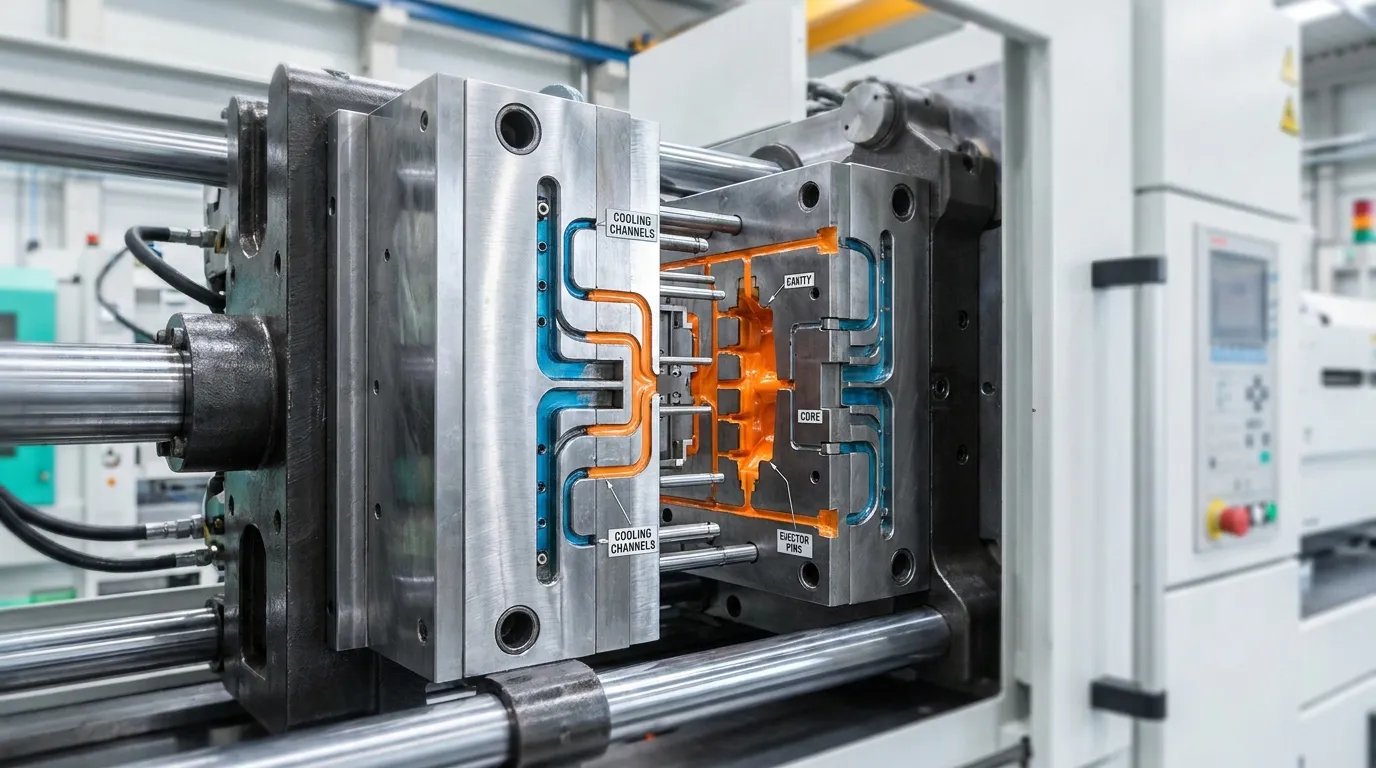
Injection mold components work together to control plastic flow, Refroidissement, Alignement, and part ejection. Core systems include the cavity, runner system, Éjecteurs, Conduits de refroidissement, and guide mechanisms.
Every injection mold includes several mechanical systems that must work together with tight precision. If one area fails, the entire molding process can suffer from defects, downtime, or inconsistent dimensions.
| Composant | Fonction | Pourquoi c’est important |
|---|---|---|
| Cavité | Forme la forme extérieure de la pièce | Dimensions des commandes et finition de surface |
| Noyau | Crée des fonctionnalités internes | Affecte l’ajustement et la géométrie structurelle |
| Système de coureurs | Dirige l’écoulement du plastique en fusion | Impacts du remplissage de la balance |
| Gate | Point d’entrée dans la cavité | Influences des lignes de soudure et des marques |
| Canaux de refroidissement | Enlève la chaleur du moule | Réduction du temps de cycle |
| Goupilles éjecteurs | Poussez les pièces finies vers l’extérieur | Empêche le collage et les dommages |
| Goupilles guides | Aligner les moitiés du moule | Maintient la précision lors du serrage |
Cooling channels often receive less attention than cavities or gates, but they directly affect production efficiency. A redesigned cooling layout can shorten cycle time significantly during high-volume production runs.
Par exemple, a medical component with tight tolerances may require advanced cooling paths and hardened steel inserts to maintain dimensional stability across long production runs.
Exactement Présentation des composants du moule provides a deeper look at individual tooling systems and their engineering roles.
For additional mold construction details, le Référence sur la construction de moules d’injection offers a useful technical resource.
What are the different types of injection molds?
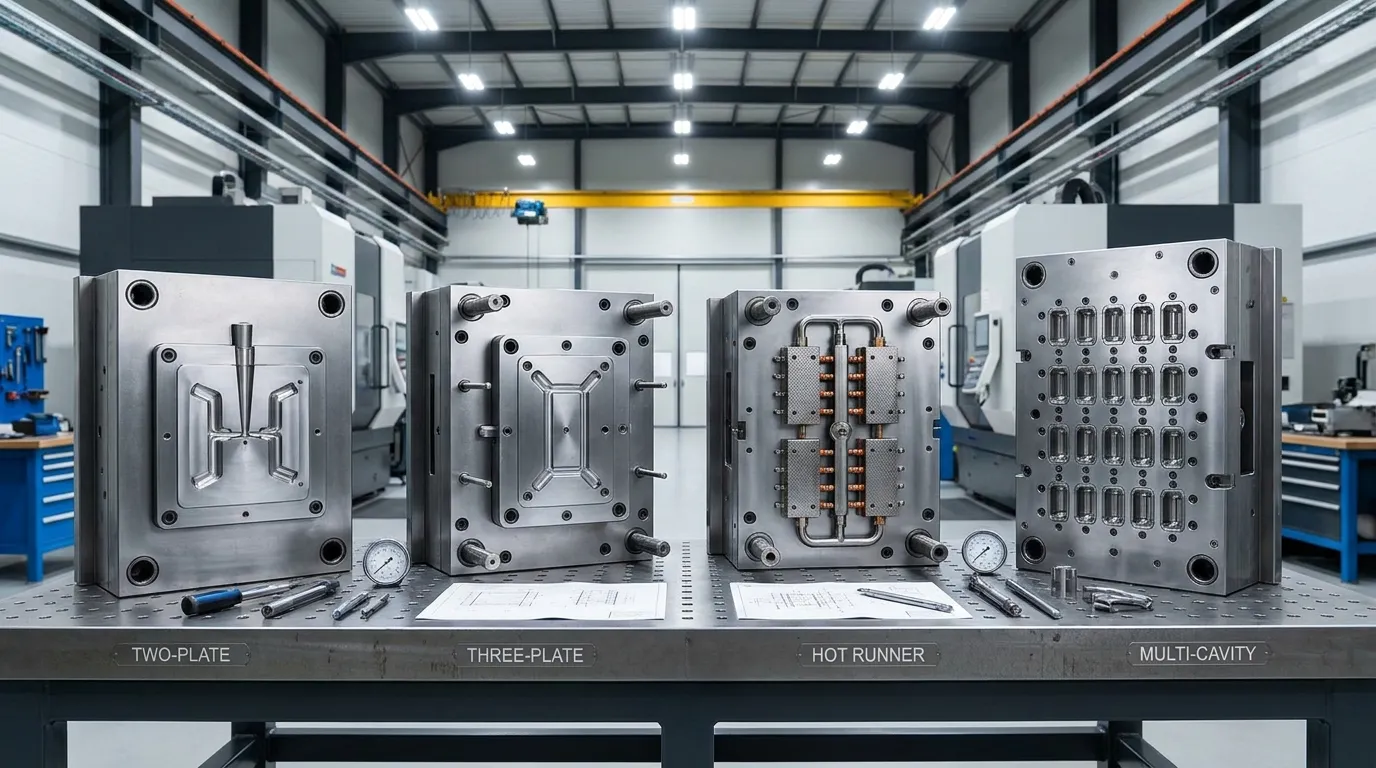
Different injection mold types are designed for different production needs. Simpler molds reduce tooling cost, while advanced systems like hot runner molds improve cycle efficiency and reduce material waste.
Manufacturers select mold types based on production volume, part complexity, gating requirements, and budget. Some molds focus on lower tooling cost, while others prioritize faster production and reduced scrap.
Moules à deux plaques vs moules à trois plaques
A two-plate mold uses a single parting line and simpler runner system. It works well for many standard plastic parts and usually costs less to manufacture.
A three-plate mold adds an extra plate that allows more flexible gate placement. This helps with complex geometries and automatic runner separation, but it also increases tooling complexity and maintenance requirements.
| Type de moule | Meilleur pour | Principal avantage | Principal inconvénient |
|---|---|---|---|
| Moule à deux plaques | Pièces de production standard | Coût d’outillage plus bas | Installation limitée des portes |
| Moule à trois plaques | Agencements complexes de portails | Meilleure flexibilité des portes | Entretien plus élevé |
| Moule à couloir chaud | Production en grande quantité | Moins de déchets matériels | Coût initial plus élevé |
| Moule multi-cavités | Grandes séries de production | Production plus élevée par cycle | Complexité d’équilibrage accrue |
Hot runner molds are not always the best choice. They improve material efficiency, but simpler cold runner systems are often safer for lower production volumes or products with frequent material changes.
A low-volume prototype project, for instance, may benefit more from a simpler tooling design with lower upfront investment.
Exactement Guide des applications industrielles des moules explains how different mold setups fit various industries and product categories.
Which materials are used to make injection molds?
Steel molds are preferred for long production runs and tight tolerances, while aluminum molds reduce tooling cost and speed up prototyping. Material selection depends on production volume, part complexity, et la durée de vie attendue du moule.
Tool steel is the most common mold material for long-term production. Hardened steel handles high injection pressure, matériaux abrasifs, and repeated cycles better than softer metals. It’s commonly used for automotive, Médical, and industrial production programs.
Aluminum molds are lighter and easier to machine. That makes them useful for prototyping, Outillages de ponts, and shorter production runs where speed matters more than maximum lifespan.
| Matériel | Meilleure utilisation | Force | Limitation |
|---|---|---|---|
| Acier trempé | Longues séries de production | Haute durabilité | Coût plus élevé |
| Acier pré-trempé | Outillages de volume moyen | Usinage plus facile | Durée de vie plus courte |
| Aluminium | Prototypes et séries à faible volume | Délais d’exécution plus rapides | Résistance à l’usure plus faible |
Aluminum molds reduce lead time and tooling cost, but steel molds are usually the better long-term investment for high-volume production. A medical connector produced in large quantities may justify hardened steel tooling because dimensional consistency matters over millions of cycles.
How long does injection mold production take?
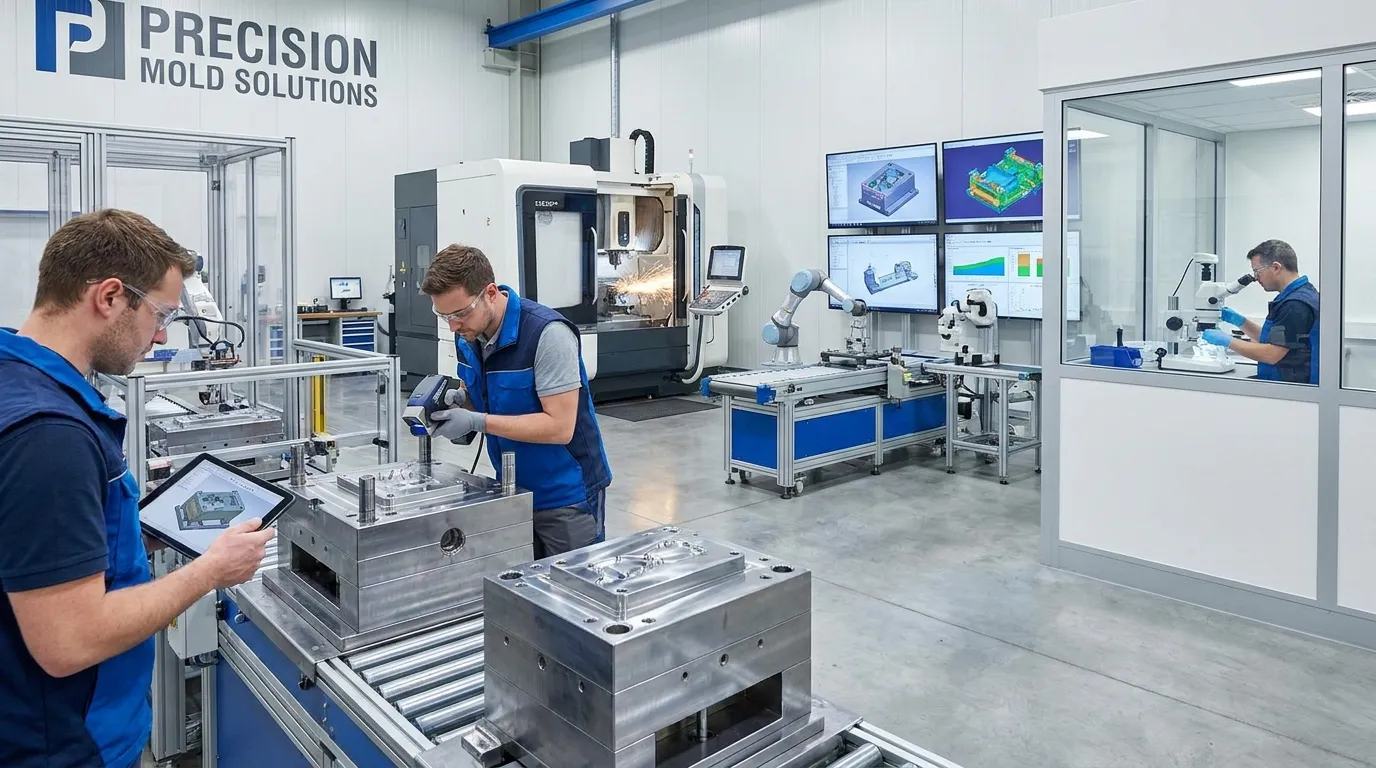
Injection mold lead times commonly range from several weeks to several months depending on mold complexity, Nombre de cavités, Révisions des outils, et exigences de validation.
Lead time depends on more than machining speed. Mold design reviews, material sourcing, Échantillonnage, and validation testing all affect delivery schedules. Complex multi-cavity molds naturally take longer because they require tighter balancing and additional machining steps.
A simple prototype mold may move from design approval to sampling quickly. A multi-cavity production tool for consumer electronics can take much longer due to cosmetic requirements and repeated validation testing.
Facteurs qui retardent la livraison du moule
- Révisions de conception après la coupe de l’acier
- Retards dans l’approvisionnement en acier à outils spécialisé
- Demandes d’échantillonnage supplémentaires
- Corrections du flux de moulage ou de refroidissement
- Retards dans l’expédition et les douanes internationaux
Faster tooling timelines are not always a positive sign. Aggressive schedules can reduce testing time and increase production issues later.
| Phase de production | Focus typique |
|---|---|
| Approbation de conception | Révision du DFM et validation des pièces |
| Usinage CNC | Fabrication de la base et des cavités de moule |
| Assemblage | Installation de composants et de systèmes |
| Échantillonnage | Production des pièces d’essai initiales |
| Validation | Contrôles dimensionnels et cosmétiques |
Exactement Guide des délais d’exécution EvokPoly explains how tooling complexity affects scheduling. Le Article sur les tendances manufacturières fictives also highlights how automation and digital validation are changing mold production workflows.
What problems can affect injection molds?
Injection molds can develop production problems from wear, cooling imbalance, alignment issues, or poor maintenance. Many defects start small and become expensive only after production volumes increase.
Flash happens when molten plastic escapes along the mold parting line. Short shots occur when the cavity does not fill completely. Uneven cooling can also create warping, Marques de naufrage, or dimensional instability.
Bases de l’entretien des moisissures
Regular maintenance helps prevent unexpected downtime and part inconsistency. Most production teams monitor wear surfaces, Conduits de refroidissement, Systèmes d’éjection, and alignment components during scheduled inspections.
A high-volume packaging mold, par exemple, may require more frequent cleaning because resin buildup can affect gate performance and filling consistency.
Liste de contrôle des problèmes courants liés aux moisissures
- Flash autour du bord de la pièce
- Plans courts ou remplissage incomplet
- Déséquilibre de refroidissement
- Goupilles d’éjection usées
- Dérive d’alignement du moule
- Blocage de la porte
- Rayures ou marques superficielles
Exactement Guide des composants de moule de précision explains how individual tooling systems influence mold precision and maintenance planning.
How do manufacturers choose the right injection mold design?
Choosing the right mold design depends on production volume, Sélection des matériaux, part geometry, and long-term cost goals. The best tooling setup is usually the one that balances reliability, cycle efficiency, and maintenance needs.
A low-volume consumer product may use aluminum tooling to reduce launch cost and shorten development time. A medical device component with strict tolerances often requires hardened steel tooling and tighter validation procedures.
Table comparative des types de moules d’injection
| Besoin de production | Installation recommandée de moisissures | Pourquoi ça va |
|---|---|---|
| Pièces prototypes | Moule en aluminium | Délai de retour plus rapide |
| Production de médium | Moule en acier à deux plaques | Équilibre entre coûts et durabilité |
| Emballage à grand volume | Moule à couloir chaud à cavités multiples | Efficacité du cycle plus rapide |
| Pièces médicales à tolérance stricte | Moule en acier trempé | Meilleure stabilité dimensionnelle |
| Boîtier électronique cosmétique | Système à conduit équilibré multi-cavités | Meilleure cohérence visuelle |
Part geometry also changes tooling strategy. Thin-wall electronics housings often require balanced runner layouts and advanced cooling control. Côtes profondes, Sous-coupes, or textured surfaces may increase tooling complexity and maintenance requirements.
Manufacturers also evaluate long-term operating cost. A cheaper mold can become expensive later if cycle times stay slow or maintenance needs increase.
Exactement Guide des applications des moules d’injection shows how tooling decisions vary across industries and product categories.
Que faire ensuite
An injection mold affects far more than part shape. It influences production speed, maintenance needs, Taux de défauts, et le coût de fabrication à long terme. That’s why mold design decisions should match the product’s production goals instead of focusing only on upfront tooling price.
If you're comparing mold options, start by defining production volume, Besoins matériels, and quality expectations first. Then review cooling strategy, cavity layout, and mold material selection with your supplier. A well-designed injection mold usually saves far more money during production than it costs during tooling development.
Questions fréquemment posées
What is an injection mold used for?
An injection mold is used to manufacture repeatable plastic parts by shaping molten material inside a precision cavity. It’s widely used for automotive, Électronique, Médical, and consumer products that require consistent dimensions and high production volume.
What are the main parts of an injection mold?
The main parts include the cavity, core, runner system, gate, Conduits de refroidissement, Système d’éjection, and guide components. Each system controls how plastic flows, Cool, aligns, et sorties pendant la production.
What is the difference between a two-plate and three-plate mold?
A two-plate mold uses one parting line and a simpler runner system, while a three-plate mold adds a separate runner plate for flexible gate placement. Three-plate molds improve gating control but increase tooling complexity and maintenance.
How long does it take to build an injection mold?
Injection mold production can take several weeks to several months depending on complexity, Nombre de cavités, testing requirements, and design revisions. Large production tools usually require longer validation and sampling stages.
Why are injection molds expensive?
Injection molds require precision machining, engineered cooling systems, hardened materials, and detailed testing. Higher cavity counts, tight tolerances, and complex part geometries increase tooling cost significantly.
How many parts can one injection mold produce?
Mold lifespan depends on tooling material, maintenance quality, et conditions de production. Hardened steel molds can often produce hundreds of thousands or even millions of cycles when maintained properly.
Partager:


Écrit par Sunshine
Au soleil, Nous sommes un fabricant et fournisseur professionnel de composants de moule de précision, proposant une large gamme de produits pour les applications de stampage et de moulage par injection. Notre objectif principal est le poinçage des coins, Goupilles et manchons d’éjection, et poteaux guides et bagues. Avec un usinage CNC avancé, Contrôle qualité strict, et de fortes capacités de production, Nous garantissons une fiabilité, Pièces de haute précision, ainsi que des composants standards en stock pour un approvisionnement mondial rapide et efficace.
ACTUALITÉS
OBTENIR UN SERVICE
Avec des pièces de qualité adaptées à tous les budgets et un personnel accueillant formé pour rendre votre visite informative et sans tracas.
