



Moulage par injection médicale: Exigences, Matériaux, et la liste de contrôle du contrôle qualité
Medical injection molding produces plastic medical components under stricter cleanliness, Validation, and quality-control standards than standard molding. Manufacturers use materials like polypropylene, polycarbonate, TPU, and PEEK while following ISO 13485 workflows, traceability controls, and documented inspection procedures. Cleanroom production, mold validation, and detailed QC checkpoints help reduce contamination, Défauts dimensionnels, and regulatory risk in medical device manufacturing.
Medical devices need consistent quality, predictable performance, and reliable documentation. A small molding defect can affect assembly, sterilization, ou la sécurité des patients. That’s why medical molding projects involve tighter process controls than standard commercial production. This guide explains how medical injection molding works, which materials are commonly used, and what buyers should check before approving tooling or production.
Qu’est-ce que le moulage par injection médicale?
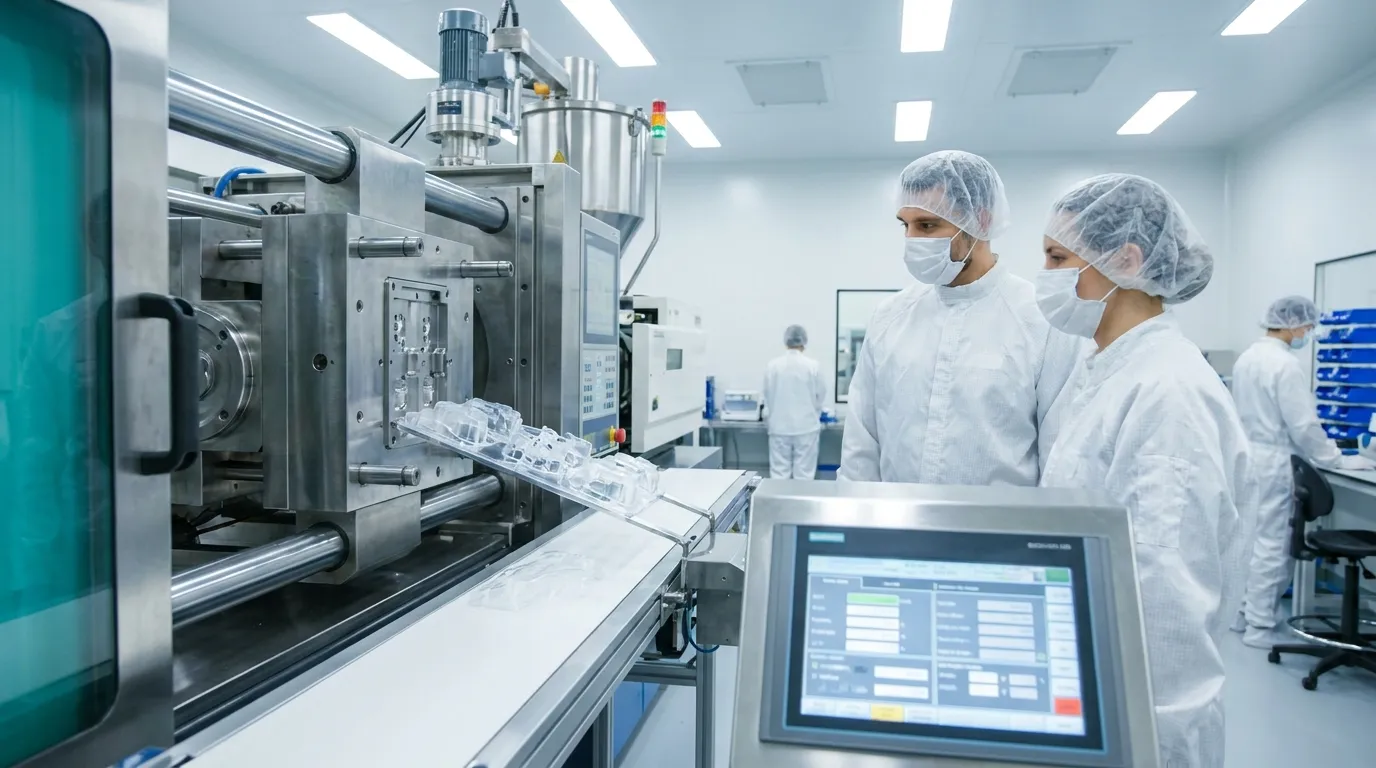
Medical injection molding produces plastic medical components under stricter quality, Traçabilité, and cleanliness standards than standard molding. It is commonly used for syringes, Boîtiers diagnostiques, surgical tools, and implant-support components that require repeatable precision and validated manufacturing controls.
Medical injection molding is a manufacturing process used to produce healthcare and medical device components with high consistency. The process injects melted plastic into a mold cavity, then cools and ejects the finished part. What changes in medical production is the level of control around materials, Inspection, documentation, and contamination prevention.
Many disposable and reusable healthcare products rely on molded plastic parts. Des exemples courants incluent les boîtiers de seringues, Connecteurs IV, Boîtiers de dispositifs de diagnostic, inhaler components, and surgical handles. These parts often require tight tolerances because dimensional variation can affect sealing, Assemblage, or sterilization.
Manufacturers also maintain stronger process documentation than in standard molding projects. Material batches, Dossiers d’inspection, and validation reports are usually tracked throughout production. If you need a broader overview of the process itself, Guide de Sunshine Pro pour Bases du moulage par injection explains the standard production workflow in more detail.
En quoi le moulage par injection médicale diffère-t-il du moulage standard?
Medical injection molding requires tighter process validation, material traceability, Contrôle de la contamination, and inspection documentation than standard commercial molding. Manufacturers often operate under ISO 13485 systems and validated production workflows to reduce risk in healthcare applications.
The biggest difference is risk control. A cosmetic flaw on a consumer product may be acceptable, but a defect on a medical component can affect patient safety, Stérilité, or device function. Medical manufacturers use stricter controls to reduce those risks during production.
De nombreux fournisseurs suivent ISO 13485 quality-management standards. Production teams document material batches, Réglages de la machine, Dossiers d’inspection, and process changes. This creates traceability if a quality issue appears later in the supply chain.
| Moulage standard | Moulage par injection médicale |
|---|---|
| Traçabilité limitée | Traçabilité complète des lots |
| Inspection de base | Validation documentée et contrôle qualité |
| Matériaux commerciaux | Résines de qualité médicale |
| Surface de production générale | Environnements de salle blanche contrôlés lorsque nécessaire |
| Flux de travail d’approbation plus rapide | Processus de validation en plusieurs étapes |
Medical molding also includes stricter contamination control. Manipulation de la résine, Emballage, and storage procedures are usually more controlled, especially for sterile or patient-contact applications.
This does not mean every medical part needs the most expensive production setup. Cleanroom molding and high-performance materials add cost. For many disposable products, polypropylene may be more practical than PEEK. Sunshine Pro Procédé de moulage plastique guide explains the broader tooling and production fundamentals behind these decisions.
Which medical devices commonly use injection molding?
Injection molding supports a wide range of medical products because it produces consistent parts at high volumes. It works especially well for disposable devices, Logements, Connecteurs, and precision plastic assemblies.
Common applications include syringes, inhalers, IV components, catheter fittings, test-kit housings, Poignées chirurgicales, and diagnostic equipment enclosures. Some implant-support components also use injection molding when precise geometry and repeatability matter.
| Produit médical | Matériel typique | Priorité de production |
|---|---|---|
| Boîtiers pour seringues | Polypropylène | Sortie à fort volume |
| Boîtiers de dispositifs de diagnostic | Polycarbonate | Stabilité dimensionnelle |
| Fixations de cathéter | TPU | Flexibilité |
| Poignées d’outils chirurgicaux | ABS ou PC | Durabilité |
| Connecteurs IV | PVC ou PP | Résistance chimique |
A diagnostic device enclosure is a good example. The housing may need cosmetic consistency, Dimensions stables, and resistance to cleaning chemicals. A poorly controlled molding process can create fit issues during final assembly.
For broader industry examples, Guide de Sunshine Pro pour Applications du moulage médical covers additional injection molding use cases across manufacturing sectors.
Which materials are used in medical injection molding?
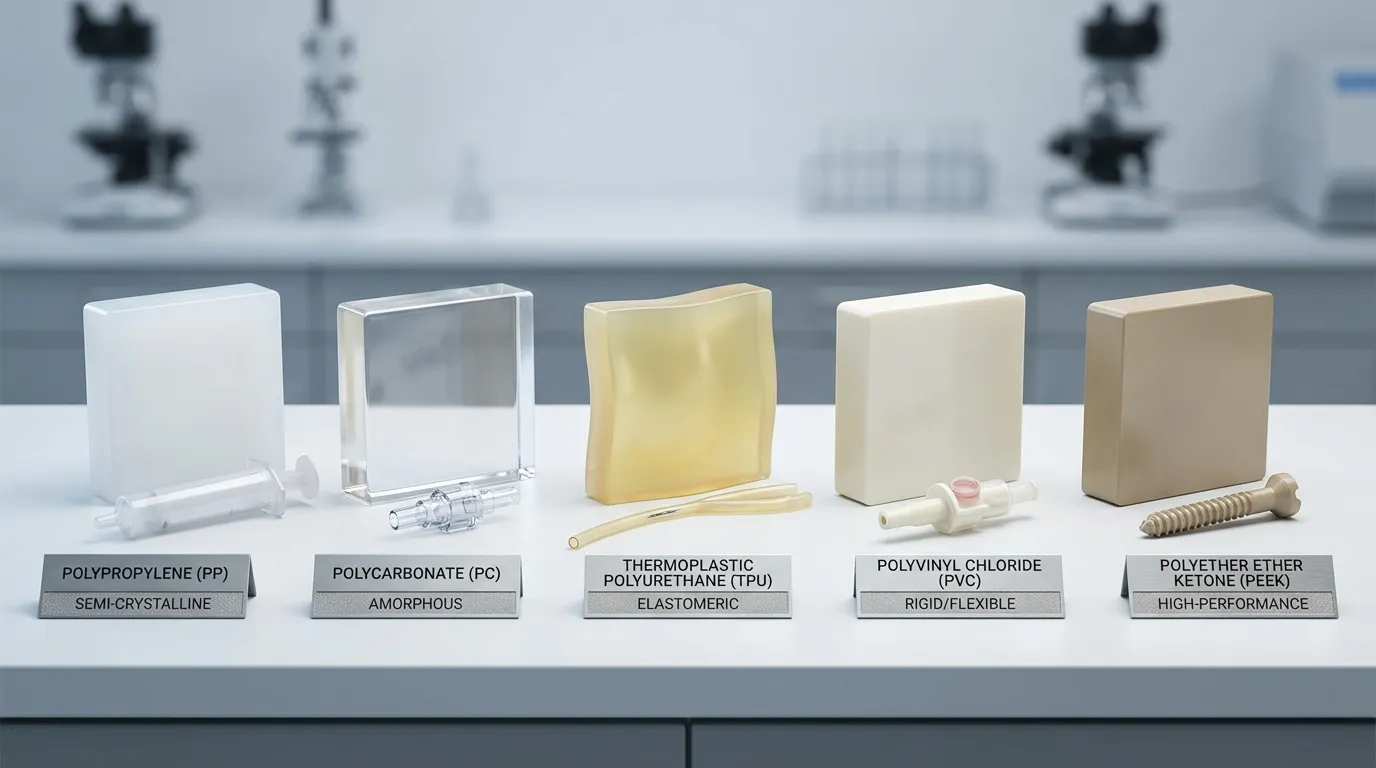
Polypropylène, polycarbonate, JEK, TPU, and PVC are among the most common medical injection molding materials. The right choice depends on sterilization method, Résistance chimique, Flexibilité, Force, transparency, and whether the part contacts the patient directly.
Material selection affects cost, Durabilité, Compatibilité de la stérilisation, and production speed. Medical-grade plastics are tested for manufacturing consistency and application suitability, especially in patient-contact environments.
A disposable syringe housing may prioritize low cost and gamma sterilization compatibility. A reusable surgical component may need higher heat resistance and dimensional stability. Choosing the wrong material can increase rejection rates or create sterilization problems later.
Quand utiliser le polypropylène dans les dispositifs médicaux
Polypropylène (PP) is one of the most common medical molding materials because it balances cost, Résistance chimique, et efficacité de production. It works well for disposable products such as syringes, specimen containers, and packaging components.
PP is not always the strongest option, but it performs well in high-volume production. For disposable devices, it often makes more sense than expensive engineering plastics.
Quand des plastiques haute performance comme PEEK ont du sens
PEEK is used in demanding applications that require heat resistance, mechanical strength, or repeated sterilization cycles. It is common in advanced medical components and specialized surgical systems.
PEEK is not automatically the best choice. The material cost is much higher than polypropylene or polycarbonate. If the application does not require high-temperature performance or structural strength, a simpler resin may be more practical.
| Matériel | Compatibilité de la stérilisation | Transparence | Flexibilité | Résistance chimique | Utilisation typique |
|---|---|---|---|---|---|
| Polypropylène (PP) | Bien | Low | Moyen | Bien | Seringues, Conteneurs |
| Polycarbonate (PC) | Bien | Haut | Low | Moyen | Boîtiers de diagnostic |
| TPU | Modéré | Moyen | Haut | Bien | Composants du cathéter |
| PVC | Bien | Moyen | Moyen | Bien | Tubulure IV |
| JEK | Excellent | Low | Low | Excellent | Composantes chirurgicales |
Some suppliers also evaluate resin selection based on mold wear, Temps de cycle, and long-term tooling maintenance. Sunshine Pro Matériaux pour moules médicaux guide explains how tooling considerations can affect material performance.
What standards and regulations apply to medical molding?
Medical molding suppliers often work within ISO 13485 quality systems and follow FDA manufacturing expectations for process control, Traçabilité, documentation, and validation. Exact requirements depend on the medical device classification and target market.
Medical molding projects usually involve stricter documentation and process control than standard manufacturing. Suppliers may maintain validated production records, inspection reports, and material traceability throughout the project lifecycle.
Le FDA expects manufacturers to control production processes that affect medical device quality. Many suppliers also follow ISO 13485 quality-management systems to support consistency and traceability.
Liste de contrôle de base pour la conformité aux moulages médicaux
- Traçabilité par lot matériel
- Dossiers d’inspection documentés
- Réglages contrôlés du procédé
- Procédures de validation
- Emballage et contrôles de contamination
- Documentation de gestion du changement
Pourquoi la traçabilité est importante dans la fabrication médicale
Traceability allows manufacturers to track which material batch and production lot produced each component. If a defect appears later, teams can isolate the affected production run more quickly.
This becomes important during recalls, audits, or customer complaints. Without traceability, manufacturers may need to quarantine much larger production volumes.
Do medical parts always require cleanroom molding?
Not every medical plastic part requires cleanroom molding. Cleanrooms are usually necessary when contamination control directly affects sterility, patient safety, Intégrité de l’emballage, or regulatory requirements for the finished device.
Cleanrooms help reduce airborne particles, Contamination, and environmental variation during production. They are common for sterile devices, implant-support components, and sensitive packaging applications.
Some buyers assume every medical component needs cleanroom production. Ce n’est pas toujours le cas. Using a cleanroom without a contamination-driven requirement can increase manufacturing cost without adding practical value.
| If the Product Requires... | Besoin de salle blanche |
|---|---|
| Emballage stérile | Généralement obligatoire |
| Patient-contact surfaces | Souvent nécessaire |
| Pièces jetables non stériles | Parfois inutile |
| Assemblages de diagnostic sensibles | Souvent recommandé |
| Boîtiers en plastique uniquement esthétiques | Cela dépend du niveau de risque |
Classifications courantes en salle blanche pour le moulage médical
Many suppliers use ISO cleanroom classifications to define environmental control levels. The required class depends on contamination sensitivity, assembly requirements, and customer specifications.
Par exemple, catheter-related components packaged for sterile environments often need tighter contamination control than a non-sterile diagnostic equipment housing.
What quality checks matter most in medical injection molding?
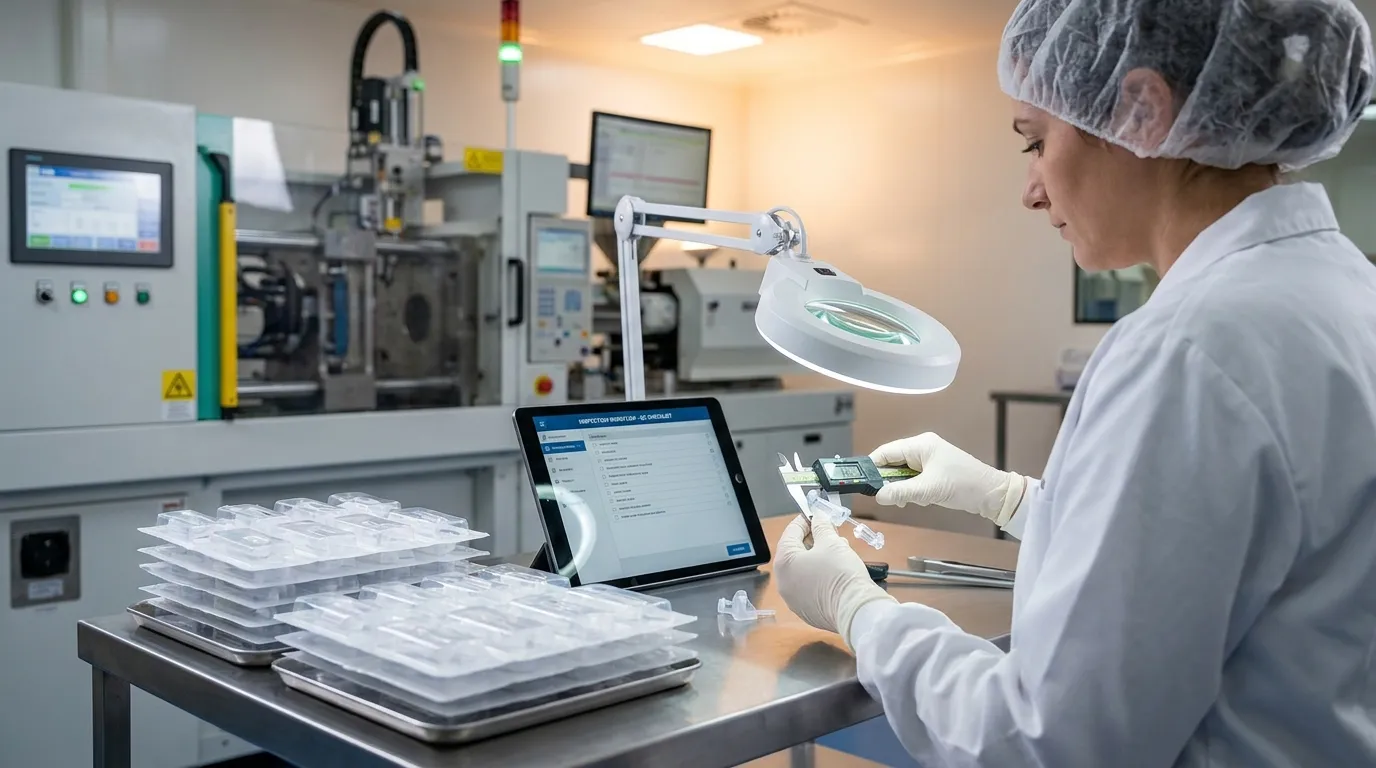
Medical injection molding quality control focuses on dimensional accuracy, Prévention de la contamination, material traceability, Cohérence des processus, and documented inspection results. QC systems are designed to reduce patient risk and maintain repeatable production performance.
Medical molding quality checks begin before production starts. Teams often inspect incoming resin batches, verify material certifications, and confirm traceability records before molding begins.
Pendant la production, inspectors monitor dimensions, Qualité cosmétique, Flash, Marques de naufrage, Contamination, and assembly fit. First article inspection is common during setup approval and process validation stages.
Liste de contrôle du contrôle qualité du moulage par injection médicale
| Étape QC | Objectif |
|---|---|
| Vérification de la résine entrante | Confirmer que le matériau correspond aux spécifications |
| Revue de la traçabilité des lots | Lots de production de pistes |
| Première inspection de l’article | Valider les dimensions de démarrage |
| Inspection dimensionnelle | Vérification des tolérances |
| Inspection de surface | Détection de flash ou de contamination |
| Inspection de l’emballage | Éviter les dommages causés par la manipulation |
| Examen de la documentation | Confirmez les dossiers de procédure |
Défauts de moulage courants qui déclenchent le rejet
Flash, Plans courts, Contamination, Marques de brûlure, and dimensional variation are common rejection causes. A small defect can create sealing problems or assembly failures in medical products.
A catheter-related component is a good example. Even minor contamination inside the molded part can affect packaging integrity or downstream sterilization performance. That is why contamination-sensitive products often require tighter process controls.
Suppliers should also maintain documented inspection workflows. Sunshine Pro Points d’inspection de moisissure guide explains how tooling condition and cavity performance affect part quality over time.
How are medical molds validated before production?
Medical mold validation confirms that tooling and processing conditions consistently produce compliant parts. Manufacturers commonly document installation qualification, operational qualification, and performance qualification before full production approval.
Validation helps confirm that the mold, Réglages de la machine, and production workflow can repeatedly produce acceptable parts. This process reduces variation before high-volume manufacturing begins.
Le FDA recommends process validation for manufacturing operations that affect product quality. In medical molding, validation usually follows a staged approval process.
Flux de travail typique de validation de moisissure médicale
- Installation Qualification (IQ)
Teams verify that tooling, machines, and support systems are installed correctly. - Operational Qualification (OQ)
Engineers test process settings such as pressure, Temps de refroidissement, and temperature ranges. - Performance Qualification (PQ)
Production runs confirm the process can consistently produce acceptable parts at normal operating conditions.
A tooling project can easily slow down if validation planning starts too late. One common issue is approving steel cutting before finalizing part geometry. If the customer changes dimensions after tooling begins, lead times can increase significantly.
Suppliers also need clear documentation during production transfers and shipping. Customs delays can affect launch schedules when paperwork or product classifications are incomplete.
For broader process guidance, Sunshine Pro Flux de travail de validation de moisissures resource explains how tooling and process planning fit together.
How should buyers evaluate a medical injection molding supplier?
Choosing a medical molding supplier involves more than checking machine capacity. Buyers should review validation capability, Systèmes de traçabilité, documentation practices, and contamination-control procedures before approving production.
La certification ISO seule ne garantit pas de bonnes performances médicales en moulage. A supplier may hold certifications but still lack strong process validation or inspection discipline.
Liste de contrôle pour l’évaluation des fournisseurs médicaux
- Systèmes de gestion de la qualité ISO 13485
- Capacité de flux de travail de validation
- Disponibilité en salle blanche si nécessaire
- Procédures de traçabilité des matériaux
- Processus d’inspection du premier article
- Contrôles documentés de gestion du changement
- Planification des délais de production
- Contrôles d’emballage et d’expédition
Lead time management also matters. A shipment held at customs because of incomplete documentation can delay device launches and customer approvals. Suppliers should understand export paperwork, product classification, and medical-device shipping requirements before production begins.
Guide de Sunshine Pro pour Outillage et planification de la production explains how early planning decisions affect lead time, Révisions des outils, and long-term manufacturing consistency.
Réussir la prochaine étape
Medical injection molding works best when material selection, validation planning, and quality control are aligned early in the project. Buyers who define inspection standards, contamination requirements, and traceability expectations before tooling begins usually avoid costly production delays later.
If you are evaluating suppliers, focus on process discipline instead of marketing claims alone. Ask how the supplier handles validation, Dossiers d’inspection, Suivi des matériaux, et actions correctives. A strong medical molding partner should explain those systems clearly and support practical production decisions from sampling through full-scale manufacturing.
Questions fréquemment posées
Medical-grade plastic is a polymer tested for consistency and suitability in healthcare applications. The exact requirements depend on whether the material contacts patients, drugs, or sterile environments.
Polypropylène, polycarbonate, TPU, PVC, and PEEK are common medical molding materials. The best option depends on sterilization needs, Flexibilité, Résistance chimique, and mechanical performance.
Non, not every medical component requires cleanroom molding. Cleanrooms are mainly used when contamination control affects sterility, patient safety, or sensitive packaging requirements.
Many medical molding suppliers follow ISO 13485 quality systems and FDA manufacturing expectations. The exact requirements depend on device classification and target market regulations.
Flash, Plans courts, Marques de naufrage, Contamination, and dimensional variation are common molding defects. These problems can affect assembly fit, Stérilité, or device performance.
Les délais de production varient en fonction de la complexité des outils, Exigences de validation, and sampling approvals. Tooling and validation can take weeks or several months depending on project scope.
Tooling revisions, failed validation runs, customs delays, and incomplete documentation commonly slow medical molding projects. Design changes after tooling approval can also extend production timelines significantly.
Partager:


Écrit par Sunshine
Au soleil, Nous sommes un fabricant et fournisseur professionnel de composants de moule de précision, proposant une large gamme de produits pour les applications de stampage et de moulage par injection. Notre objectif principal est le poinçage des coins, Goupilles et manchons d’éjection, et poteaux guides et bagues. Avec un usinage CNC avancé, Contrôle qualité strict, et de fortes capacités de production, Nous garantissons une fiabilité, Pièces de haute précision, ainsi que des composants standards en stock pour un approvisionnement mondial rapide et efficace.
ACTUALITÉS
OBTENIR UN SERVICE
Avec des pièces de qualité adaptées à tous les budgets et un personnel accueillant formé pour rendre votre visite informative et sans tracas.
