



Guide des composants de moule: Types, Fonctions, et Liste de contrôle des achats
Mold components are the precision parts that control alignment, Refroidissement, feeding, and ejection inside an injection mold. Buyers should compare component types, material grades, Tolérances, Dureté, and lead times before sending an RFQ. Standard parts reduce replacement costs and delivery risk, while custom components work better for specialized molds with tighter performance requirements.
A mold may look simple from the outside, but component quality decides how well it performs on the production floor. Poor ejector pins, weak guide bushings, or incorrect tolerances can lead to flash, Stuck, Temps morts, and expensive repairs. This guide explains the main mold component types, ce que chacun fait, and what buyers should check before choosing a supplier or requesting a quote.
What are mold components and why do they matter?
Mold components are the individual functional parts inside an injection mold, y compris les goupilles éjecteurs, Silents guides, Systèmes de refroidissement, and mold bases. Their precision affects cycle time, Qualité des pièces, alignment accuracy, et durée de vie du moule.
Every injection mold uses multiple parts that work together during molding. These components guide mold movement, cool molten plastic, Éjecter les pièces finies, and keep alignment stable during repeated production cycles. If one critical part wears out early, the entire mold can lose accuracy.
Standardized components also make maintenance easier. Factories can replace worn pins, Silents, or springs without redesigning the entire tool. That matters for high-volume production lines where every hour of downtime affects output and delivery schedules.
Buyers comparing suppliers should focus on more than machining price. Qualité des matériaux, hardness treatment, and dimensional consistency often determine whether a mold performs well after 100,000 cycles or after 1 million cycles.
For a broader overview of mold construction and tooling workflow, Voir ceci Bases des moules d’injection plastique.
What are the main types of mold components?
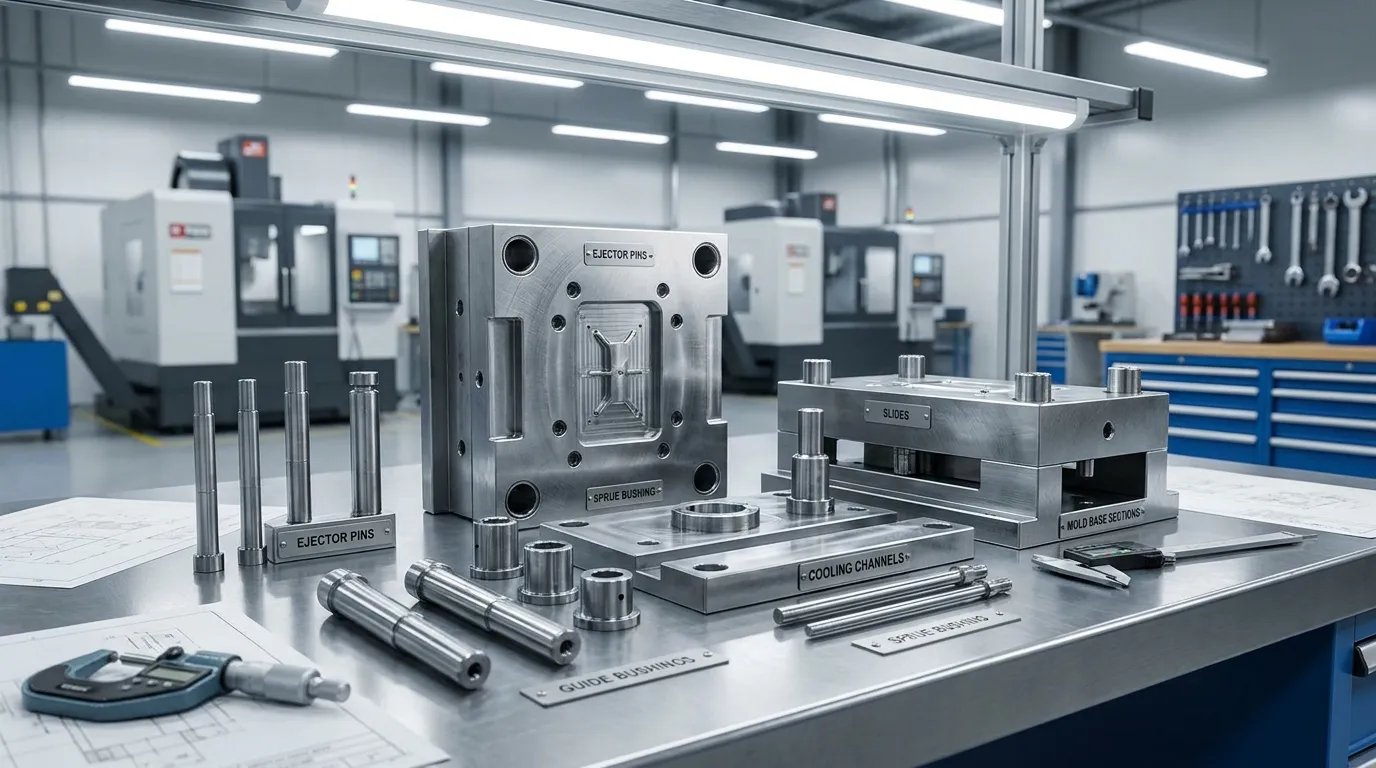
The main mold components include the mold base, guiding system, Conduits de refroidissement, feed system, and ejection system. Each section controls a different part of molding performance, from alignment and resin flow to cooling efficiency and part release.
Most injection molds follow a similar structure, even when part geometry changes. Understanding these systems helps buyers compare molds and evaluate supplier capabilities more accurately.
| Groupe des composants | Fonction principale | Parties communes |
|---|---|---|
| Base de moule | Soutient toute la structure du moule | Plates, clamps, support pillars |
| Système de guidage | Maintient l’alignement lors de l’ouverture et de la fermeture | Goupilles guides, Silents guides |
| Système d’alimentation | Dirige la résine en fusion dans la cavité | Brogues en surrade, Coureurs, Portes |
| Système de refroidissement | Contrôle la température du moule | Canaux de refroidissement, fittings |
| Système d’éjection | Enlève les pièces moulées en toute sécurité | Goupilles éjecteurs, Manches, Plaques de dénudage |
According to industry references from FirstMold, cooling and ejection systems directly affect cycle consistency and molded part quality. Poor cooling design can increase warpage, while weak ejection systems may scratch finished surfaces.
Composantes d’éjection
Ejector pins are among the most heavily used mold parts. They push finished plastic parts out of the cavity after cooling. Sleeve ejectors and stripper plates are also common in molds with deep or complex geometry.
An automotive supplier producing high-volume trim parts may replace ejector pins every 500,000 cycles. Upgrading to hardened coated pins often reduces replacement frequency and lowers maintenance downtime.
Composants de guidage
Guide pins and guide bushings keep both mold halves aligned during operation. Misalignment can damage cavities, create flash, or increase wear on moving sections.
Standard guide systems are usually the safer choice for maintenance-heavy factories because replacement parts are easier to source quickly. Custom guide systems work best only when a mold requires specialized movement or tight space constraints.
For more detail on component categories and tooling systems, visit Systèmes de composants de moule.
Quels composants de moule s’usent le plus rapidement?
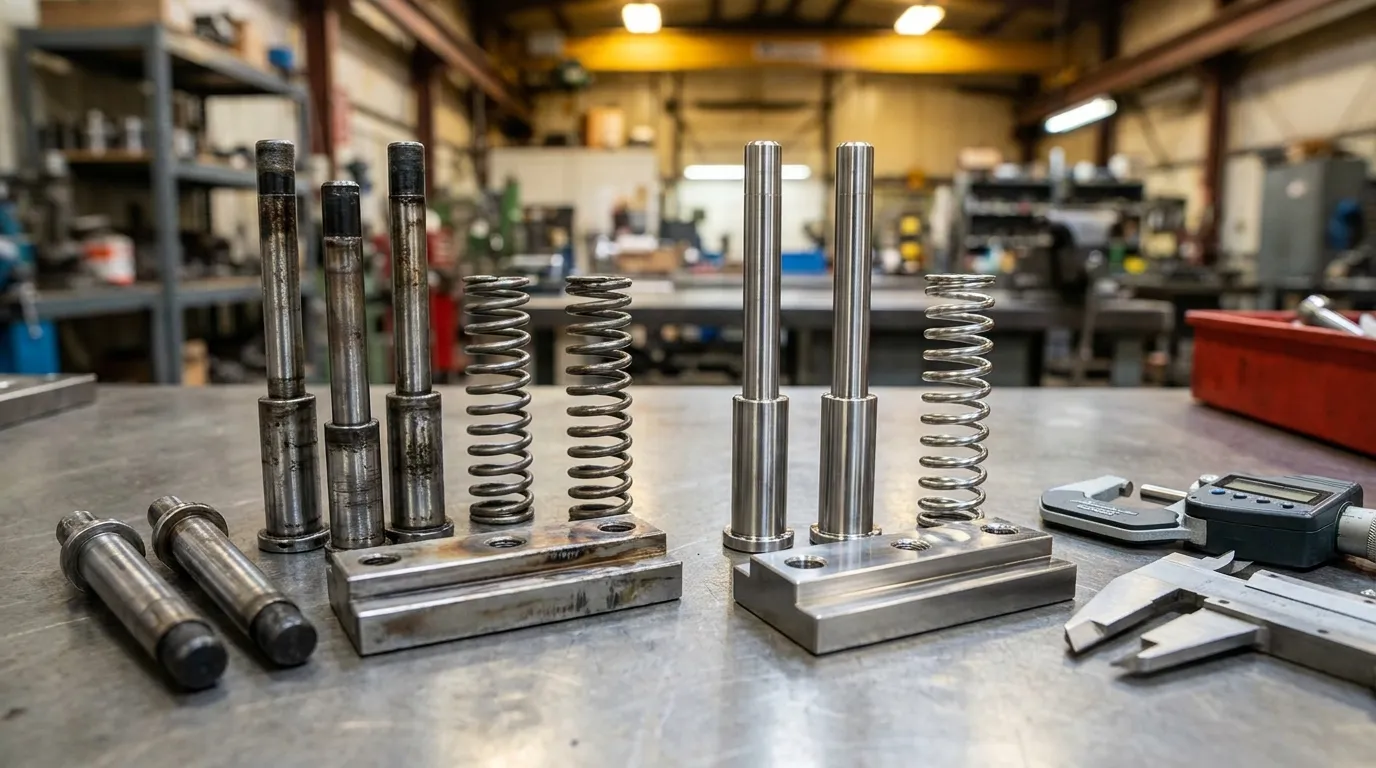
Goupilles éjecteurs, Silents guides, diapositives, and springs usually wear out faster because they face repeated friction, Chaleur, and movement. Buyers should check hardness, Revêtement, Qualité des matériaux, and replacement availability before ordering.
High-wear parts operate under constant pressure and repeated movement. Friction between sliding components slowly removes material, especially in molds running abrasive resins or high production volumes. Weak coatings or low-grade steel can accelerate wear even faster.
The most common wear-prone components include:
- Goupilles éjecteurs
- Silents guides
- Ressorts de retour
- Glissières et poussoirs
- Broches de noyau exposées à des matériaux assifs
A medical mold buyer working in a humid cleanroom environment may choose stainless steel components to reduce corrosion risk. Standard carbon steel parts often degrade faster when moisture exposure is constant.
Extremely tight tolerances are not always beneficial. Over-specifying tolerances can increase machining cost and lead time without improving molded part quality. Buyers should match tolerance requirements to the actual application instead of requesting the highest precision by default.
Preventive maintenance also matters. Replacing inexpensive wear components early usually costs far less than repairing damaged cavities or mold bases later.
Composants standard vs moules personnalisés: which is better?
Standard mold components are faster and cheaper to replace, while custom components work better for specialized geometry or high-performance molds. Le bon choix dépend du volume de production, Tolérances, and maintenance priorities.
Many buyers assume custom components always improve mold performance. Ce n’est pas toujours le cas. Standard components reduce sourcing complexity, Simplifier la maintenance, and lower emergency replacement costs for most production environments.
Custom components become useful when a mold requires unusual geometry, limited installation space, or advanced movement systems. Médical, Aérospatiale, and multi-cavity tooling often require more customization than general consumer product molds.
Tableau de décision standard vs personnalisé
| Facteur | Composants standards | Composants personnalisés |
|---|---|---|
| Coût | Lower | Plus haut |
| Délai d’exécution | Plus vite | Plus lent |
| Disponibilité des remplaçants | Doucement | Limité |
| Entretien | Plus simple | Plus spécialisé |
| Flexibilité de précision | Modéré | Plus haut |
| Meilleur cas d’utilisation | Moules de production générale | Outillage spécialisé |
The cheapest mold components often create the highest long-term production cost. Remplacements fréquents, Problèmes d’alignement, and downtime can easily exceed the savings from a lower initial purchase price.
A factory producing packaging parts around the clock may prefer standardized guide bushings because emergency replacements are easier to source locally. A specialized medical mold may justify custom components because dimensional stability is more critical than replacement convenience.
What materials are commonly used for mold components?
Tool steel is the most common material for mold components because it handles pressure, Chaleur, and repeated movement well. Stainless steel and coated alloys are also used when corrosion resistance or wear protection is important.
Le choix des matériaux dépend du volume de production, Type de résine, et conditions de fonctionnement. Components exposed to abrasive glass-filled plastics usually require harder steel grades than molds running softer resins.
| Matériel | Usage courant | Principal avantage |
|---|---|---|
| Acier à outillage trempé | Goupilles éjecteurs, Couleurs | Forte résistance à l’usure |
| Acier inoxydable | Environnements médicaux et humides | Résistance à la corrosion |
| Acier allié | Glissières et systèmes mobiles | Robustesse |
| Acier nitruré | Composants à haute friction | Dureté de surface |
Heat treatment matters as much as the steel itself. Improper hardening can lead to cracking, Déformation, or uneven wear during production cycles. Buyers should confirm hardness specifications in the RFQ instead of assuming all suppliers use the same standards.
A supplier quoting low-cost components without hardness certification may create future maintenance problems. That risk increases in high-volume automotive or electronics production where molds cycle continuously for long periods.
What should buyers check before sending an RFQ?
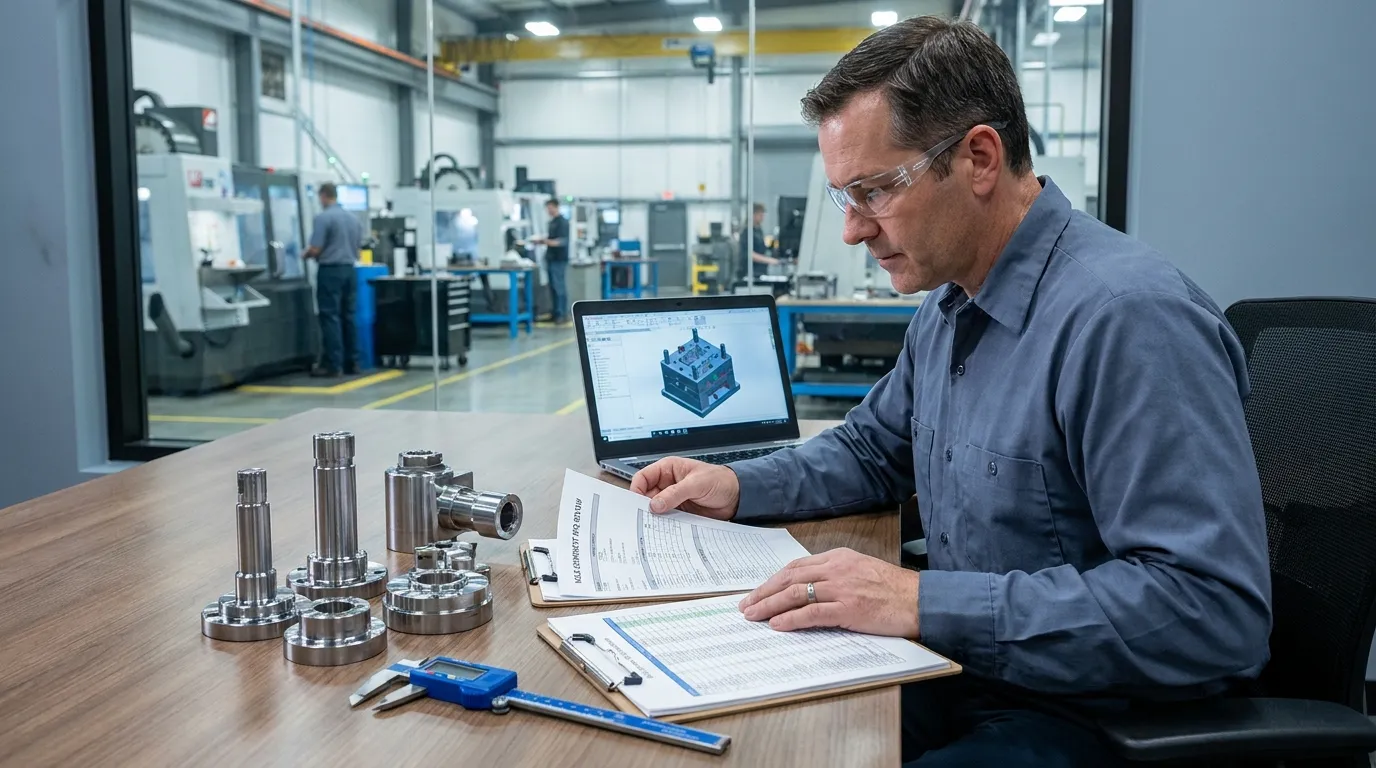
Before sending an RFQ for mold components, buyers should confirm tolerances, Qualité acier, Dureté, Revêtements, delivery lead time, Normes d’inspection, and replacement availability. Missing specifications often cause fit problems and production delays.
Many RFQ problems start with incomplete technical details. Suppliers may quote different materials, Tolérances, or coatings if specifications are unclear. That makes pricing difficult to compare accurately.
A procurement team comparing two RFQs may discover one supplier omitted hardness specifications entirely. The lower quote can look attractive at first, but the long-term wear risk may be much higher.
Liste de contrôle des demandes d’offres des acheteurs
| Point à confirmer | Pourquoi c’est important |
|---|---|
| Qualité des matériaux | Influence la résistance à l’usure |
| Plage de dureté | Impacts durée de vie |
| Exigences de tolérance | Évite les problèmes d’ajustement |
| Finition de surface | Permet un mouvement fluide |
| Type de revêtement | Réduit la friction et l’usure |
| Norme d’inspection | Confirme la précision dimensionnelle |
| MOQ | Impact sur la flexibilité d’achat |
| Délai d’exécution | Aide à la planification de production |
| Disponibilité des remplaçants | Réduit le risque d’arrêt |
Détails de la RFQ dont les fournisseurs ont besoin
Most suppliers need clear drawings, production volume estimates, resin information, and dimensional tolerances before quoting accurately. Surface finish requirements and expected mold life should also be included early.
Factories ordering overseas should ask about inventory availability before approving production. Long machining queues or material shortages can extend delivery schedules significantly.
If you're comparing overseas manufacturing partners, Travailler avec un Fournisseur de composants de moules personnalisés that provides engineering support and inspection documentation can reduce sourcing risk.
How do lead times and customs delays affect mold component sourcing?
Lead times for mold components depend on machining complexity, inventory availability, and international shipping processes. Incorrect documentation or HS codes can delay customs clearance and disrupt mold maintenance schedules.
Production delays often come from logistics issues rather than machining itself. Custom parts usually require longer manufacturing windows, while stock components can ship quickly if inventory is available.
Industry estimates from Aprios show complex injection mold tooling can require lead times of several weeks, especially when multiple machining operations and heat treatment processes are involved.
A shipment of replacement mold accessories may also get delayed during customs clearance if HS codes or paperwork are incomplete. One overseas buyer experienced maintenance downtime after guide bushings were held for classification review during import processing.
Liste de contrôle pour l’approvisionnement en composants de moule
- Vérifiez l’état de l’inventaire avant de commander
- Confirmer l’exactitude du code HS
- Examiner les exigences relatives aux documents douaniers
- Maintenir le stock de secours pour les composants d’usure
- Demandez les délais d’expédition estimés en avance
- Calendriers de remplacement de plans avant la défaillance
Factories running high-volume production lines often keep spare ejector pins, Silents, and springs on-site. Waiting for emergency overseas shipments can stop production for days.
How do you evaluate a mold component supplier?
A reliable mold component supplier should provide consistent tolerances, clear material specifications, stable lead times, and responsive technical support. Buyers should evaluate long-term reliability instead of comparing price alone.
Strong suppliers usually maintain quality control systems and provide dimensional inspection records. They should also explain steel grades, heat treatment methods, and coating options clearly during quotation discussions.
Tableau d’évaluation des fournisseurs
| Zone d’évaluation | Que vérifier |
|---|---|
| Contrôle qualité | Inspection reports, measurement process |
| Vérification des matériaux | Steel certifications, hardness data |
| Capacité d’usinage | Plage de tolérance de précision |
| Profondeur des stocks | Disponibilité des pièces standard |
| Stabilité dans les délais de livraison | Estimations réalistes de la livraison |
| Soutien technique | Clarification des RFQ et conseils techniques |
| Soutien au remplacement | Disponibilité des composants de rechange |
Suppliers serving automotive or electronics production often maintain stricter tolerance consistency because those industries depend on repeatability. Buyers working with complex molds should ask how dimensional deviations are handled during inspection.
For examples of how component choices vary across industries, Examinez ces Applications dans les moules d’injection.
Réussir la prochaine étape
Choosing the right mold components is not only about matching dimensions on a drawing. Material quality, Planification du remplacement, Délais d’exécution, and supplier consistency all affect long-term production performance.
Start by identifying which components experience the most wear in your molds. Then compare suppliers based on technical capability, inventory support, and inspection standards instead of price alone. A well-planned RFQ usually prevents more problems than it creates.
If your production depends on stable cycle times and reliable maintenance scheduling, investing in higher-quality mold components often saves money over the full life of the tool.
Questions fréquemment posées
Quelles sont les principales pièces d’un moule d’injection?
The main parts of an injection mold include the mold base, cavité, Noyau, Système de refroidissement, feed system, and ejection system. Each section supports molding accuracy, Sortie partielle, and cycle efficiency.
What does an ejector pin do?
An ejector pin pushes the molded plastic part out of the cavity after cooling. Poor ejector pin quality can cause sticking, scratches, or inconsistent ejection during production.
What materials are mold components made from?
Most mold components are made from hardened tool steel, Acier inoxydable, or wear-resistant alloy steel. Material choice depends on production volume, Abrasivité de la résine, Exposition à la corrosion, et tolérances requises.
How long do mold components last?
Mold component lifespan depends on material quality, Entretien, molding pressure, and production cycles. High-wear parts like ejector pins and bushings usually require replacement more often than mold bases.
What causes mold component failure?
Mold components commonly fail because of friction, Mauvaise lubrification, incorrect hardness, Corrosion, ou problèmes d’alignement. Using low-grade materials or incorrect tolerances also increases premature wear risk.
Should I choose standard or custom mold components?
Standard components are easier to replace and usually cost less, while custom components support specialized mold geometry or tighter tolerances. The best choice depends on mold complexity and production goals.
Partager:


Écrit par Sunshine
Au soleil, Nous sommes un fabricant et fournisseur professionnel de composants de moule de précision, proposant une large gamme de produits pour les applications de stampage et de moulage par injection. Notre objectif principal est le poinçage des coins, Goupilles et manchons d’éjection, et poteaux guides et bagues. Avec un usinage CNC avancé, Contrôle qualité strict, et de fortes capacités de production, Nous garantissons une fiabilité, Pièces de haute précision, ainsi que des composants standards en stock pour un approvisionnement mondial rapide et efficace.
ACTUALITÉS
OBTENIR UN SERVICE
Avec des pièces de qualité adaptées à tous les budgets et un personnel accueillant formé pour rendre votre visite informative et sans tracas.
