



Moulage par injection sur mesure en plastique: Outillage, Matériaux, et Guide de production
Custom plastic injection molding works best for products that need repeatable quality, scalable production, and tight dimensional control. Success depends on choosing the right tooling, resin, and validation process before mass production begins. Buyers should evaluate mold type, Procédures d’échantillonnage, production lead times, and supplier experience early to reduce revision costs, Retards, and long-term quality issues.
Custom molded parts can fail long before production starts if tooling, Matériaux, or DFM decisions are rushed. A strong injection molding project is built around planning, not just machine capacity. Buyers need clear answers about tooling cost, Sélection de la résine, production timing, and validation steps before approving steel cutting or mass production.
What is custom plastic injection molding and when does it make sense?
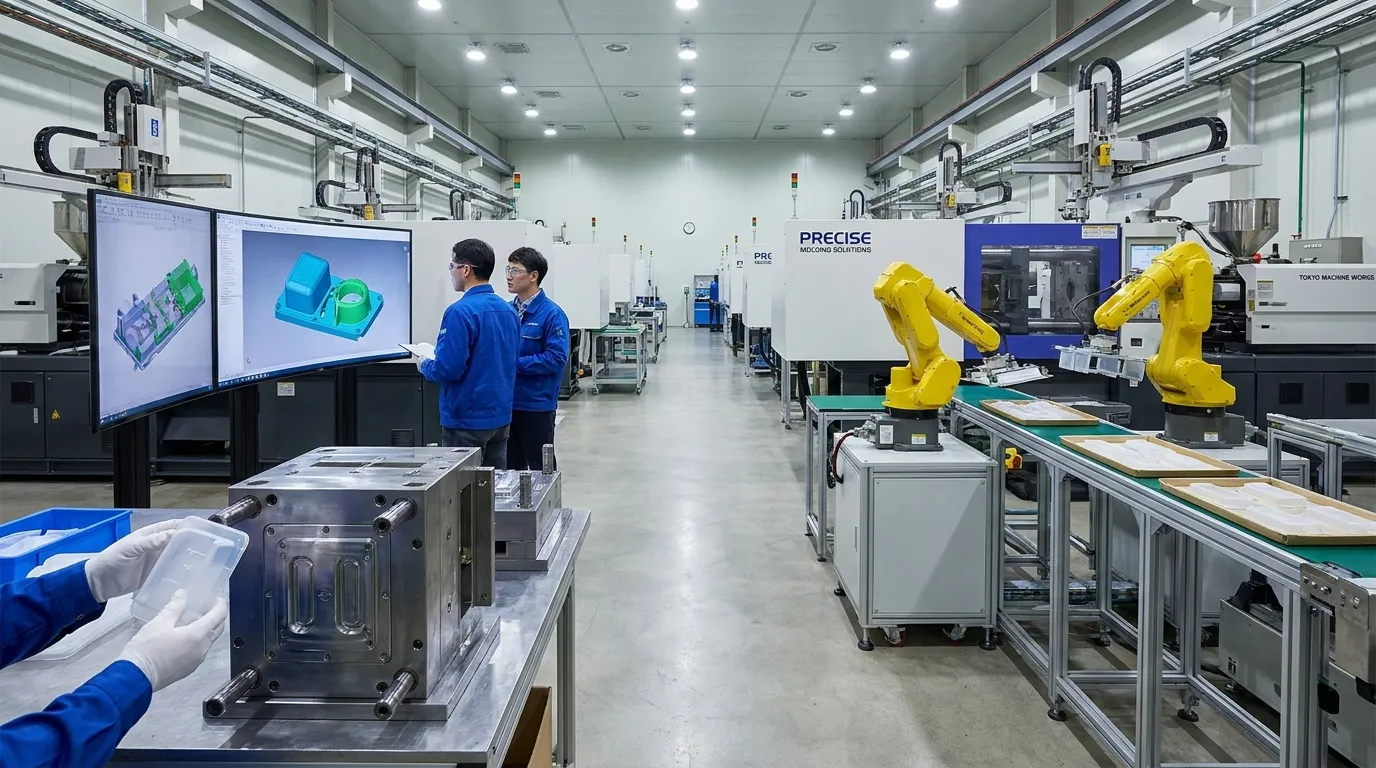
Custom plastic injection molding works best when a product needs repeatable quality, Tolérances strictes, and medium-to-high production volume. The process requires upfront tooling investment, but lowers per-part cost once production scales.
Injection molding creates plastic parts by injecting molten resin into a mold cavity under pressure. The same mold can produce thousands or millions of identical parts with consistent dimensions and surface finish.
The process makes sense when a product requires stable repeatability, Consistance cosmétique, or complex geometry. Boîtiers pour électronique grand public, Clips automobiles, Composants d’appareil, and medical enclosures are common examples. Selon Annuaire IQS, injection molding remains one of the most widely used methods for large-scale plastic part production.
| Besoins en fabrication | Ajustement par injection |
|---|---|
| Volume de production élevé | Excellent |
| Tolérances strictes | Fort |
| Changements rapides de prototypes | Limité après l’outillage |
| Faible investissement initial | Pauvre |
| Finition de surface cosmétique | Fort |
| Sortie répétable | Excellent |
Low-volume projects sometimes benefit from bridge tooling or aluminum molds. A startup producing 5,000 consumer electronics housings may use aluminum tooling first to reduce launch risk before moving to hardened steel tooling later.
For a broader overview of mold structures and tooling systems, voir le Guide du moule d’injection.
How does the custom injection molding process work from design to production?
Most custom injection molding projects follow a predictable sequence: Critique du DFM, tooling fabrication, Échantillonnage T1, Révisions, Validation, et production de masse. Problems become far more expensive once steel cutting begins.
A typical project starts with a DFM review, diminutivité de Design for Manufacturability. Engineers evaluate wall thickness, Angles de tirage, gating positions, Écoulement des matières, and part geometry before tooling begins. Early DFM approval prevents expensive mold revisions later.
Une fois la conception approuvée, the manufacturer creates the mold tool. This stage includes CNC machining, EDM work, Polissage, Ajustement, and cooling channel preparation. The full Flux de travail de production de moules usually takes several weeks depending on mold complexity.
Critique du DFM
DFM is where many projects either stay on track or begin slipping. A buyer changing wall thickness after steel cutting may trigger additional machining, delayed sampling, and new validation rounds.
One common example is an automotive supplier switching from ABS to PC/ABS after tooling starts because the original resin failed heat testing. That single material change can affect shrinkage rates, Porte de barrage, and cooling behavior.
T1 et validation
Après la fin de l’outillage, the manufacturer runs the first trial shot, often called T1 sampling. Engineers inspect dimensions, Finition cosmétique, gate marks, Flash, et la cohérence des cycles.
Mass production should not begin immediately after T1 approval. Stable production requires process tuning, repeatability checks, and validated inspection procedures before the production ramp starts.
How do you choose the right plastic material?
Material selection affects strength, Résistance à la chaleur, Usure de l’outillage, Temps de cycle, and final part cost. Choosing resin based only on price often creates long-term production problems.
The right resin depends on the product’s environment, Exigences de charge, appearance goals, et conditions de production. Polypropylene works well for flexible consumer parts, while polycarbonate provides stronger heat resistance and impact performance.
A resin also affects tooling life and production efficiency. Glass-filled materials can increase mold wear. High-temperature resins often require slower cycle times and more advanced tooling design. Groupe Goodfish explains how resin behavior directly impacts manufacturability and long-term part performance.
| Matériel | Meilleure utilisation | Avantage clé | Limitation |
|---|---|---|---|
| PP | Biens de consommation | Faible coût, flexible | Résistance à la chaleur plus faible |
| ABS | Logements | Belle apparence | Durabilité modérée |
| PC | Électronique | Forte résistance à l’impact | Coût plus élevé |
| Nylon | Pièces mécaniques | Résistance à l’usure | Absorption de l’humidité |
The cheapest resin is not always the lowest total cost. A lower-grade material may increase defect rates, cosmetic rejection, or part failure during production.
A medical device project may require multiple resin evaluations before approval. If sterilization temperatures exceed the material’s limit, the part can warp or crack after shipment. Dans ces cas, engineering-grade resin becomes necessary even if tooling and cycle costs increase.
For broader mold and resin production context, voir Solutions de moules en plastique.
Should you use aluminum or steel tooling?
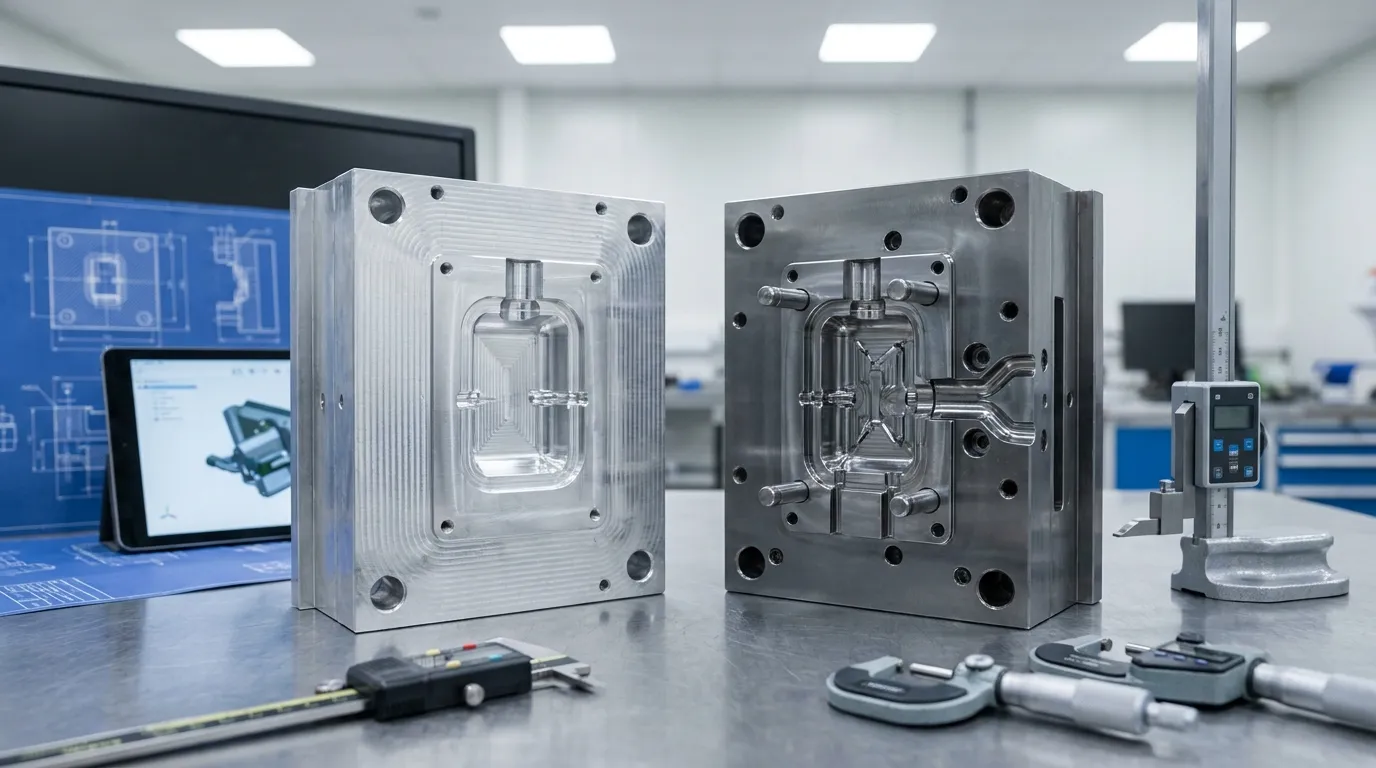
Aluminum molds reduce lead times and tooling cost for lower-volume projects, while hardened steel tooling is safer for long production runs and tighter tolerances.
Tooling material changes both project economics and production stability. Aluminum molds machine faster and cost less upfront, making them useful for prototyping, Production de ponts, or market testing.
Steel molds require more time and investment, but they handle higher production volumes and abrasive materials more reliably. Plastique Weilin notes that aluminum tooling is often preferred for low-volume manufacturing because of faster turnaround times.
Table de décision des outils
| Facteur | Outillages en aluminium | Outillages en acier |
|---|---|---|
| Délai d’exécution | Plus vite | Plus longtemps |
| Coût initial | Lower | Plus haut |
| Durée de vie de production | Lower | Beaucoup plus haut |
| Flexibilité des révisions | Plus facile | Plus fort |
| Le meilleur pour | Prototypes, bridge runs | Production à long terme |
Aluminum tooling is not always the cheapest long-term option. It works well for startup launches and pilot production, but hardened steel tooling is safer when repeatability and large production runs matter.
A startup launching a smart home device may choose aluminum tooling for the first 8,000 Unités. Once demand stabilizes, the company can transition to steel tooling for larger production volumes and improved durability.
If you're comparing tooling suppliers, Critique injection mold tooling before committing to a production plan.
What affects tooling cost and production pricing?
Tooling cost depends on part geometry, Nombre de cavités, Comportement de la résine, Exigences de tolérance, et volume de production. Small design changes after tooling starts can increase both lead time and total project cost.
Most injection molding costs fall into two categories: tooling cost and per-part production cost. Tooling includes machining, Conception du moule, Sélection de l’acier, Systèmes de refroidissement, and finishing work. Per-part cost depends on resin usage, Temps de cycle, labor, and output volume.
Complex geometry increases tooling cost quickly. Sous-découpes, threaded sections, Actions secondaires, and polished cosmetic surfaces all require additional machining and engineering time.
| Facteur de coût | Impact sur la tarification |
|---|---|
| Moule multi-cavités | Coût d’outillage plus élevé, lower part cost |
| Tolérances strictes | Plus d’usinage et de validation |
| Résine de qualité ingénierie | Coût plus élevé des matériaux |
| Finition esthétique | Polissage supplémentaire |
| Révisions de conception | Retards et retouches |
The lowest mold quote is rarely the lowest total project cost. Weak DFM review and poor validation often create expensive corrections later.
Par exemple, a buyer approving tooling before finalizing snap-fit geometry may face steel modifications after T1 sampling. Even small tooling revisions can delay production schedules and increase engineering costs.
When evaluating suppliers, a qualified Fournisseur de moulages sur mesure should explain cost drivers clearly instead of quoting only a single mold price.
How long does a custom injection molding project take?
Most custom plastic injection molding projects take several weeks to months depending on tooling complexity, Révisions, sampling cycles, et exigences de validation de production.
Simple tooling projects may move from DFM approval to production in a few weeks. Complex hardened steel molds with multiple cavities and cosmetic requirements often take much longer. Selon Aprios, production mold lead times can extend from several weeks to multiple months depending on complexity.
| Phase de projet | Synchronisation typique |
|---|---|
| Critique du DFM | 2 à 7 jours |
| Conception du moule | 1 à 2 semaines |
| Fabrication d’outils | Plusieurs semaines |
| Échantillonnage T1 | Quelques jours |
| Révisions et validation | Variable |
| Ascension de production | Cela dépend de l’approbation |
Causes courantes du retard
Most delays come from project changes, not machine downtime. Révisions de conception tardives, Spécifications incomplètes, resin changes, and failed validation rounds create the largest schedule disruptions.
A medical device project may require multiple T1 sampling rounds before dimensional stability meets approval standards. That extra validation time is normal in regulated production environments.
Evokpoly also highlights how tooling complexity and engineering changes affect overall lead time.
What should happen during sampling and production validation?
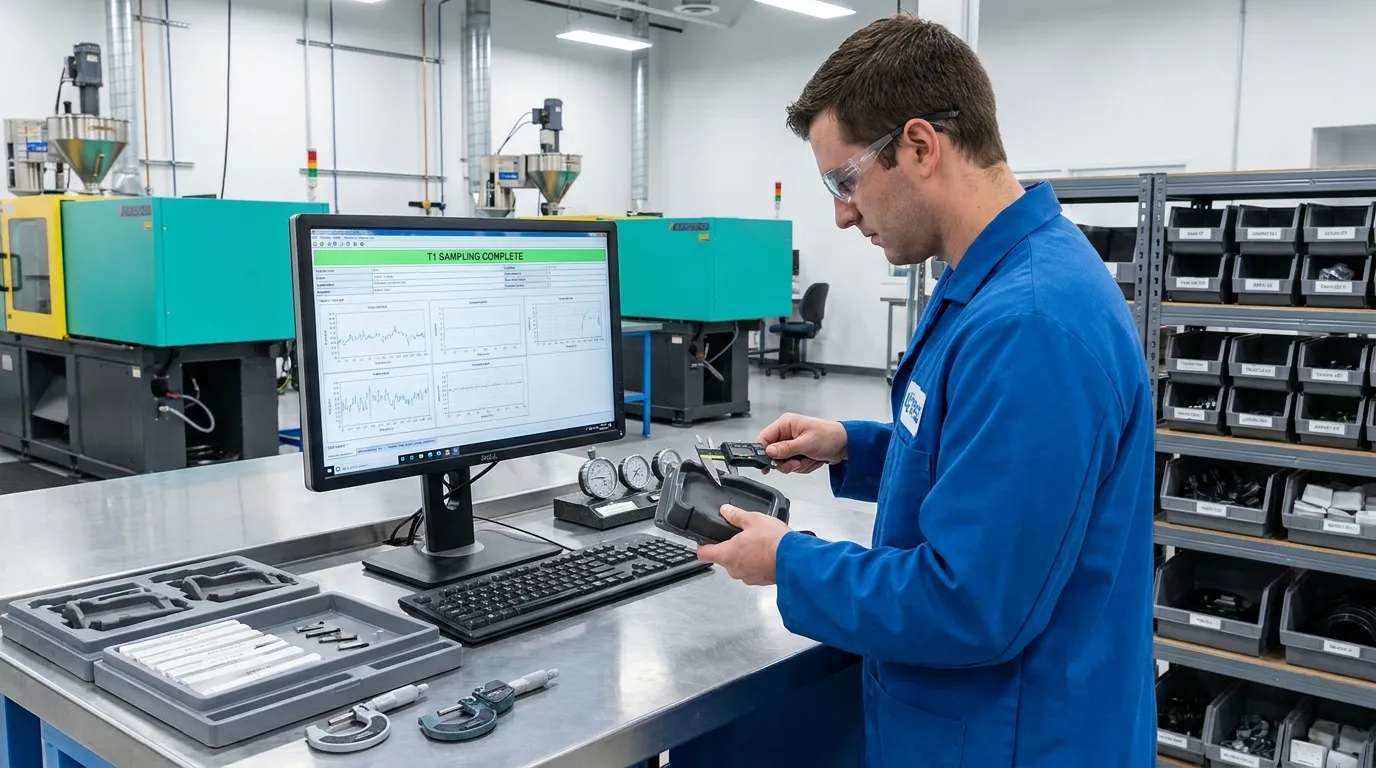
T1 sampling is where manufacturers validate dimensions, Comportement matériel, and molding stability before full production begins. Skipping structured validation increases the risk of downstream defects and delays.
Sampling is the transition point between tooling completion and production readiness. The goal is not just to create acceptable parts. The goal is to prove the process can repeat stable results consistently.
Manufacturers usually inspect dimensions, Qualité cosmétique, gate performance, cooling behavior, and material consistency during T1 and follow-up validation rounds.
Liste de contrôle de préparation à la production
- Approbation de l’échantillon T1
- Rapport d’inspection dimensionnelle
- Vérification de la résine
- Inspection de finition de surface
- Examen des paramètres de processus
- Approbation de l’emballage
- Revue de la planification logistique
- Confirmation du suivi de la révision
A rushed production launch often creates avoidable quality problems. Faster production timing only helps if validation procedures are complete.
Before export shipment, some manufacturers also perform mold function testing and trial verification. Moisissure alpine recommends reviewing trial reports, functionality, and dimensional checks before shipment approval.
For additional production-stage planning, review the Processus de validation du moule used during mold qualification and production release.
How can buyers reduce production delays and supply chain risk?
Most production delays come from design revisions, Spécifications incomplètes, Modifications des outillages, and poor production planning rather than machine downtime alone.
The best way to reduce delays is to lock specifications before tooling begins. Changing geometry, Type de résine, or surface finish after steel cutting usually affects tooling, Validation, and scheduling.
International projects also require planning for customs paperwork, shipping schedules, and packaging requirements. Both Trade.gov et États-Unis. Douanes et Protection des frontières provide guidance related to import procedures and shipment documentation.
| Si cela arrive | Augmentation du risque |
|---|---|
| Changements de matériau après l’outillage | Délais d’échantillonnage |
| Spécifications de tolérance inclaires | Échecs d’inspection |
| Aucun avis sur l’emballage | Dommages liés au transport maritime |
| Faible cadence de communication | Confusion de production |
A buyer delaying steel cutting until DFM approval often saves far more money than a buyer rushing into production. Early discipline reduces revision cycles and keeps production schedules predictable.
Les entreprises qui se préparent à l’augmentation de la production devraient également examiner Soutien à la planification de la production before approving long-term manufacturing agreements.
How do you choose the right injection molding manufacturer?
Choosing the right supplier depends on engineering support, Systèmes de qualité, tooling capability, and communication quality. A manufacturer should help reduce production risk, not simply quote a mold price.
Buyers should evaluate whether the supplier handles DFM reviews, sampling reports, Support de validation, and export coordination internally. Clear engineering communication matters just as much as machine capacity.
Liste de contrôle pour l’évaluation des fournisseurs
- Support technique DFM
- Expérience en outillage
- Capacité de production
- Procédures d’inspection qualité
- Expérience en exportation et logistique
- Contrôles d’approvisionnement en matériaux
- Temps de réponse à la communication
- Processus de gestion des révisions
An experienced supplier should also explain where risk exists. Par exemple, a supplier producing automotive parts may recommend hardened steel tooling immediately if annual production targets exceed projected aluminum mold lifespan.
If you're comparing long-term manufacturing partners, an Fabricant expérimenté de moules should be able to explain tooling decisions, validation methods, and production scalability clearly.
Réussir la prochaine étape
A successful custom plastic injection molding project depends on early planning, Chronologies réalistes, and disciplined validation. Buyers who focus only on mold price often face higher costs later through revisions, Retards, ou production instable.
Start by reviewing your production volume, Besoins matériels, Attentes en matière de tolérance, and launch timeline. Then evaluate whether aluminum or steel tooling fits the project long term. A supplier that supports DFM review, structured sampling, and production validation will usually reduce risk far more effectively than a low-cost quote alone.
Questions fréquemment posées
How much does custom plastic injection molding cost?
Costs depend on tooling complexity, Sélection de la résine, Nombre de cavités, exigences cosmétiques, et volume de production. The mold is usually the largest upfront expense, while per-part pricing becomes lower as production volume increases.
Combien de temps faut-il pour construire un moule d’injection ??
Simple molds may be completed within a few weeks, while complex hardened steel tooling can take several months. Projectiles d’échantillonnage, Révisions, and validation requirements also affect the final production timeline.
Les outillages doivent-ils être en aluminium ou en acier?
Aluminum tooling works well for prototypes and lower-volume production because it reduces cost and lead time. Steel tooling is better for large production runs, Tolérances plus strictes, and longer mold lifespan.
Which plastic material should I use for my application?
Material selection depends on heat resistance, Durabilité, Flexibilité, Exposition chimique, et exigences cosmétiques. Resin choice also affects tooling wear, Temps de cycle, et la cohérence de la production à long terme.
What certifications should I look for in an injection molding supplier?
Most buyers evaluate ISO compliance, quality management procedures, Systèmes de traçabilité, and industry-specific certifications. Medical and automotive programs often require stricter validation and inspection standards.
What causes delays in injection molding projects?
Révisions de conception après le début des outils, Spécifications incomplètes, Changements matériels, and failed validation rounds are common delay sources. Early DFM review helps reduce many of these production risks.
Partager:


Écrit par Sunshine
Au soleil, Nous sommes un fabricant et fournisseur professionnel de composants de moule de précision, proposant une large gamme de produits pour les applications de stampage et de moulage par injection. Notre objectif principal est le poinçage des coins, Goupilles et manchons d’éjection, et poteaux guides et bagues. Avec un usinage CNC avancé, Contrôle qualité strict, et de fortes capacités de production, Nous garantissons une fiabilité, Pièces de haute précision, ainsi que des composants standards en stock pour un approvisionnement mondial rapide et efficace.
ACTUALITÉS
OBTENIR UN SERVICE
Avec des pièces de qualité adaptées à tous les budgets et un personnel accueillant formé pour rendre votre visite informative et sans tracas.
