



D2 vs M2 acier pour les goupilles de poinçon: Usure, Robustesse, et Vitesse
For punch pins, D2 and M2 solve different combinations of wear, Impact, and thermal stress. D2 is often a practical choice when gradual abrasive wear is the main concern and the die operates under controlled cold-work conditions. M2 may be the stronger candidate when the punch faces repeated edge chipping, difficult stock, long production runs, slender geometry, or sustained heat at the cutting edge.
Neither material is automatically better. Press speed alone does not determine the answer, and a harder punch is not always a more durable punch. Dégagement, Traitement thermique, Géométrie, alignement, Lubrification, and the actual failure pattern can matter as much as the steel grade.
Material selection is also only one part of a complete die system. The broader relationship between punches, Ceci, Dégagement, and tooling requirements is covered in SunshinePro’s Guide des matrices de poinçon (déduit).
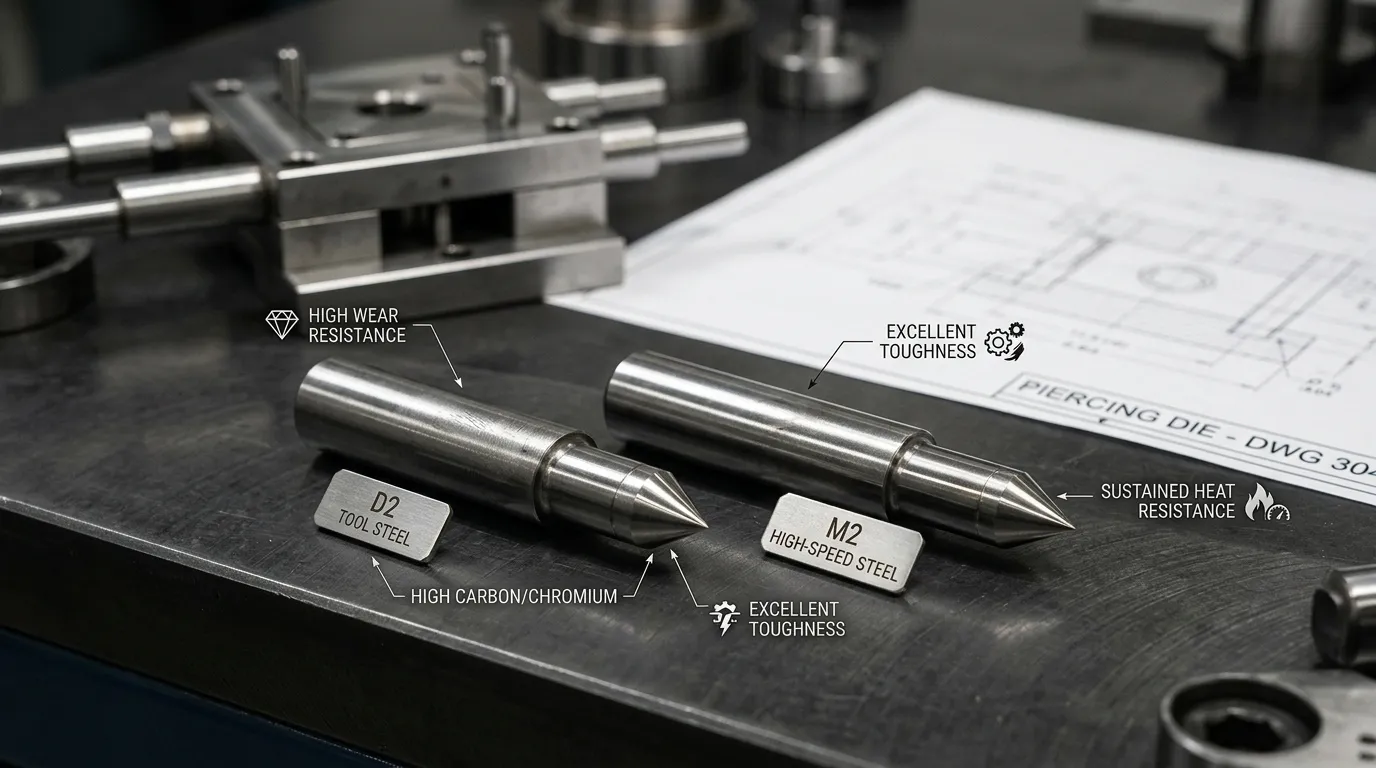
Comparaison des goupilles D2 vs M2 en un coup d’œil
| Facteur de comparaison | Acier à outillage D2 | Acier à grande vitesse M2 |
|---|---|---|
| Famille de l’acier | Acier à outils à froid | Acier à grande vitesse |
| Typical selection strength | Forte résistance à l’usure dans des conditions de travail froid contrôlées | Balanced wear resistance, Stabilité des bords, Robustesse, and hot hardness |
| Principale limitation | Can become vulnerable to chipping or fatigue when the hardness, Géométrie, or loading is too aggressive | Un coût plus élevé des matériaux et de transformation peut ne pas être justifié dans des applications légères |
| Usure abrasive | Souvent un candidat fort lorsque l’usure abrasive progressive domine | Also wear resistant, especially where wear occurs with heat or repeated impact |
| Robustesse et éclat | Dépendant de l’application; geometry and heat treatment must be controlled | Souvent considéré lorsque D2 subit un éclat récurrent sur les bords dans des conditions autrement stables |
| Chaleur soutenue | Moins adapté aux applications où le tranchant reste chaud pendant de longues périodes | Mieux connue pour conserver sa dureté sous des températures de service élevées |
| Conditions de meilleure adéquation | Stable alignment, suitable clearance, controlled impact, moderate thermal demand | Long runs, difficult stock, higher thermal demand, coups de poing fins, or expensive downtime |
| Direction des coûts | Communément considéré comme le point de départ le plus économique | Généralement évalué lorsque la fiabilité améliorée peut compenser le coût supplémentaire |
| Vérification requise | Grade exact, Traitement thermique, Dureté, Géométrie, et conditions de production | Grade exact, Traitement thermique, Condition de trempe, Dureté, et conditions de production |
These are selection tendencies, not guaranteed performance rankings. A poorly supported M2 punch can fail before a correctly designed D2 punch, while an over-hardened or misaligned D2 punch can chip before its wear resistance becomes useful.
Pourquoi D2 et M2 se comportent-ils différemment dans un poing
D2 is a high-carbon, high-chromium cold-work tool steel. It is commonly associated with wear resistance, compressive-load capability, and dimensional stability in tools operating without sustained high-temperature exposure. Le Fiche technique BÖHLER K110, which covers a D2-family grade, lists punching and stamping tools among its applications.
M2 belongs to the molybdenum high-speed-steel family. Its alloy system is designed to retain hardness and cutting performance under greater thermal demand. Le Fiche technique BÖHLER S600, covering an M2-family grade, emphasizes wear resistance, Robustesse, Stabilité des bords, Résistance à la compression, and red hardness.
The difference cannot be reduced to a single Rockwell hardness value. Two punch pins at a similar HRC may still behave differently because of:
- Composition des alliages et distribution des carbures
- Austenitisation, Trempe, and tempering conditions
- Microstructure conservée
- Meulage et condition de surface EDM
- Géométrie du poinçon et support
- Température pendant la production
- Le type d’usure ou de fracture survenant
The agreed material standard therefore matters. ASTM A681 covers alloy tool steels such as D2, tandis que ASTM A600 covers high-speed tool steels such as M2.
Des noms de grade que les acheteurs ne devraient pas considérer comme des équivalents automatiques
Worldwide sourcing often involves several designation systems. D2 may be discussed alongside SKD11 or 1.2379, while M2 may be cross-referenced with SKH51, SKH9, or 1.3343.
These names should not be accepted as interchangeable without checking the applicable standard, Chimie, production route, and final heat-treated condition. The drawing or purchase specification should identify the agreed grade rather than relying on a general trade name.
DC53 also should not be described as another name for standard D2. It is a separate modified cold-work steel with its own processing and performance characteristics.
Résistance à l’usure: Identify the Wear Mechanism Before Choosing
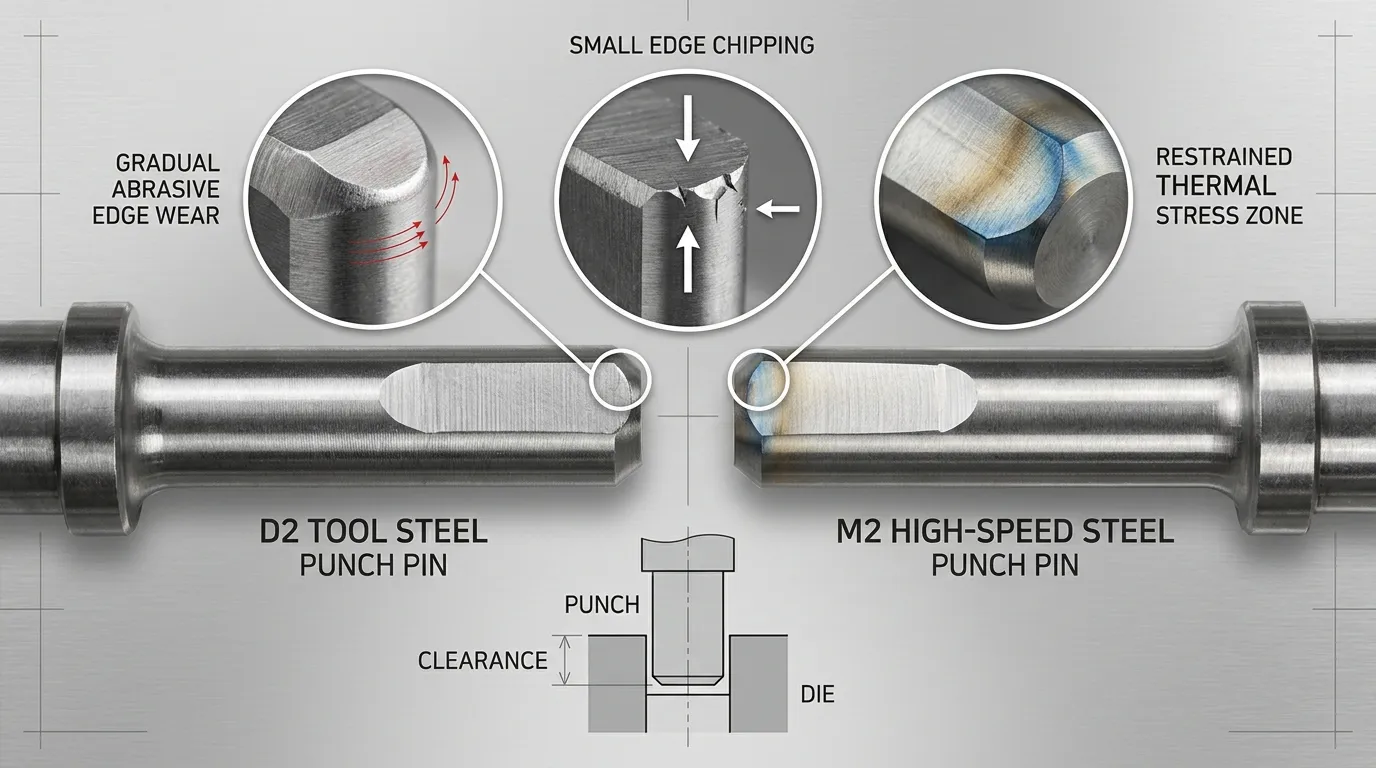
Asking which steel has “better wear resistance” is incomplete until the wear mechanism is known.
Usure abrasive gradually removes material from the punch edge or flank. It may be driven by hard particles, Échelle, an abrasive workpiece, or repeated sliding contact. D2 is often considered when this predictable, gradual wear is the primary problem and shock loading remains controlled.
Usure des adhésifs et galures involve material transfer, micro, or local seizure between the punch and workpiece. These problems are influenced heavily by workpiece material, Finition de surface, Lubrification, Dégagement, et revêtement. Changing from D2 to M2 may not correct galling if friction and material adhesion remain the real causes.
Usure combinée à l’éclat ou à la chaleur creates a different selection problem. M2 may provide a more useful performance balance where the edge must resist abrasion while also tolerating repeated stress and sustained temperature.
Before changing steel, inspect how the existing punch is deteriorating:
| Condition observée | Problématique probable à enquêter | Implications matérielles |
| Smooth, gradual edge recession | Usure abrasive | D2 may remain suitable; compare maintenance interval and total cost |
| Collecte de matériaux ou dépôts bruts | Galling, Fin, Lubrification, revêtement | Corrigez les conditions de surface avant de blâmer l’acier en vrac |
| De petits morceaux qui se cassent du bord | Ébréchage, Dureté excessive, Géométrie, Dégagement, Chargement latéral | M2 peut être envisagé après que les causes du système ont été contrôlées |
| Usure rapide lors de longues sorties ininterrompues | Combinaison d’abrasion et de chaleur | La capacité de dureté à chaud du M2 pourrait devenir plus pertinente |
SunshinePro’s die punch pin page lists precision grinding and TiN and TiCN coating options. These processes can support surface condition and wear control, but a coating cannot compensate for unsuitable steel, Mauvais alignement, Autorisation incorrecte, or weak punch support.
Robustesse, Ébréchage, and Punch Geometry
Punch toughness is not determined by the steel name alone. The final hardness, Traitement thermique, edge shape, longueur non supportée, and loading direction all affect whether the punch bends, Puces, or develops fatigue cracks.
A large, well-supported round punch and a long, narrow punch do not place the same demands on the material. Small-diameter punches, sharp internal features, narrow points, and long unsupported sections create greater stress concentration and bending risk.
Repeated chipping can result from:
- Dureté excessive pour la géométrie
- Jeu incorrect entre la poinçonnage et la puce
- Mauvais guidage ou alignement
- Chargement latéral
- Soutien insuffisant de la tête ou du corps
- Dégâts de broyage
- Une couche recaste EDM non contrôlée
- Défauts de traitement thermique
- Surcharge locale due à la variation d’origine
A published failure analysis of an AISI D2 punch found that punch damage could involve fatigue, carbide cracking, excessive loading, heat-treatment issues, backup-plate wear, Dégagement, and guiding conditions. The study reinforces a basic rule: changing the material without correcting the mechanical cause may only move the failure to another location. Voir l’étude sur fatigue et usure dans un coup de poing AISI D2.
M2 may deserve evaluation when a D2 punch repeatedly chips despite correct alignment, suitable clearance, stable heat treatment, and adequate support. It should not be treated as a substitute for investigating the die system. A more complete diagnosis of side loading, Dégagement, Guidage, and fracture causes belongs in the guide to Cassure de la poinçon dans les matrices d’emboutissage.
Quand la vitesse de pression rend la dureté chaude de M2 pertinente
The term “high-speed steel” often leads to an oversimplified rule: fast press equals M2. Actual punch conditions are more complicated.
Strokes per minute affect the number of loading events, but they do not directly state the cutting-edge temperature. Thermal demand also depends on:
- Durée continue de la série
- Résistance et épaisseur de la pièce
- Taille du trou et géométrie du poinçon
- Dégagement de la mise à la puce
- Frottement et galaison
- Lubrification
- Dissipation de la chaleur entre les coups
- La durée et la fréquence des arrêts de production
A fast press running short batches of thin, manageable stock may produce less sustained edge heat than a slower press running thick, high-strength material continuously.
M2’s hot hardness becomes more valuable when the cutting edge remains hot enough for ordinary cold-work performance to deteriorate. That condition may appear during long progressive-die runs, difficult stock punching, Haute friction, or inadequate cooling between cycles.
D2 can still be suitable at a high numerical press speed when thermal load, Impact, and chipping risk remain controlled. M2 should therefore be selected because of the complete duty cycle, not because the press specification contains a high strokes-per-minute number.
D2 or M2? Choose by Failure Mode and Application
The following table provides a starting direction. It is not a substitute for examining the die, Pièce à travailler, Traitement thermique, and failed punch.
| Conditions d’application | Candidat probable de départ | Raison | Vérifiez avant de décider |
| Écurie, gradual abrasive wear | D2 | Une forte capacité d’usure au froid peut suffire | Dureté, Intervalle d’affûtage, stock abrasiveness |
| L’arête D2 ébrèche à plusieurs reprises | M2 peut être évalué | Un équilibre plus large entre robustesse et stabilité des tranchants peut aider | Dégagement, alignement, Géométrie, Traitement thermique |
| Production longue et ininterrompue avec une chaleur soutenue sur les bords | M2 | La dureté à chaud devient plus importante | Actual temperature drivers, Friction, Lubrification |
| Perforatrice de petit diamètre ou fine | M2 peut être évalué | La géométrie peut nécessiter une plus grande résistance aux écaillages et à la fatigue | Unsupported length, Guidage, head support |
| Perforation en acier doux ou carbone à volume modéré | D2 peut suffire | La demande thermique et d’impact ne justifie peut-être pas M2 | Stock thickness, Dégagement, desired maintenance interval |
| Matériau inoxydable ou sujet aux galles | Dépendant de l’application | Friction, Adhérence, and heat may dominate | Lubrification, Finition de surface, revêtement, Dégagement |
| Feuille épaisse ou de plus grande résistance | M2 peut offrir un avantage | Des charges plus élevées peuvent augmenter les contraintes des bords et la chaleur | Punch diameter, press force, Soutien, hole geometry |
| Le temps d’arrêt est nettement plus cher que le coût des outils | M2 peut être justifié économiquement | Un coût initial supplémentaire peut être acceptable si la fiabilité s’améliore | Dossiers de production et résultats d’essais contrôlés |
Conditions typiques où D2 peut être suffisant
D2 remains a reasonable candidate when the punch experiences predictable wear under stable cold-working conditions. Suitable clearance, strong guidance, adequate support, and controlled hardness allow its wear resistance to be used without excessive chipping.
It can be a practical choice for moderate production duties where current sharpening intervals are acceptable and the application does not create sustained heat or severe impact.
Des conditions où M2 pourrait justifier son coût plus élevé
M2 becomes more attractive when a punch must maintain its edge under combined wear, repeated stress, and thermal demand. Examples include long production runs, difficult or higher-strength stock, slender punch geometry, and applications where recurring D2 chipping continues after system problems have been corrected.
The economic case is strongest when unplanned breakage or press downtime costs much more than the difference in punch material and processing.
Steel Grade Alone Will Not Fix Clearance, Alignement, or Heat-Treatment Problems
Before replacing D2 with M2, confirm that the current punch is being tested fairly. Au minimum, Critique:
- Dégagement de la mise à la puce
- Concentricité et alignement du poinçon
- État du poteau directeur et des bagues
- Soutien du poinçon et longueur non supportée
- Variation de l’épaisseur et de la dureté de la pièce
- Consistance de la lubrification
- Brûlures de grincement ou dégâts sur les bords
- État de surface EDM
- Dureté finale et condition de trempe
- Coating condition
- Motif d’usure sur l’ouverture de la poinçonnette et de la matrice
Incorrect clearance can increase cutting load, Formation de la meule, edge stress, et le chipping. Misalignment can place bending loads on a punch designed mainly for compression. Grinding or EDM damage can also provide a starting point for fatigue cracks.
A punch works as part of a larger assembly. The relationship between the punch, Serviteur, Guides, Silents, die insert, and support components is covered more broadly in the Guide des composants de la puce.
Compare Cost by Downtime and Maintenance, Not Steel Price Alone
D2 may have a lower initial cost in many sourcing situations, but purchase price does not show the complete economic result. M2 may cost more to purchase, Machine, heat-treat, or grind, yet still be worthwhile if it reduces expensive production interruptions.
A useful comparison should include:
| Facteur coût | Question à évaluer |
| Coût initial du poinçon | What is the delivered cost in the specified grade and condition? |
| Affûtage | How many hits occur between scheduled sharpening events? |
| Casse non planifiée | Does the punch wear predictably or fail without warning? |
| Temps mort | How much production is lost during replacement and die adjustment? |
| Ferraille | Does edge deterioration affect burrs, Dimensions, or part quality? |
| Inventaire | How many spare punches are required to protect production? |
| Main-d’œuvre d’entretien | How much toolroom time is spent inspecting, Affûtage, and replacing punches? |
M2 is not automatically the lower-cost choice. It becomes economically attractive only when its performance under the actual application reduces enough maintenance, failure, Ferraille, or downtime to offset the added cost.
Quoi préciser avant de demander une goupille perforatrice D2 ou M2
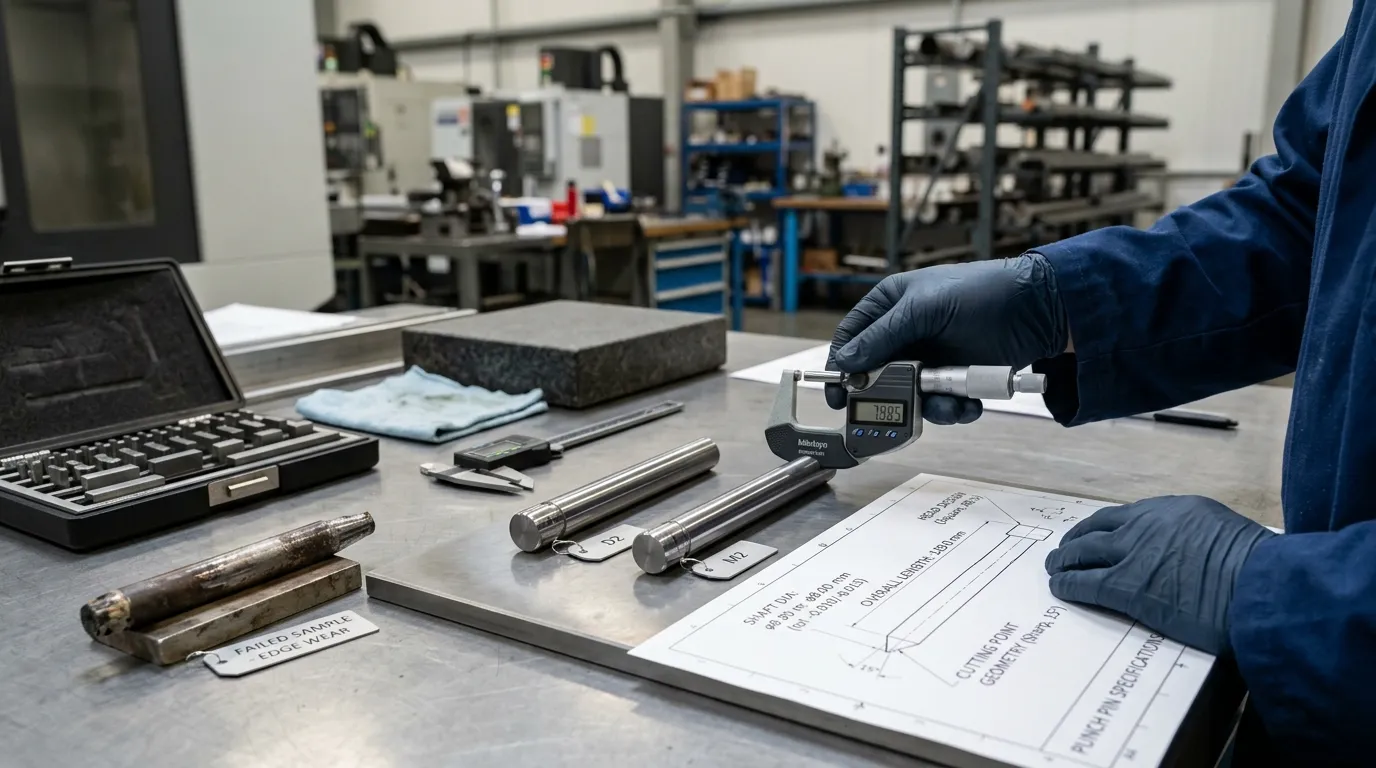
A supplier cannot make a reliable material recommendation from the punch diameter alone. The RFQ should describe both the component and its operating conditions.
Fournir:
- Un dessin en dimensions
- Punch diameter, Longueur, and unsupported length
- Conception de la tête et disposition du support
- Point shape, corner radii, and special cutting features
- Matériau et grade de la pièce
- Épaisseur de la feuille
- Dimensions et forme du trou
- Dégagement de la mise à la puce
- Type de presse et vitesse de fonctionnement
- Durée continue de la série
- Nombre annuel attendu de visites
- Lubrifiant et méthode d’application
- Matériau de poinçon existant et dureté mesurée
- Current failure symptom: Usure, Irritant, Ébréchage, pliage, ou fatigue
- Photographies ou échantillons défaillants lorsque disponibles
- Revêtement requis
- Désignation et norme du matériau convenues
- Certificat matériel requis
- Documentation sur le traitement thermique
- Exigence d’inspection de dureté
- Critères d’acceptation pour un essai de production
SunshinePro states that non-standard components can be produced from customer drawings. Son Page produit de la goupille de perforatrice lists custom diameter, Longueur, Conception de la tête, Matériel, et options de revêtement, together with SKH51, SKH9, DC53, Notes ASP, et carbure. The page also mentions CNC machining, Rectification de précision, EDM, et traitement thermique sous vide.
That information does not confirm AISI D2 availability. Buyers requiring D2 should ask the supplier to confirm the exact material designation, applicable standard, Condition de traitement thermique, and documentation before ordering.
A controlled trial remains the most reliable final check. Compare D2 and M2 using the same drawing, Dégagement, Presse, workpiece batch, lubrifiant, Statut du revêtement, et méthode d’inspection. Record the hit count and actual failure mechanism rather than judging only by whether the punch still appears usable.
Quand ni D2 ni M2 conventionnel ne sont la bonne solution
If both materials fail after clearance, Soutien, alignement, Lubrification, Géométrie, and heat treatment have been corrected, the application may require a different solution.
Possible next steps include reviewing:
- Acier à grande vitesse pour la métallurgie des poudres
- Carbe
- Un système de revêtement différent
- Géométrie révisée du poinçonnage
- Amélioration du guidage ou du soutien
- Modifications du jeu ou de la lubrification
SunshinePro lists ASP grades and carbide among its punch-pin material categories, but these alternatives should be evaluated against the same application data rather than treated as automatic upgrades.
For a material review or quotation, submit the punch drawing, Détails de la pièce, Conditions de production, and current failure evidence through the Page de contact SunshinePro. The strongest recommendation will come from matching the steel, Traitement thermique, Géométrie, and die conditions to the failure mode the punch must actually survive.
Partager:


Écrit par Sunshine
Au soleil, Nous sommes un fabricant et fournisseur professionnel de composants de moule de précision, proposant une large gamme de produits pour les applications de stampage et de moulage par injection. Notre objectif principal est le poinçage des coins, Goupilles et manchons d’éjection, et poteaux guides et bagues. Avec un usinage CNC avancé, Contrôle qualité strict, et de fortes capacités de production, Nous garantissons une fiabilité, Pièces de haute précision, ainsi que des composants standards en stock pour un approvisionnement mondial rapide et efficace.
ACTUALITÉS
OBTENIR UN SERVICE
Avec des pièces de qualité adaptées à tous les budgets et un personnel accueillant formé pour rendre votre visite informative et sans tracas.
