



Procédé de moule d’injection: Guide étape par étape du design à la production
Injection mold process describes the complete workflow used to design, manufacture, test, and mass-produce plastic parts using injection molding tools. The process includes DFM review, Conception du moule, Usinage, Essais de moisissure, Échantillonnage, quality validation, and production ramp-up. Stable production depends on accurate tooling, controlled process parameters, and early defect prevention before full manufacturing begins.
Injection molding projects rarely fail because of one major issue. Most problems start with small design mistakes, rushed tooling decisions, or unstable sampling results. Understanding the full process helps buyers avoid delays, reduce tooling revisions, and improve production consistency. This guide explains each stage clearly, from early DFM review to final production approval.
What Is the Injection Mold Process?
Injection mold process refers to the complete workflow of designing, building, Essais, and using a mold to mass-produce plastic parts. The process includes DFM review, mold manufacturing, Échantillonnage, quality approval, and stable production ramp-up.
The process starts long before molten plastic enters a mold cavity. Manufacturers first review the product design, evaluate moldability, and identify production risks. This early planning stage has a major effect on tooling quality, Stabilité en cycle, et le coût de production à long terme.
Une fois la conception approuvée, the mold moves through machining, Ajustement, Polissage, and assembly. Après la fin de l’outillage, manufacturers perform mold trials and sample inspections before releasing the tool for production. Selon le Aperçu du moulage par injection dans l’annuaire IQS, injection molding remains one of the most common manufacturing methods for high-volume plastic parts.
If you're new to tooling fundamentals, Ceci Guide pour moule d’injection plastique gives broader background on mold structures and manufacturing systems. Vous pouvez aussi consulter Bases de la conception des moules en plastique to understand how product geometry affects tooling decisions.
How Does the Injection Mold Process Work Step by Step?
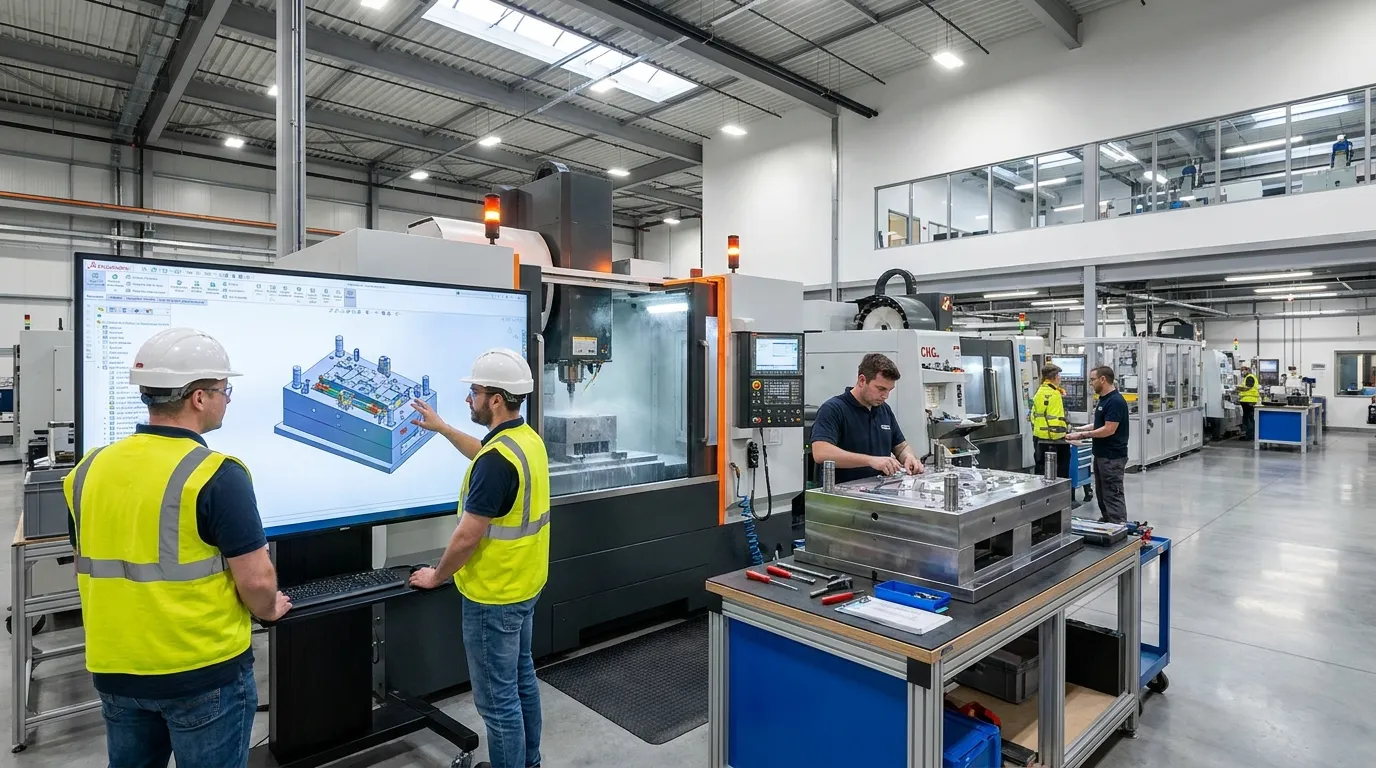
The injection mold process starts with design review and DFM analysis, followed by mold design, Usinage, Assemblage, Échantillonnage, Essais, et l’approbation finale de production. Stable mass production begins only after part quality and cycle consistency are confirmed.
Most injection molding projects follow the same core sequence. The exact timeline changes based on complexity, tooling size, et exigences de production, but the overall workflow stays similar across industries.
| Scène | Objectif principal | Sortie commune |
|---|---|---|
| Critique du DFM | Identifier les risques de moisissure | Recommandations de conception |
| Conception du moule | Créer la mise en page des outils | Fichiers de moules 3D |
| Fabrication d’outils | Construis le moule | Composants de moule usinés |
| Essai de moisissure | Performance du moule d’essai | Pièces d’échantillon T1 |
| Validation | Confirmez la cohérence de la qualité | Échantillons approuvés |
| Ascension de production | Stabiliser la fabrication | Production complète |
Revue de conception et DFM
The first stage focuses on manufacturability. DFM, or Design for Manufacturing, checks whether the part can be molded consistently without excessive defects or tooling risk. Les ingénieurs examinent l’épaisseur des parois, Angles de tirage, Sous-coupes, Emplacements des portes, and material flow before steel cutting begins.
Un boîtier d’électronique grand public est un exemple courant. If the housing wall thickness changes late in the project, the mold may require additional machining after sampling. That adds cost and delays production approval. Early DFM prevents many of these problems before tooling starts.
For a deeper breakdown of design optimization, review this guide on Procédé DFM par injection.
Fabrication de moules
After DFM approval, mold manufacturing begins. Toolmakers machine steel blocks using CNC equipment and EDM processes to create cavities, Couleurs, and detailed part geometry. Canaux de refroidissement, Systèmes d’éjection, and alignment features are added during this stage.
Fast tooling is not always the best option. Rushed DFM review often creates larger delays later when mold corrections become necessary. A slightly longer design review usually saves time during sampling and production.
Échantillonnage et approbation de la production
Once tooling is assembled, manufacturers perform mold trials to evaluate part quality and machine stability. The first sample run is often called T1 sampling. Engineers inspect dimensions, Qualité cosmétique, Rétrécissement, and molding consistency.
Mass production does not start immediately after T1 approval. Most projects require process adjustments and repeat testing before production becomes stable. This stage determines whether the mold can reliably support long-term manufacturing.
Why Is DFM Review Important Before Mold Manufacturing?
DFM review helps manufacturers identify molding risks before tooling begins. Early analysis reduces defects, prevents expensive steel modifications, and improves production consistency after sampling starts.
DFM review is one of the most important stages in the injection molding workflow. Une fois la coupe de l’acier commencée, design changes become expensive and time-consuming. A simple geometry issue can require additional machining, insert replacement, or another round of mold trials.
Selon Guide de moldabilité de Protolabs, Consistance de l’épaisseur des parois, draft angle design, and material flow all affect molding success. These factors also influence cooling time, part warpage, and cycle stability.
- Angles vifs qui créent des points de contrainte
- Angles de tirage insuffisants pour l’éjection des pièces
- Épaisseur inégale des parois provoquant des traces d’enfoncement
- Mauvais placement des grilles affectant l’écoulement des matériaux
- Des tolérances serrées qui augmentent la complexité des outillages
A draft-angle correction is a good real-world example. A part may look acceptable in CAD, but without proper draft, the component sticks during ejection. Fixing that problem before machining prevents costly steel modifications later.
Low mold pricing can look attractive initially, but poor sampling stability usually increases long-term production cost and quality risk. Experienced suppliers spend more time reviewing manufacturability because stable production matters more than fast quoting.
Vous pouvez en apprendre davantage sur l’optimisation du design et Exigences de conception des moules before tooling approval.
What Happens During Injection Mold Manufacturing?
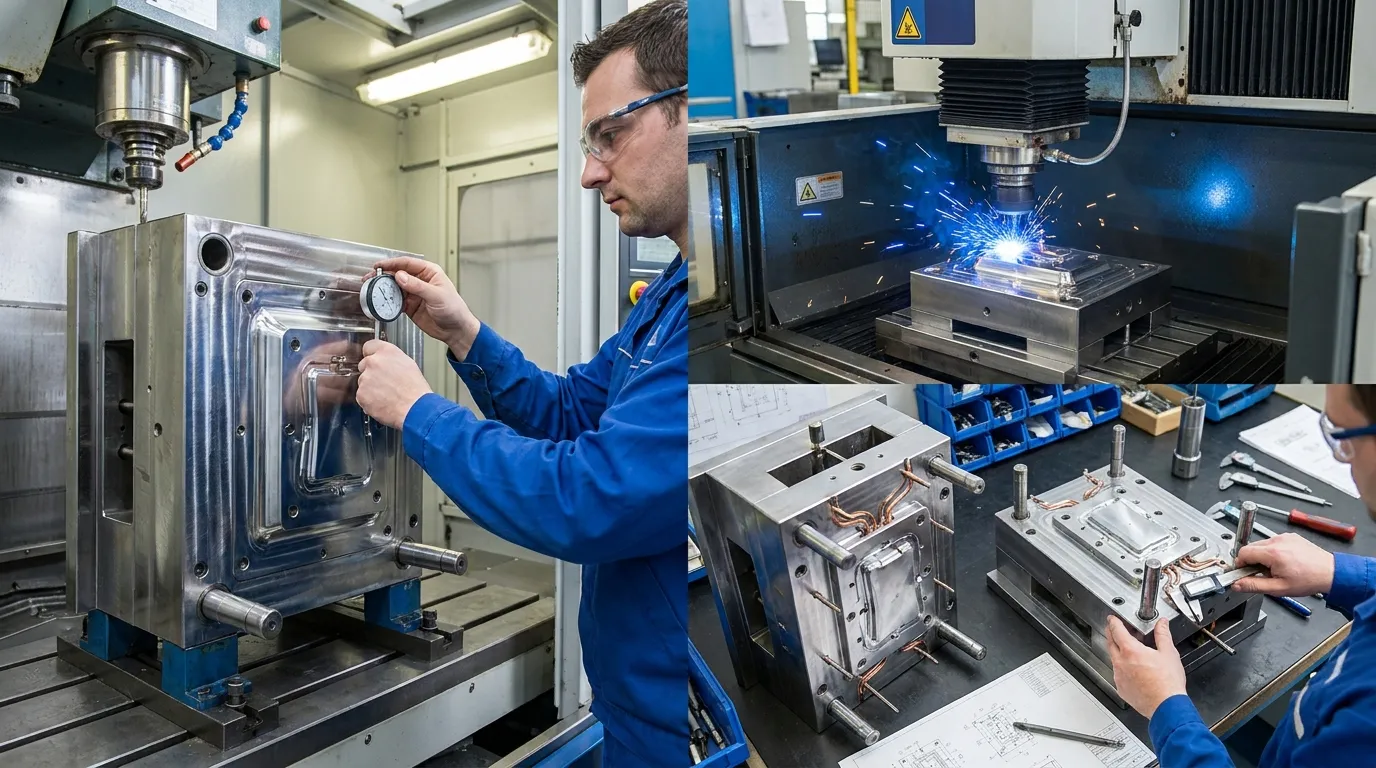
Injection mold manufacturing combines CNC machining, Traitement EDM, Polissage, Ajustement, and assembly to produce a mold capable of repeatable production. Accuracy during this stage directly affects part quality, Temps de cycle, et durée de vie du moule.
Tool manufacturing transforms engineering files into a functional production mold. Most molds are built from hardened steel or aluminum, depending on expected production volume and part complexity.
Usinage et EDM
CNC machining removes large sections of steel and creates the primary mold structure. EDM, or Electrical Discharge Machining, handles finer details and sharp internal features that traditional machining cannot easily produce.
Complex automotive trim components often require both machining methods. Tight cosmetic surfaces, snap-fit details, and textured areas usually need additional EDM processing before polishing begins.
| Étape de fabrication | Objectif |
|---|---|
| Usinage CNC | Créer une structure de moule |
| Traitement EDM | Produire une géométrie détaillée |
| Meulage | Améliorer la précision des surfaces |
| Polissage | Améliorer la finition de surface |
| Fitting | Aligner les composants du moule |
| Assemblage | Système de moule final de construction |
Ajustement et polissage du moule
Après l’usinage, technicians fit all mold components together and check alignment accuracy. Cooling systems, Goupilles éjecteurs, Sliders, and guide components are installed during assembly. Surface polishing then improves cosmetic appearance and material flow.
A medical device enclosure is a good example. During sampling, cosmetic defects may appear near visible surfaces. Additional polishing is often required before final approval. Selon Recherche sur les procédés de polissage des moules, surface finishing has a direct impact on molded part quality.
Manufacturers also verify mold movement and sealing during this stage. Poor alignment can cause flash defects, Variation dimensionnelle, or premature tool wear during production.
For additional tooling details, Ceci Guide des outillages pour moules d’injection explains how mold systems are structured.
What Happens During Mold Trial and Sampling?
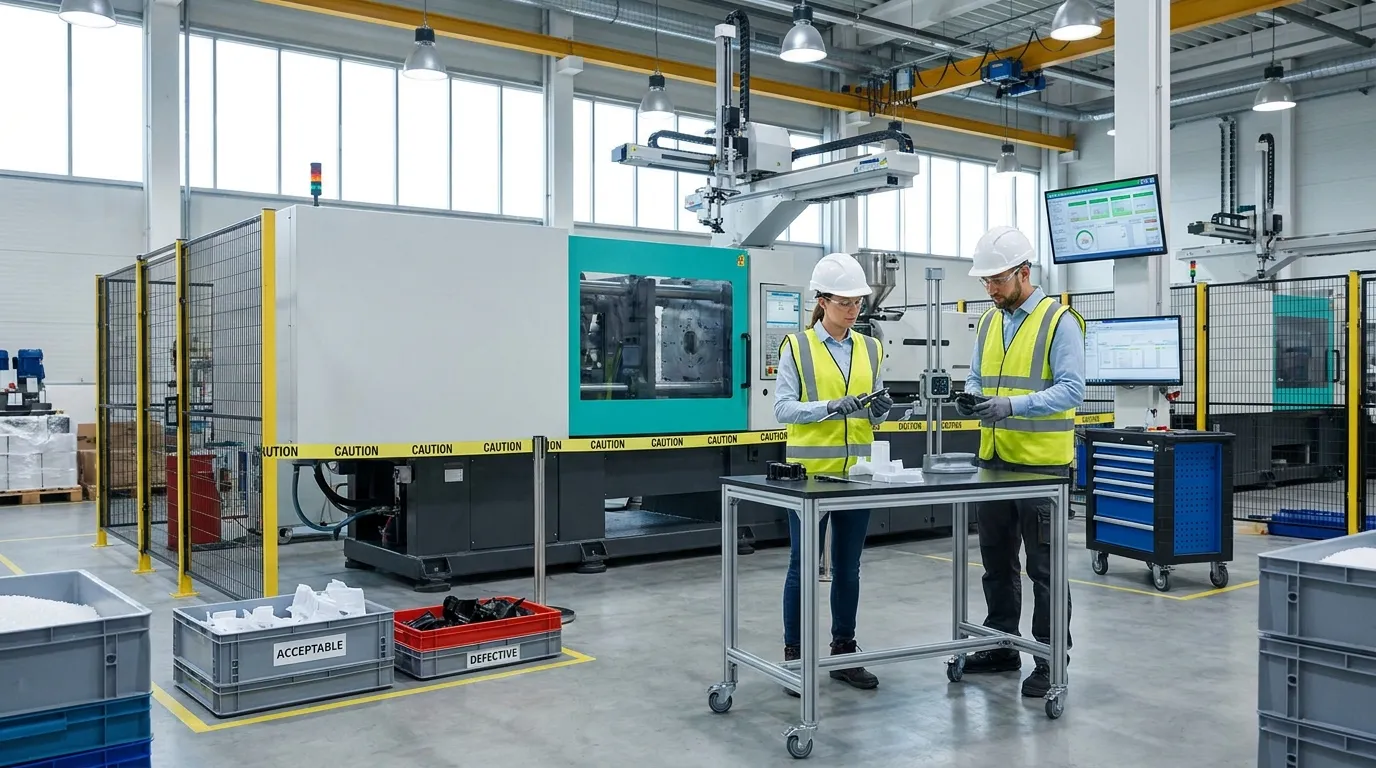
Mold trial and sampling verify whether the tool can consistently produce acceptable parts. Manufacturers evaluate dimensions, Défauts, Rétrécissement, and cycle stability before approving the mold for production.
Sampling is the point where theoretical design becomes real production output. The first mold trial checks whether the mold performs correctly under production conditions. Engineers monitor filling balance, cooling behavior, Précision dimensionnelle, et qualité cosmétique.
T1 samples often reveal issues that were not visible during design review. Common problems include warpage, Marques de naufrage, Plans courts, Flash, or uneven shrinkage. Manufacturers then adjust process settings or modify tooling before running another trial.
Défauts courants observés lors de l’échantillonnage
| Défaut | Cause typique | Correction courante |
|---|---|---|
| Marques de naufrage | Sections de mur épaisses | Ajuster la conception des murs |
| Flash | Mauvais scellement de la moisissure | Améliorer l’ajustement |
| Warpage | Refroidissement inégal | Modification de la disposition de refroidissement |
| Coup court | Écoulement des matériaux médiocre | Ajuster la position de la porte |
| Marques de brûlure | Air piégé | Améliorer la ventilation |
A production ramp-up scenario shows why this stage matters. One manufacturer completed tooling on schedule, but unstable cycle times caused inconsistent dimensions during sampling. The project needed additional process tuning before production approval could move forward.
Many buyers focus too heavily on mold completion dates, but production stability after sampling is what actually determines project success. A mold that ships quickly but fails during validation usually creates larger delays later.
Manufacturers also use this stage to verify customer specifications and inspection requirements. Exactement Validation du moule d’injection resource explains how design decisions influence final part quality.
How Does Mass Production Start After Sampling?
Mass production starts after sampling results are approved and process parameters become stable. Manufacturers monitor cycle time, Taux de défauts, and dimensional consistency before scaling to full production volume.
Production ramp-up focuses on consistency. Engineers lock machine parameters, validate repeatability, and monitor output quality before increasing manufacturing volume. This stage confirms that the process works reliably outside controlled trial conditions.
Selon Guide de développement des procédés de Kaysun, stable processing conditions help reduce variability and improve long-term manufacturing performance. Small changes in temperature, Pression, or cooling time can significantly affect part quality.
- Temps de cycle stable
- Dimensions cohérentes
- Taux de défauts contrôlés
- Vérification des performances des matériaux
- Réglages de la machine reproductibles
An unstable process can delay mass production even when tooling is technically complete. One automotive project passed dimensional inspection during T1 trials, but cycle instability created inconsistent shrinkage during extended production runs. Additional process tuning delayed launch approval.
C’est ici que Conception de moules prête à la production becomes important. Strong DFM planning makes production stabilization much easier after sampling.
What Delays Commonly Affect Injection Mold Projects?
Injection mold projects are commonly delayed by design revisions, tooling corrections, pénuries de matériaux, and international shipping issues. Delays often happen after steel cutting because modifications require additional machining and validation.
Most mold projects do not fail because of one major event. Delays usually build from multiple smaller issues across design, Outillages, Échantillonnage, and logistics.
| Cause du retard | Quand ça arrive | Impact | Méthode de prévention |
|---|---|---|---|
| Révisions de conception tardives | Avant ou après l’outillage | Usinage supplémentaire | Critique complète du DFM en avance |
| Défauts d’échantillonnage | Lors des essais de T1 | Essais répétés | Validez soigneusement les outils |
| Penuries de matériaux | Préparation à la production | Calendrier différé | Confirmez la chaîne d’approvisionnement tôt |
| Retards en douane | Transport maritime international | Livraison tardive | Préparez la documentation à l’avance |
| Instabilité des cycles | Ascension de production | Approbation retardée | Optimiser les paramètres du processus |
International logistics can also affect mold timelines. An automotive trim component shipped overseas may face inspection delays if customs documentation is incomplete. Information from CBP et Trade.gov shows that import processing and trade documentation can influence shipment timing.
Buyers should also understand that mold modifications after steel cutting are rarely quick fixes. Even small changes can require additional machining, Polissage, Ajustement, and repeat sampling before approval.
How Can Buyers Reduce Risk Before Starting an Injection Mold Project?
Reducing injection molding risk starts with preparation. Buyers who clarify specifications early usually avoid expensive tooling changes later. Good communication during DFM and sampling stages also improves project stability.
A strong supplier should explain process risks clearly before production starts. If the supplier avoids discussing DFM limitations, tolerance concerns, or sampling expectations, that is usually a warning sign.
- Confirmez la revue du DFM avant la découpe de l’acier
- Examinez l’épaisseur des parois et les angles de tirage
- Définir tôt les exigences de qualité esthétique
- Clarifier les attentes d’approbation de l’exemple
- Prévoyez des délais réalistes pour les révisions
- Vérifier la disponibilité des matériaux avant la production
- Confirmer les normes d’inspection et de validation
A practical example is a consumer electronics enclosure with cosmetic surface requirements. If the customer approves tooling before discussing polishing standards, additional rework may appear during T1 sampling. That creates extra delays and additional cost.
Exactement Liste de contrôle de la planification des moules d’injection can help buyers organize design and production expectations before tooling approval.
Que faire ensuite
The injection mold process works best when design review, Outillages, Échantillonnage, and production planning are treated as one connected workflow. Problems caught early are usually manageable. Problems discovered after tooling or during unstable production often become expensive and time-consuming.
Before starting a new project, review manufacturability carefully and confirm how your supplier handles DFM, Essais de moisissure, and production validation. Stable production matters more than fast tooling completion. A supplier with strong process control can reduce defects, improve delivery consistency, and help avoid unnecessary mold revisions later in the project lifecycle.
Questions fréquemment posées
What is the injection mold process?
The injection mold process is the workflow used to design, manufacture, test, and use molds for producing plastic parts. It includes DFM review, Outillages, Essais de moisissure, quality validation, and mass production preparation.
How long does injection mold manufacturing take?
Injection mold manufacturing timelines vary based on complexity, Révisions, and sampling requirements. Tooling and production ramp-up can extend project timelines across several weeks or months depending on mold size and validation needs.
Why is DFM important in injection molding?
DFM helps identify production risks before tooling starts. Early review reduces defects, minimizes costly tool modifications, and improves long-term production stability after sampling begins.
Que se passe-t-il lors de l’échantillonnage de moisissure?
Mold sampling checks whether the mold can consistently produce acceptable parts. Manufacturers inspect dimensions, Défauts, Rétrécissement, and cycle stability before approving the tool for production.
What causes injection molding delays?
Injection molding delays often come from design revisions, tooling corrections, logistics issues, or material shortages. Changes after steel cutting usually increase lead times because additional machining and validation are required.
How do manufacturers reduce molding defects?
Manufacturers reduce molding defects through DFM review, controlled process settings, sampling adjustments, and consistent quality monitoring. Stable machine parameters are important before scaling to full production volume.
Partager:


Écrit par Sunshine
Au soleil, Nous sommes un fabricant et fournisseur professionnel de composants de moule de précision, proposant une large gamme de produits pour les applications de stampage et de moulage par injection. Notre objectif principal est le poinçage des coins, Goupilles et manchons d’éjection, et poteaux guides et bagues. Avec un usinage CNC avancé, Contrôle qualité strict, et de fortes capacités de production, Nous garantissons une fiabilité, Pièces de haute précision, ainsi que des composants standards en stock pour un approvisionnement mondial rapide et efficace.
ACTUALITÉS
OBTENIR UN SERVICE
Avec des pièces de qualité adaptées à tous les budgets et un personnel accueillant formé pour rendre votre visite informative et sans tracas.
