



Plastic Mold Manufacturing: Processus, Cost Factors, and Quality Checks
Plastic mold manufacturing involves designing, Usinage, assembling, and testing tooling used to produce repeatable plastic parts. Mold cost depends on steel type, Cavités, Tolérances, cooling design, and validation work. Most molds require sampling, dimensional inspection, and correction before production approval. Buyers should evaluate lead time planning, Systèmes QC, and supplier experience carefully because tooling decisions directly affect long-term production cost and part quality.
A plastic part can only perform as well as the mold behind it. Poor tooling creates unstable dimensions, cosmetic defects, and expensive production delays. Good tooling shortens cycle times, improves consistency, and reduces long-term manufacturing risk. If you're sourcing a new mold, understanding how the manufacturing process works helps you ask better questions before approving production.
What is plastic mold manufacturing?
Plastic mold manufacturing is the process of designing, Usinage, assembling, and testing tooling used to produce repeatable plastic parts. Mold quality directly affects part consistency, Vitesse de production, defect rates, and long-term manufacturing cost.
Plastic mold manufacturing turns a CAD product design into a physical mold used in injection molding machines. The mold shapes molten plastic into finished parts during production. Selon TWI Global, injection molding is widely used for repeatable, high-volume plastic production because it delivers consistent dimensions and fast cycle times.
Most production molds include cavities, Conduits de refroidissement, Systèmes d’éjection, et systèmes de patins. These features control how plastic flows, cools, and releases during production. Even small tooling changes can affect part quality, warpage, or cycle time.
If you need a broader overview of tooling systems and components, le Guide du moule d’injection covers the larger injection molding ecosystem in more detail.
Vous pouvez aussi consulter Bases des moules d’injection plastique to understand how molds interact with the molding process itself.
How does the plastic mold manufacturing process work?
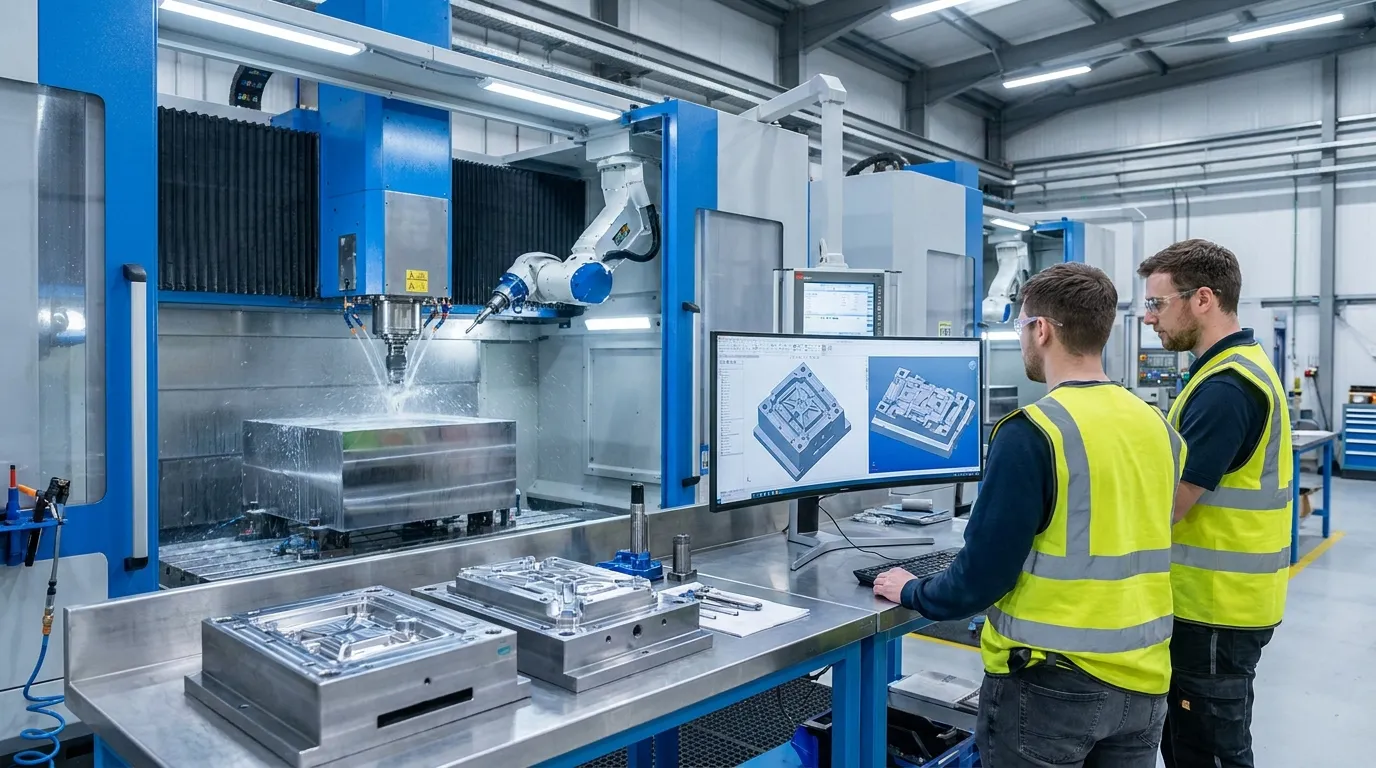
Plastic mold manufacturing starts with DFM analysis and mold design, followed by machining, EDM, fitting, Polissage, Assemblage, and mold trials. Most production molds require testing and adjustments before final approval.
The process usually begins with DFM analysis, short for Design for Manufacturability. Engineers review wall thickness, Angles de tirage, gate locations, shrinkage risk, and cooling requirements before machining starts. This step helps avoid expensive tooling changes later.
Once the design is approved, the mold base and core inserts are machined from steel or aluminum. CNC machining handles most shaping work, while EDM machining creates fine details and sharp corners that standard cutting tools cannot produce.
DFM et conception de moules
Mold design controls how the part fills, cools, and ejects. Cooling channel layout is especially important because uneven cooling often causes warpage or dimensional instability.
A consumer electronics housing is a good example. Cosmetic surfaces may require balanced flow paths and careful gate placement to avoid visible sink marks or weld lines on the finished product.
Usinage et EDM
After machining, manufacturers perform heat treatment if hardened steel tooling is required. The mold then moves into fitting, Polissage, Assemblage, and texture work.
Faster tooling schedules are not always better. Aggressive lead times often reduce fitting and testing time, which increases the risk of corrections during production trials.
Essais de moisissures et validation
Most molds go through one or more sampling stages before approval. During mold trials, technicians test cycle stability, Précision dimensionnelle, cooling performance, and cosmetic quality.
If the mold fails inspection, engineers may adjust cooling layouts, venting, gating, or process settings before another trial begins.
For a deeper breakdown of machining and tooling stages, review this Flux de travail de fabrication de moules resource.
What factors affect plastic mold manufacturing cost?
Mold cost depends mainly on tooling complexity, Type en acier, Nombre de cavités, cooling design, Tolérances, et exigences de validation. Design changes after machining begins are one of the most common causes of unexpected tooling cost increases.
Simple prototype tooling may cost far less than hardened steel production molds designed for millions of cycles. The largest cost drivers are usually machining time, mold complexity, et exigences d’inspection.
Tighter tolerances increase machining and validation work. Multi-cavity molds also require more balancing, cooling control, and dimensional consistency during production.
Table des Facteurs de Coût d’Outillage
| Facteur de coût | Pourquoi cela augmente le coût | Impact sur le délai d’exécution | Production Impact |
|---|---|---|---|
| Acier trempé | Plus difficile à usiner et à traiter thermiquement | Moyen | Durée de vie plus longue du moule |
| Conception multi-cavités | Demande un équilibre et de la précision | Haut | Production plus élevée |
| Système à couloir chaud | Ajoute de la complexité de contrôle thermique | Moyen | Réduction des déchets matériels |
| Tolérances strictes | Nécessite un usinage et une inspection supplémentaires | Haut | Meilleure précision dimensionnelle |
| Finition esthétique | Améliore le polissage et le travail de texture | Moyen | Amélioration de l’apparence |
| Révisions de conception | Nécessite une remise au travail après l’usinage | Haut | Retards d’approbation |
Hot runner molds are not automatically the best choice. They work well for high-volume production with stable materials, but cold runner systems are often safer for lower-volume projects or products that change materials frequently.
A medical connector project, par exemple, may justify hardened steel tooling because long production runs require stable dimensions over millions of cycles.
Vous pouvez comparer Comparaison des types de moules options when evaluating tooling complexity and lifespan requirements.
Aluminum vs steel molds: which one makes sense?
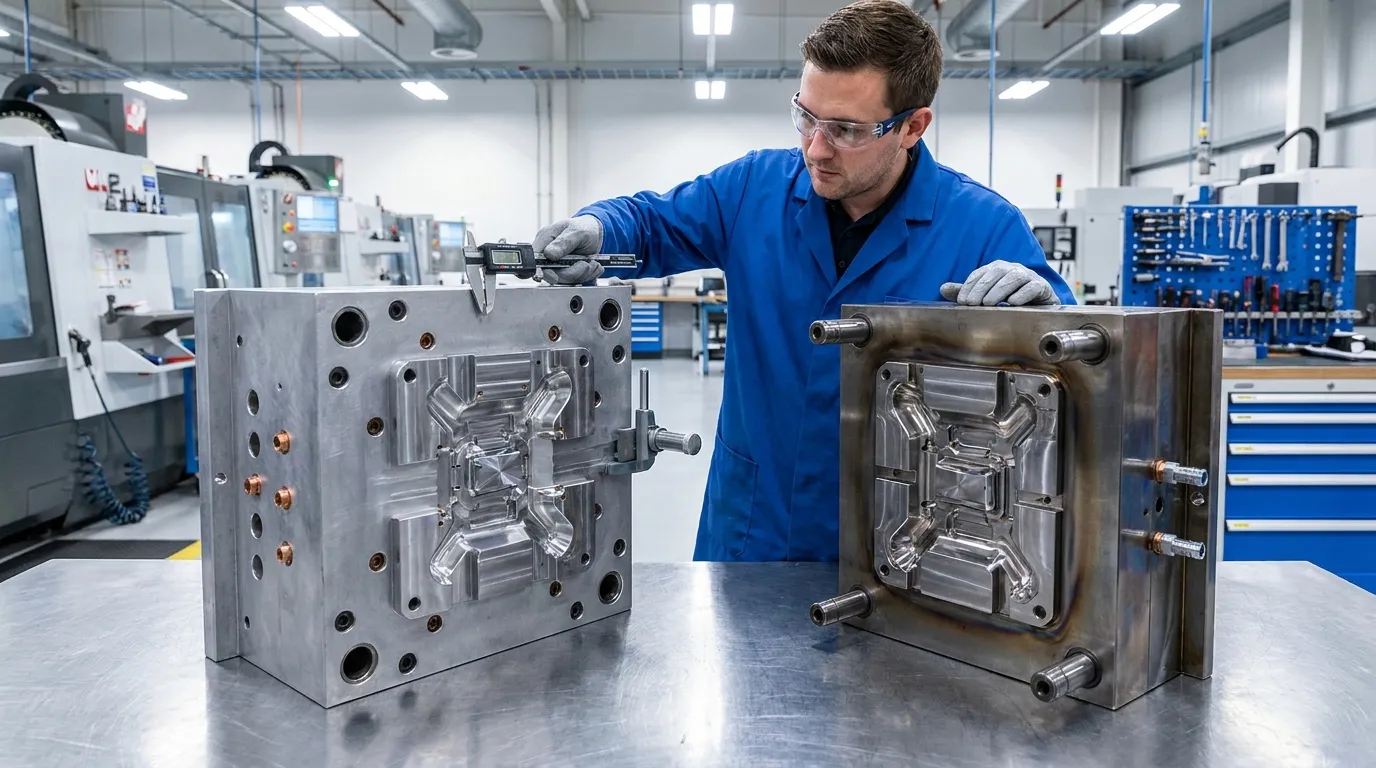
Aluminum molds reduce lead time and upfront tooling cost, while steel molds handle higher production volumes and tighter tolerances. The better option depends on expected production volume, material abrasiveness, and lifespan requirements.
Aluminum tooling is common for prototypes, bridge tooling, and lower-volume production. It machines faster than steel, which reduces lead time and upfront cost.
A startup launching a consumer product may choose aluminum tooling to shorten development time and validate market demand before investing in hardened steel production tooling.
| Facteur | Moule en aluminium | Moule en acier |
|---|---|---|
| Coût initial | Lower | Plus haut |
| Délai d’exécution | Plus vite | Plus lent |
| Durabilité | Lower | Plus haut |
| Volume de production | Faible à moyen | Moyen à élevé |
| Matériaux abrasifs | Moins adapté | Mieux adapté |
| Stabilité dimensionnelle | Modéré | Fort |
Steel tooling usually makes more sense for long production runs, abrasive materials, or tighter tolerances. Although the upfront cost is higher, the long-term production stability is often better.
Vous pouvez explorer plus largement Moules en acier vs en aluminium considerations before finalizing tooling material selection.
How long does plastic mold manufacturing take?
Plastic mold manufacturing timelines often range from several weeks to several months depending on tooling complexity, sampling revisions, validation requirements, and shipping conditions. Design changes after steel cutting are one of the biggest causes of delay.
Selon Guide des délais d’exécution d’EvokPoly, tooling schedules vary significantly based on mold size, Complexité, and production requirements.
A simple prototype mold may move quickly through machining and validation. Multi-cavity production tooling with cosmetic surface requirements usually takes longer because fitting, Polissage, and sampling are more demanding.
Calendrier de fabrication de moules en plastique
| Scène | Activité typique |
|---|---|
| Critique du DFM | Analyse de la fabricabilité |
| Conception du moule | Cooling, gating, et conception de cavités |
| Usinage CNC | Coupe de carottes et cavités |
| Usinage EDM | Travail de détail fin |
| Assemblage et montage | Alignement du moule et polissage |
| Essai de moisissure | Échantillonnage initial de la production |
| Validation | Inspection dimensionnelle et esthétique |
| Transport maritime | Emballage et dédouanement |
Causes courantes des retards d’outillage
- Révisions tardives de la conception produit
- Déséquilibre de refroidissement découvert lors de l’échantillonnage
- Délais d’approvisionnement en acier
- Corrections répétées du moule
- Problèmes de dédouanement pendant le transport maritime
A packaging mold project may look complete during machining but still require several sampling revisions if cooling channels create uneven shrinkage across cavities.
International tooling shipments can also face customs classification delays. Guide des codes HS de FreightAmigo explains how mold classification affects shipping documentation and customs processing.
For additional scheduling context, Ceci Processus de délai d’exécution des outillages guide explains how production stages connect together.
What quality checks happen before mold approval?
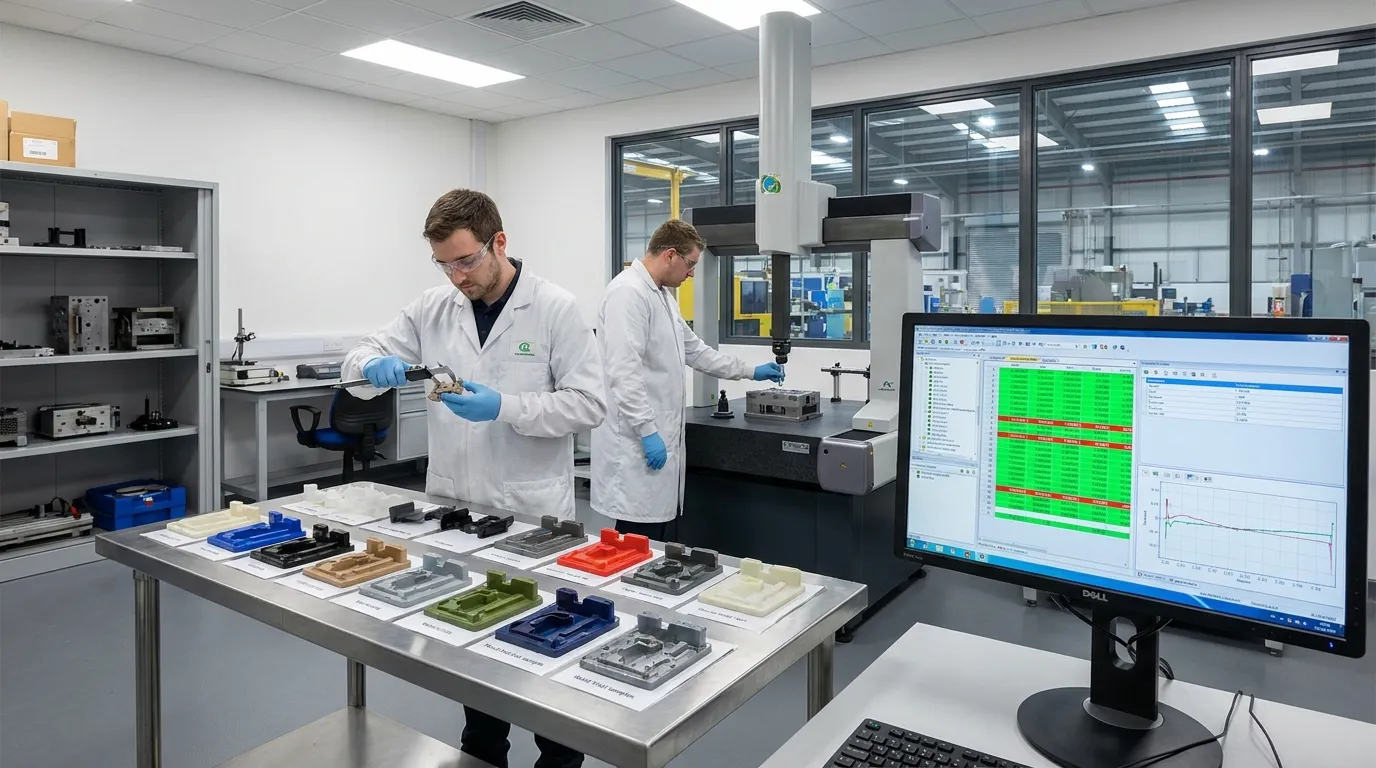
Mold approval should include dimensional inspection, cosmetic validation, mold trial reports, cooling verification, and production sampling. A mold that passes machining inspection can still fail during real production testing.
Machining accuracy alone does not guarantee stable production performance. Mold trials test how the tool behaves under real molding conditions, including pressure, Refroidissement, shrinkage, and cycle consistency.
Manufacturers typically measure critical dimensions against approved drawings after sampling. Cosmetic inspection checks for sink marks, Flash, Plans courts, and weld lines.
Inspection d’essai de moisissure
- Équilibre de remplissage entre les cavités
- Performances de refroidissement
- Partie de déformation
- Consistance de l’éjection
- Qualité de la finition de surface
- Stabilité en temps de cycle
A consumer electronics housing may pass dimensional inspection but still fail cosmetic review if gate placement leaves visible marks on display surfaces.
Vérifications de validation en production
Good suppliers also document process settings and inspection reports before production approval. These records help maintain consistency after mass production begins.
The cheapest tooling quote is often the most expensive production decision later if cooling performance, maintenance access, or sampling support are weak.
If you need a broader tooling overview, le Aperçu des composants du moule explique comment les systèmes de moule fonctionnent ensemble pendant la production.
Vous pouvez aussi consulter Notions de base de l’inspection de moisissures for additional inspection terminology and tooling concepts.
What problems commonly delay or damage mold projects?
Many mold delays start before machining begins. Incomplete product drawings, late engineering changes, weak cooling design, and customs clearance problems can all extend tooling schedules and increase project cost.
Late revisions are one of the biggest risks in mold manufacturing. Once steel cutting starts, even small geometry changes may require expensive rework or replacement inserts.
Weak cooling layouts also create long-term production problems. Uneven cooling increases shrinkage variation, which often leads to repeated sampling corrections and unstable dimensions.
Liste de contrôle courante des risques des outillages
- Examen incomplet du DFM
- Exigences de tolérance peu claires
- Mauvaise conception de la ventilation
- Accès limité à la maintenance
- Délais de livraison irréalistes
- Plans d’échantillonnage faibles
- Erreurs de documentation douanière
Trade conditions and tariff changes can also affect tooling schedules and cost planning. L’Association de l’industrie des plastiques notes that changing trade conditions continue to affect plastics supply chains and manufacturing logistics.
A tooling shipment delayed at customs can stop production planning even after the mold itself is complete. That's why experienced export support matters during international projects.
For additional production context, review Production de moules d’injection to understand how tooling decisions affect molding performance later.
How should buyers evaluate a plastic mold manufacturer?
Choosing the right mold manufacturer depends on more than price. Buyers should evaluate engineering support, sampling capability, inspection systems, communication quality, and long-term tooling support before approving a project.
Good suppliers explain lead times clearly and identify risks early. They also provide realistic feedback during DFM review instead of simply accepting every product design without discussion.
Liste de contrôle pour l’évaluation des acheteurs
- Capacité de revue DFM
- Soutien à l’analyse de l’écoulement de moisissure
- Processus d’échantillonnage et de validation
- Qualité de la documentation QC
- Planification de l’entretien des moisissures
- Expérience en exportation et expédition
- Processus de gestion des révisions
- Support du dépannage en production
Tool ownership and documentation should also be clarified before production begins. Guide d’outillage de Harris Sliwoski explains why tooling agreements matter in international manufacturing relationships.
Vous pouvez également consulter ce texte Guide du fournisseur de moules d’injection for broader supplier evaluation criteria.
Réussir la prochaine étape
Plastic mold manufacturing affects far more than tooling cost alone. Conception du moule, cooling layout, sampling quality, and validation planning all shape long-term production performance. A lower upfront quote may create larger costs later if the tool requires repeated corrections or unstable production settings.
Before approving a project, review the supplier's DFM process, Normes d’inspection, and sampling workflow carefully. Ask how they handle revisions, cooling verification, and production troubleshooting. A well-built mold usually saves time, scrap, and maintenance cost long after the first production run begins.
Questions fréquemment posées
How much does plastic mold manufacturing cost?
Plastic mold manufacturing cost depends on tooling complexity, Type en acier, Cavités, Tolérances, runner systems, et exigences de validation. Simple prototype molds cost much less than hardened steel production tooling designed for long production runs.
How long does it take to manufacture a plastic mold?
Plastic mold manufacturing can take several weeks to several months depending on tooling complexity and validation requirements. Design changes after steel cutting commonly extend lead times and increase production delays.
What quality checks are required before mold approval?
Mold approval should include dimensional inspection, cosmetic validation, mold trial reports, cooling verification, and sampling review. Production testing matters because machining accuracy alone does not guarantee stable molding performance.
Should I choose aluminum or steel tooling?
Aluminum tooling works well for prototypes and lower production volumes because it reduces cost and lead time. Steel molds are usually better for high-volume production, abrasive materials, and tighter tolerances.
What causes mold manufacturing delays?
Mold manufacturing delays often come from late design revisions, steel sourcing problems, sampling corrections, and shipping issues. Poor project planning can extend tooling schedules significantly.
What happens during mold sampling?
Mold sampling tests whether the tool can produce parts that meet dimensional and production requirements. Manufacturers often adjust cooling, gating, or process settings after the first trial.
Partager:


Écrit par Sunshine
Au soleil, Nous sommes un fabricant et fournisseur professionnel de composants de moule de précision, proposant une large gamme de produits pour les applications de stampage et de moulage par injection. Notre objectif principal est le poinçage des coins, Goupilles et manchons d’éjection, et poteaux guides et bagues. Avec un usinage CNC avancé, Contrôle qualité strict, et de fortes capacités de production, Nous garantissons une fiabilité, Pièces de haute précision, ainsi que des composants standards en stock pour un approvisionnement mondial rapide et efficace.
ACTUALITÉS
OBTENIR UN SERVICE
Avec des pièces de qualité adaptées à tous les budgets et un personnel accueillant formé pour rendre votre visite informative et sans tracas.
