



Composants de précision pour moules: Quand la précision et la résistance à l’usure comptent
Precision components for molds are high-tolerance parts that improve alignment, Répétabilité, and wear resistance in injection mold systems. Components such as guide posts, Goupilles éjecteurs, and bushings need tight dimensional control to reduce flash, uneven wear, and part variation. The right material, Revêtement, and inspection process can extend mold life and maintain stable production quality across long manufacturing runs.
A mold can look well-built on paper and still fail in production because of small component inaccuracies. Désalignement, Usure de surface, and tolerance drift often start with the parts that guide, Poste, and eject material inside the mold. For manufacturers running high-volume production, precision components are not just about tighter machining. They affect maintenance costs, scrap rates, and long-term mold stability.
What are precision components in mold manufacturing?
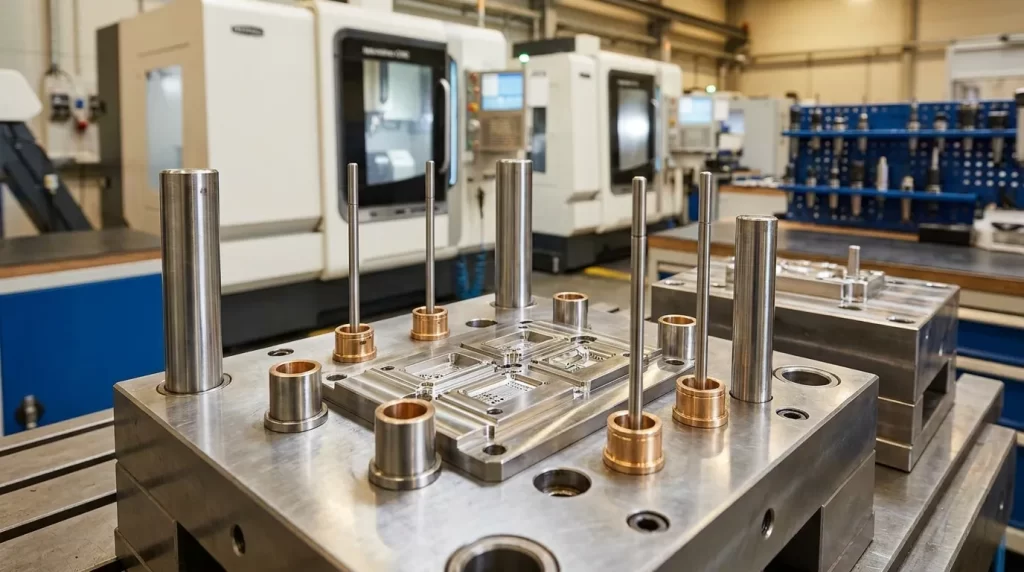
Precision components in molds are high-tolerance parts designed to maintain alignment, Répétabilité, and dimensional accuracy during repeated production cycles. They reduce variation, minimize wear-related defects, and improve mold lifespan.
Dans la fabrication de moules, precision components refer to parts that must maintain exact positioning under repeated mechanical stress. These components include guide posts, Silents, Goupilles éjecteurs, Manches, and cavity inserts. Even a small dimensional shift can create flash, Stuck, or inconsistent plastic parts.
The need for precision becomes more obvious in high-cycle molds. A mold producing thousands of parts each day cannot rely on loose-fitting components. Wear increases quickly when alignment drifts, especially in molds processing abrasive resins or thin-wall parts.
Manufacturers often use hardened tool steels, Rectification de précision, Usinage EDM, and advanced inspection systems to maintain dimensional consistency. A broader overview of mold systems and component categories is available in this Guide complet des composants du moule.
For buyers comparing suppliers, the key issue is not just machining capability. It is whether the supplier can maintain repeatability over long production runs using properly engineered Composants de moule de précision.
Which mold components require the highest precision?
Systèmes de guidage, ejector components, and cavity alignment parts usually require the highest precision because even small dimensional variation can create flash, mismatch, Usure prématurée, or unstable part quality.
Not every mold component needs micron-level tolerances. Some areas are far more sensitive to dimensional variation than others. Guide systems and moving parts usually experience the highest stress and alignment pressure during production.
Systèmes de guidage
Guide posts and bushings control mold alignment during opening and closing. If these parts wear unevenly, cavity surfaces may no longer match correctly. That often causes flash on finished parts or visible mismatch lines.
Automotive trim molds are a common example. A guide-post tolerance difference as small as ±0.01 mm can affect visible surface quality on exterior plastic parts.
Systèmes d’éjection
Ejector pins and sleeves require smooth movement and consistent positioning. Excess friction or slight misalignment increases wear and can damage molded parts during ejection.
In high-volume electronics production, ejector pins often fail early because of short cycle times and repeated friction contact. Poor alignment accelerates galling and surface scoring.
| Composant de moisissure | Pourquoi la précision est importante | Risque de défaillance courant |
|---|---|---|
| Poteaux guides | Maintient l’alignement du moule | Flasher et incompatibilité |
| Silents | Contrôle la stabilité des mouvements | Usure inégale |
| Goupilles éjecteurs | Prend en charge la libération propre des pièces | Encollage par épingle |
| Inserts à noyau | Maintient la précision dimensionnelle | Incohérence des parties |
| Manches | Réduit le mouvement de friction | Score en surface |
Approvisionnement des fabricants Pièces d’alignement du moule should focus on repeatability and wear performance instead of chasing the tightest possible tolerance everywhere.
What tolerance range is considered high precision for mold components?
High-precision mold components commonly operate within ±0.01 mm tolerance or tighter depending on mold complexity, Type de résine, and production volume requirements.
Tolerance requirements depend on the mold application. Thin-wall packaging molds and medical molds usually require tighter dimensional control than general consumer products. Selon Attur International, precision machining applications often operate within ±0.01 mm tolerance ranges.
That does not mean every component should be machined to the tightest possible limit. Ultra-tight tolerances are not automatically better. If the mold application does not require them, they can increase cost without improving production stability.
| Type d’application | Exigence de tolérance typique |
|---|---|
| Composants généraux du moule | ±0.02 mm |
| Pièces d’alignement de précision | ±0.01 mm |
| Moulures à paroi fine | ±0.005 mm |
| Moulage médical ou micro-moulage | Below ±0.005 mm |
Tolerance planning should match actual production conditions. High-volume molds processing abrasive materials usually benefit more from stable wear resistance than from unnecessary ultra-fine tolerances.
Why does wear resistance matter in injection molds?
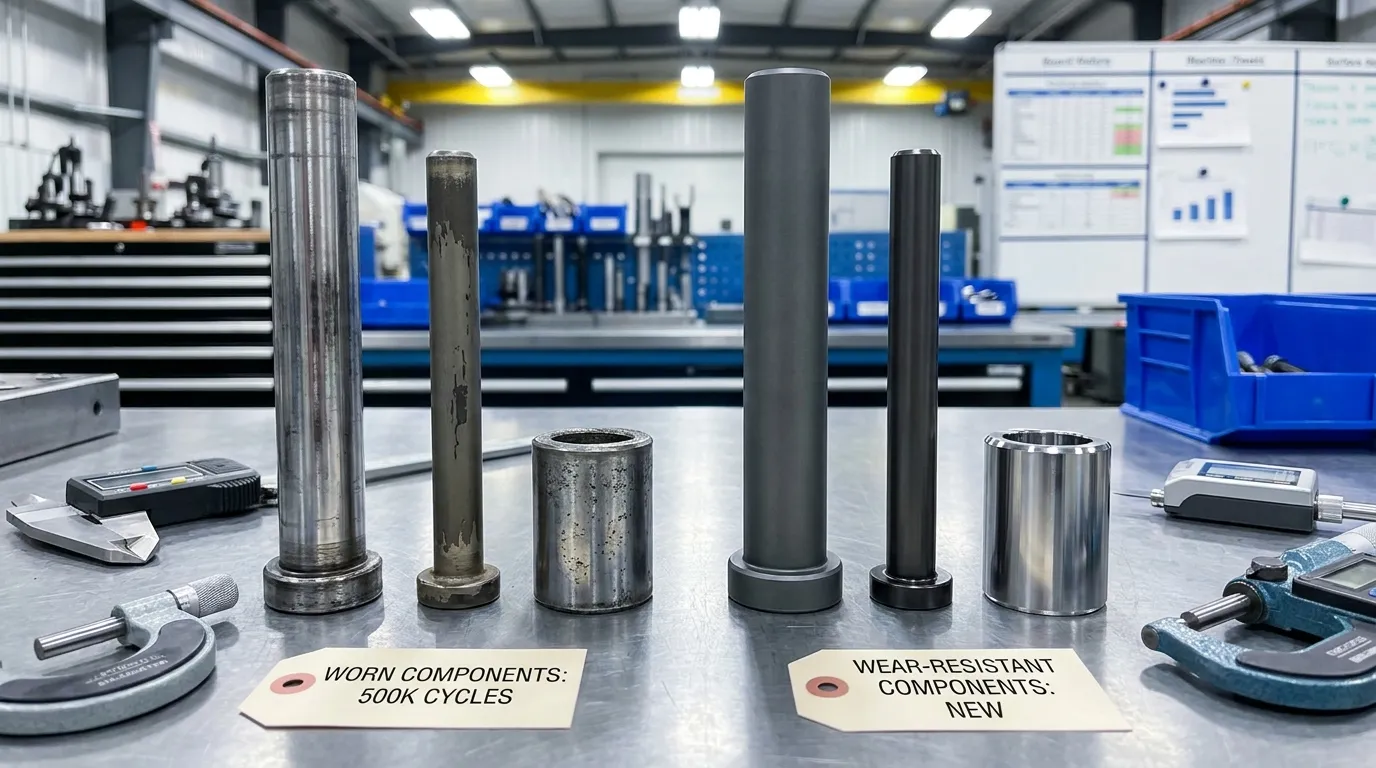
Wear resistance directly affects mold lifespan, cycle stability, and part consistency. Poor wear performance increases maintenance frequency, Dérive dimensionnelle, and the risk of flash or sticking during production.
Mold components experience repeated friction, Pression, and heat during production. Over time, these forces remove material from contact surfaces and reduce alignment accuracy. Once wear begins, dimensional variation spreads quickly through the entire mold system.
Abrasive plastics make the problem worse. Glass-filled resins and engineering plastics create higher friction loads that accelerate surface damage. Components that start with weak hardness or poor surface treatment often fail much earlier than expected.
Points d’usure courants
The most common wear locations include:
- Poteaux guides et bagues
- Goupilles éjecteurs
- Noyaux glissants
- Surfaces d’arrêt
- Manchons et inserts mobiles
Coatings help, but they cannot compensate for poor alignment or weak base material selection. A nitrided surface on a poorly fitted guide system will still wear unevenly under repeated load.
Liste de contrôle de l’usure de la moisissure
| Panneau d’avertissement | Cause probable | Action recommandée |
|---|---|---|
| Flasher sur les pièces moulées | Usure de l’alignement | Système de guides d’inspection |
| Encollage par épingle | Gallage de surface | Remplacer ou enrober les goupilles d’éjection |
| Usure irrégulière des cavités | Dureté médiocre | Qualité des matériaux d’amélioration |
| Score en surface | Dégâts par friction | Améliorer la lubrification |
| Entretien fréquent | Faible résistance à l’usure | Révision de la stratégie de revêtement |
Pour les fabricants comparant Pièces de moule résistantes à l’usure, the better long-term choice is often the component that reduces downtime rather than the one with the lowest purchase price.
Which materials and coatings improve mold component lifespan?
High-grade tool steels combined with surface treatments like nitriding or PVD coatings improve hardness, Réduire la friction, and extend the operating life of precision mold components under repeated production stress.
Material selection affects both wear resistance and dimensional stability. Hardened tool steels are common because they maintain strength under repeated mechanical load. Surface treatments improve resistance to friction and abrasion without changing the entire component structure.
Nitriding is widely used because it hardens the outer surface while maintaining core toughness. PVD coatings reduce friction and improve release performance on moving parts.
| Matériau ou revêtement | Principal avantage | Utilisation typique |
|---|---|---|
| Acier à outillage | Forte dureté | Composants principaux |
| Nitrurage | Résistance à l’usure de surface | Systèmes de guidage |
| Revêtement PVD | Friction moindre | Goupilles éjecteurs |
| Traitement thermique | Stabilité dimensionnelle | Parties structurelles |
A supplier comparison often shows the real value of coatings. One production facility using coated bushings reduced maintenance intervals compared with untreated steel bushings operating under the same cycle conditions.
Custom precision components are valuable for high-cycle or complex molds, but standard parts are often the smarter choice for easier maintenance and replacement. Buyers evaluating Composants de moule durables should balance lifespan, Vitesse de remplacement, and total operating cost.
How are precision mold components inspected and verified?
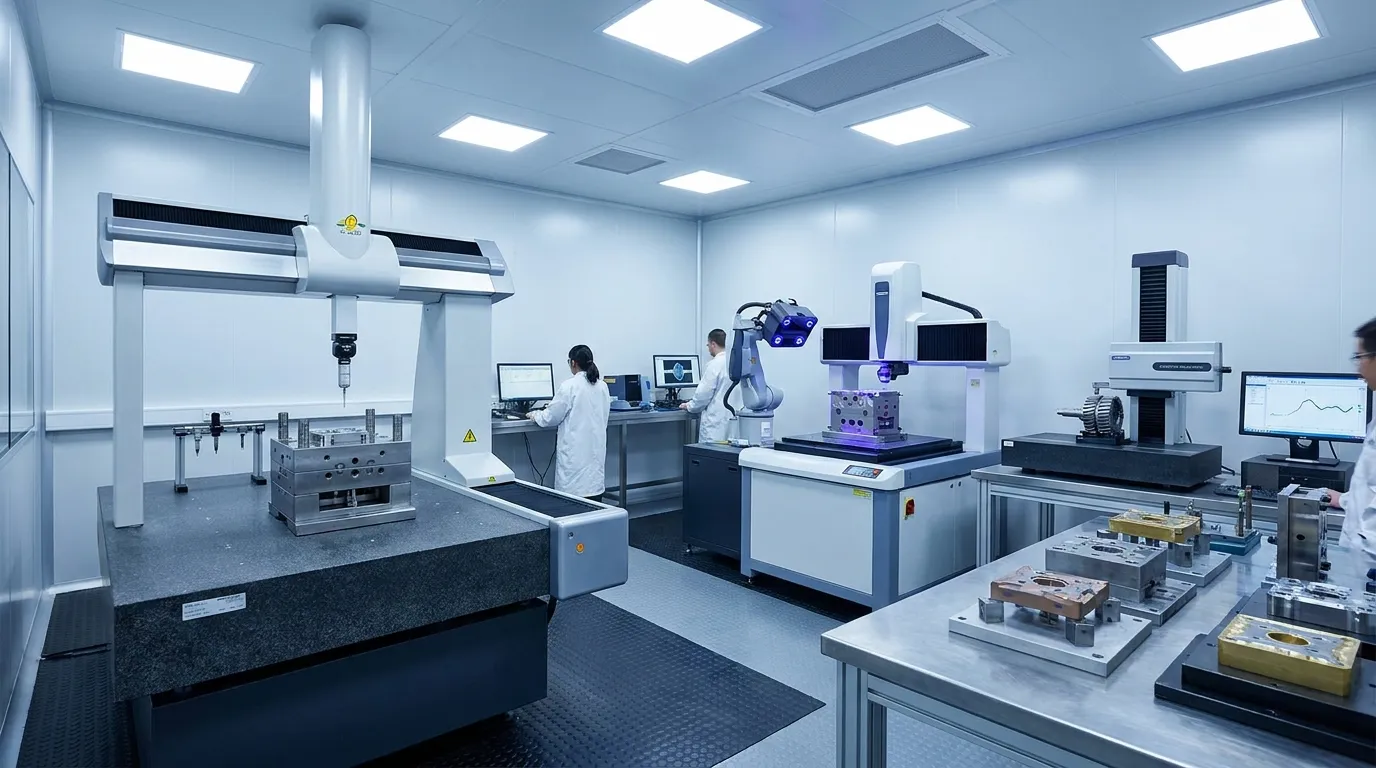
Manufacturers verify precision mold components using contour measurement systems, optical inspection, and dimensional metrology tools to confirm tolerance accuracy and surface conformity before production use.
Inspection matters because even small dimensional variation can affect mold performance. Most suppliers use multiple verification methods depending on component complexity and tolerance requirements.
Selon MinebeaMitsumi, precision manufacturing depends heavily on dimensional consistency and stable machining accuracy.
Processus d’inspection typique
- Mesure dimensionnelle initiale à l’aide d’un étrier ou micromètre
- Vérification de précision avec des systèmes de mesure CMM ou de contour
- Inspection de surface pour détecter des marques d’usure ou des défauts de finition
- Validation finale de la répétabilité avant l’expédition
Optical inspection systems are common for smaller components with complex geometry. Contour measuring equipment helps verify profiles and edge accuracy on inserts and precision-fit parts.
Inspection also helps identify process drift before it becomes a production issue. In thin-wall molding, a ±0.01 mm alignment variation can create inconsistent cavity fill and visible defects across thousands of parts.
Are custom precision components always better than standard parts?
Custom precision components are not always the best choice. They work well for demanding molds with tight tolerances or unusual geometry, but standard components are often easier to replace and maintain during regular production.
The decision depends on production volume, Complexité, et stratégie de maintenance. A custom component may improve cycle stability in a high-volume automotive mold, but it can also increase lead time and replacement cost.
Table de décision de la précision vs tableau de décision des composants standards
| Situation | Meilleur choix | Pourquoi |
|---|---|---|
| Production en grande quantité | Pièces de précision personnalisées | Meilleure stabilité à long terme |
| Produits de consommation simples | Pièces standard | Remplacement plus rapide |
| Moulage à tolérance serrée | Pièces personnalisées | Alignement amélioré |
| Environnements de maintenance fréquents | Pièces standard | Approvisionnement plus facile |
| Géométrie complexe du moule | Pièces personnalisées | Meilleur ajustement et performances |
A buyer producing low-volume consumer products may gain little value from expensive custom alignment systems. En revanche,, medical or electronics molds often justify higher precision because downtime and defect rates carry much higher production costs.
The smarter approach is matching component strategy to production conditions instead of assuming tighter tolerance always improves results.
How do sourcing and customs delays affect precision component supply?
Precision mold components often have longer sourcing timelines because they require specialized machining, Inspection, and export documentation. Customs delays can add another layer of risk when replacement parts are needed quickly.
Shipment documentation matters more in 2026 because import systems are stricter in several regions. The EU’s Import Control System 2 (ICS2) requires more detailed shipment information for imported goods.
A common problem is vague shipment labeling. One supplier described mold components simply as “machine parts,” which delayed customs clearance because the classification lacked enough detail.
Liste de contrôle pour l’expédition de composants de précision
- Confirmez l’exactitude du code HS avant l’expédition
- Utilisez des descriptions détaillées des pièces
- Vérifier la documentation des documents
- Inclure les spécifications dimensionnelles lorsque cela est nécessaire
- Confirmez les exigences de conformité à la destination
- Révisez les documents d’importation avant l’expédition
Selon Directives de DHL concernant les retards en douane et récent Bulletins commerciaux de la CBP, incomplete documentation remains a major cause of shipping disruption.
Que faire ensuite
Choosing the right precision components comes down to production stability, Résistance à l’usure, and realistic tolerance requirements. The best option is not always the tightest or most expensive part. It is the component that maintains accuracy over time without creating unnecessary maintenance cost or sourcing delays.
If you are reviewing mold performance problems, start with alignment systems, ejector components, and wear surfaces first. Those areas usually reveal the earliest signs of dimensional drift. For a broader understanding of mold systems and applications, Ceci Guide pour moule d’injection plastique provides additional context on how molds are designed and used across production environments.
Questions fréquemment posées
What are precision components used for in molds?
Precision components maintain alignment, Précision dimensionnelle, and repeatability inside mold systems. They help reduce defects, improve consistency, and extend mold lifespan during repeated production cycles.
What tolerance is considered high precision in mold manufacturing?
High precision in mold manufacturing commonly means tolerances around ±0.01 mm or tighter depending on the application. Critical mold areas may require even smaller variation for stable production.
Which mold components wear out the fastest?
Goupilles éjecteurs, guide systems, and high-friction contact surfaces usually experience the fastest wear. Mauvaise lubrification, Désalignement, and abrasive materials accelerate failure.
Are coated mold components worth the cost?
Coated components often last longer and reduce friction in high-cycle production environments. The added cost is usually justified when downtime or replacement frequency becomes expensive.
How are precision mold parts inspected?
Manufacturers use contour measuring systems, Équipement d’inspection optique, and dimensional metrology tools to verify tolerances and surface quality. Inspection confirms repeatability before production use.
Can standard mold components replace custom precision parts?
Standard components work well for many general applications, but custom parts are often necessary for tight tolerances, unusual geometries, or high-volume production stability.
Partager:


Écrit par Sunshine
Au soleil, Nous sommes un fabricant et fournisseur professionnel de composants de moule de précision, proposant une large gamme de produits pour les applications de stampage et de moulage par injection. Notre objectif principal est le poinçage des coins, Goupilles et manchons d’éjection, et poteaux guides et bagues. Avec un usinage CNC avancé, Contrôle qualité strict, et de fortes capacités de production, Nous garantissons une fiabilité, Pièces de haute précision, ainsi que des composants standards en stock pour un approvisionnement mondial rapide et efficace.
ACTUALITÉS
OBTENIR UN SERVICE
Avec des pièces de qualité adaptées à tous les budgets et un personnel accueillant formé pour rendre votre visite informative et sans tracas.
