



Conception de la ligne de rupture de tablette pour un séparation fiable et une durée de vie fiable des outils
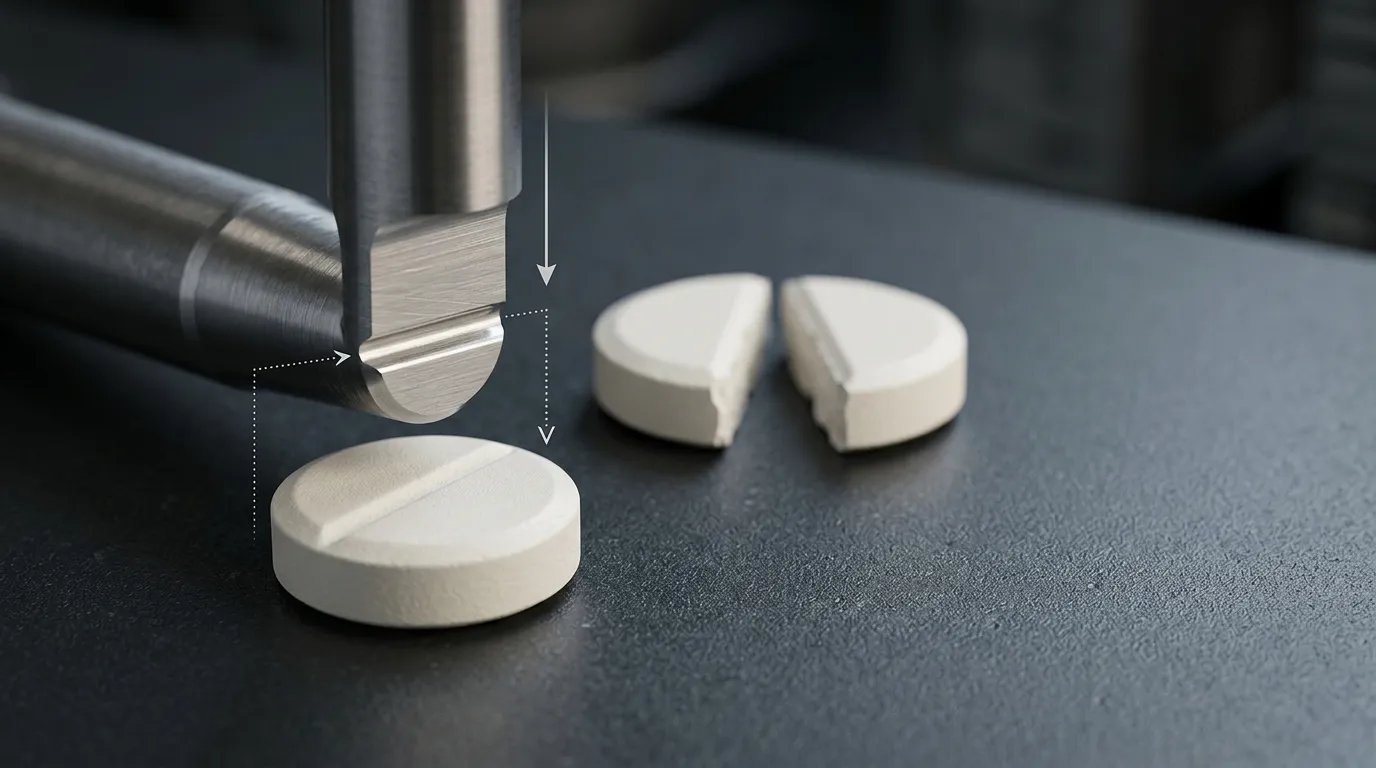
Tablet break line design is not a matter of making the deepest possible groove. A functional break line, also called a tablet score line, must guide the tablet along an intended fracture path while leaving enough strength for compression, Éjection, Revêtement, Emballage, et maniement.
The geometry must also be practical for the punch tip that forms it. A sharper or more protruding feature may help initiate a break, but it can increase local stress, reduce clearance between upper and lower punches, or make the tooling more vulnerable to chipping.
La géométrie de la ligne de rupture est une décision spécialisée dans la gamme plus large de Types d’outils de presse à tablette. The final design should be evaluated as a system involving the tablet shape, Épaisseur, Formulation, Plage de dureté, punch configuration, Installation de la presse, and product-validation method.
What Makes a Tablet Break Line Functional?
A functional score line is intended to help a tablet divide into defined portions. Its performance cannot be judged only by how visible, straight, or symmetrical the groove appears.
A useful break line should support several outcomes:
- The tablet can be held and divided using the intended method.
- Fracture occurs close to the planned path.
- The resulting portions are reasonably consistent.
- Material loss from crumbs and fragments remains controlled.
- The intact tablet remains strong enough for production and handling.
- Subdivision does not create unacceptable changes in product performance.
Le Directives de la FDA sur la notation des comprimés treats scoring as a product-performance issue rather than a cosmetic feature. Depending on the product and market, evaluation may include splitting behavior, mass loss, Friabilité, Dissolution, Stabilité, and performance across the proposed tablet-hardness range.
Partition fonctionnelle versus rainure décorative
A tablet may contain a visible groove without being suitable for accurate subdivision. A decorative line may improve appearance or product recognition, but it should not be represented as a functional score unless the finished tablet has been tested for that purpose.
Visual inspection can confirm that the groove exists. It cannot prove that:
- The fragments have consistent mass.
- The active ingredient is evenly distributed.
- The tablet will divide similarly across the production hardness range.
- The split portions retain acceptable release characteristics.
- Patients or operators can reproduce the result using the intended method.
Tooling inspection and tablet-performance validation are therefore separate requirements.
Variables de géométrie de la ligne de rupture et leurs compromis
A score feature is defined by several connected dimensions. Changing one variable can affect the others, so break-line depth should never be specified in isolation.
| Variable de conception | Effet escompté | Risque si on est poussé trop loin | Ce qu’il faut vérifier |
|---|---|---|---|
| Profondeur ou pénétration | Réduit la section du comprimé qui doit se fracturer | Weak intact tablet, fragile center, tall punch feature | Tablet strength, split force, punch clearance |
| Largeur de rainures | Crée de l’espace pour la partition et affecte son profil | Élimination excessive de matériaux ou mauvaise définition visuelle | Comportement de fracture et fabricabilité |
| Angle inclus | Concentre le chemin de fracture | Géométrie de poinçon nette et contrainte locale plus élevée | Puissance du coup de poing et régularité des subdivisions |
| Rayon raciculaire | Contrôle la netteté en bas du score | Too small may weaken the tooling; too large may reduce fracture guidance | Contrainte des outils et cassabilité des tablettes |
| Durée du score | Prolonge le chemin de fracture guidé | Écaillage des bords ou interférence avec d’autres caractéristiques | Chemin de fissure et disposition en forme de face tablette |
| Position et orientation | Définit la géométrie des segments souhaités | Sections inégales ou désalignement | Symmetry, Clé, and drawing orientation |
The correct combination depends on the tablet rather than on a universal score-line standard.
Profondeur, Width, and Remaining Tablet Section
A deeper groove leaves less tablet material beneath the score. This can reduce the force needed to start a fracture, but it can also weaken the tablet before the user intends to split it.
Depth must be considered relative to:
- Overall tablet thickness.
- Cup depth and face curvature.
- The location of the score across the curved surface.
- Tablet hardness.
- Whether the opposite face also contains a score.
- The height and shape of the punch-tip feature.
Par exemple, the same nominal score depth may leave a substantial residual section in a thick, shallow-profile tablet but a much thinner section in a smaller tablet with a deep cup.
Groove width also affects the feature profile. It should provide a manufacturable transition without removing more material than necessary or creating a punch feature that is too thin to withstand repeated loading.
Angle et rayon racinaire
The included angle and root radius influence how strongly the score concentrates stress when the tablet is bent.
A sharp groove can encourage fracture to start at the intended line. The corresponding punch-tip feature, cependant, may contain a thin or sharp transition where mechanical stress becomes concentrated during each compression cycle.
A larger root radius generally creates a smoother tooling transition, but it may provide less concentrated fracture guidance in the tablet. This is why angle and radius should be reviewed together rather than treated as independent cosmetic dimensions.
Sources techniques de conception de tablettes telles que le I Holland papier à conception de tablette discuss score penetration, Rayon, angle, punch stress, and the need to balance tablet breakability with robust tooling. These relationships are useful design principles, but they do not establish a universal dimension for every formulation.
Longueur, Poste, and Interaction With Face Features
The score should follow the intended segment boundary and remain compatible with the tablet’s shape and face profile.
Its endpoints require particular attention. A line that extends too close to a tablet edge may create a vulnerable edge condition, while a line that stops too early may not guide the complete fracture path.
Other face features also affect placement:
- Logos and characters can interrupt a symmetrical fracture path.
- Deep embossing can compete with the score for available face area.
- Curved surfaces can change the effective score penetration along its length.
- Off-center placement can create unequal tablet sections.
- Multiple intersecting scores increase both tablet and punch-tip complexity.
The score, identification marks, and overall cup profile should be reviewed as one punch-face layout.
Pourquoi les propriétés des tablettes modifient le résultat
Identical punch geometry can produce different subdivision behavior in different formulations.
Tablet size and shape influence how the product can be held and where bending forces are applied. A large oblong tablet may provide more leverage than a small round tablet, even when the score geometry appears similar.
Thickness and cup profile determine how much material remains under the groove. Formulation properties then control how that material responds to stress.
Relevant formulation behavior includes:
- Fragilité.
- Récupération élastique.
- Déformation plastique.
- Compactability.
- Internal bonding strength.
- Distribution of the active ingredient.
Compression force also changes the result because it influences tablet density and hardness. A score that performs well at one development condition may become difficult to break at a higher hardness or excessively fragile at a lower one.
L’évaluation évaluée par les pairs Tablet Scoring: Current Practice, Fundamentals, and Knowledge Gaps describes tablet subdivision as a multivariable problem involving patient use, Géométrie de tablette, Formulation, manufacturing conditions, and the selected test method.
The design should therefore be evaluated across the intended production range, not only on a single batch produced under ideal development conditions.
Single-Sided or Double-Sided Scoring?
A tablet can be scored on one face or on both opposing faces. Neither configuration is automatically better.
| Facteur de sélection | Score à un seul côté | Score double face |
| Configuration du poinçon | Caractéristique de score sur un seul coup de poing face | Caractéristiques coordonnées sur les poinçons supérieurs et inférieurs |
| Alignement rotationnel | Généralement moins exigeant | Les traits opposés doivent rester alignés |
| Section restante de la tablette | Contrôlé d’un côté | Réduits des deux côtés |
| Risque de dégagement | Plus bas pour le visage adverse non marqué | Les protubérances opposées peuvent réduire l’écart entre la pointe et la pointe |
| Complexité de la disposition des faces | Laisse la face opposée disponible | Utilise l’espace sur les deux faces |
| Sensibilité à la configuration | Généralement plus simple | Plus dépend du keying et des longueurs nominales |
| Besoin de vérification | Spécifique au produit | Produit- and setup-specific |
A double-sided score may guide fracture from both surfaces, but it introduces additional mechanical and setup requirements. The two features must be positioned correctly relative to each other, and their combined penetration must not leave an excessively weak central section.
The choice should be based on the tablet geometry, Formulation, intended segment pattern, available face area, Système d’outillage, and validation results.
Alignement et clavage pour les scores opposés
Opposed score features must remain rotationally aligned during production. If one punch turns relative to the other, the score lines may no longer meet across the intended fracture plane.
Anti-turn keys and key guides can control punch orientation. Depending on the tooling arrangement, the lower punch may also require a keyed configuration.
The review should confirm:
- Which punch faces contain the score.
- The required angular orientation.
- The location of each key.
- Whether the press supports the intended keyed arrangement.
- How orientation will be checked during setup.
- Whether key or guide wear could allow movement over time.
This discussion is limited to score alignment. General upper- and lower-punch functions belong to the broader tooling system rather than this specific break-line decision.
Protection de la pointe du poinçon contre le contact et la défaillance prématurée
The score feature machined into a punch face may be narrow, sharp, or raised relative to the surrounding cup. These conditions can increase local mechanical stress.
Repeated compression subjects the punch to cyclic loading. A geometry with a thin section or abrupt transition may become more vulnerable to fatigue, while an overload, contact event, unsuitable material condition, or handling impact can contribute to chipping or brittle fracture.
A Discussion sur la technologie pharmaceutique sur les défaillances des outillages identifies fatigue, brittle fracture, Conception du poinçon, État des matériaux, and compaction load as relevant contributors to punch-tip damage.
The main tooling risks associated with a break line include:
| Risque | Cause possible | Conséquence possible | Action de révision |
| Concentration locale de contrainte | Sharp angle, small radius, thin feature | Caractéristique de fissure par fatigue ou de saise ébréchée | Révision des transitions et du chargement |
| Contact avec les caractéristiques opposées | Jeu insuffisant pour les hauts/bas | Ébréchage ou fracture immédiate | Vérifiez les longueurs nominales et l’écart de pointe |
| Désalignement rotationnel | Problème de clé ou de configuration | Uneven score, Interférence, poor fracture path | Vérifier les commandes d’orientation |
| Protubérance excessive de caractéristiques | Géométrie du score profond | Interférence d’éjection ou dégagement réduit | Critique, hauteur des fonctionnalités et retrait de la tablette |
| Surcharge | Force de compression élevée ou condition de presse anormale | Déformation plastique ou rupture cassante | Confirmez la portée de fonctionnement |
| Conception de tablette marginale | Pénétration excessive ou section centrale faible | Fracture prématurée du comprimé | Essais à travers les conditions de production |
Tool material and heat treatment affect durability, but they cannot compensate for direct punch contact, an unsafe stress concentration, or an incorrect press setup.
SunshinePro Page des outils de presse sur tablettes Listes de l’acier à grande vitesse, Usinage CNC, Traitement thermique, Inspection dimensionnelle, and custom tooling from drawings or samples. These are relevant supplier capabilities, but they should not be interpreted as a guarantee of score performance or tool life for a specific product.
Dégagement des coups de poinçon supérieur à inférieur
Double-sided or highly protruding score features require careful clearance review.
The available gap depends on more than the visible tablet thickness. It can also be affected by:
- Feature height above each punch face.
- Upper and lower punch nominal lengths.
- Compression position.
- Press adjustment.
- Usure des outils.
- Setup error.
- Deflection under load.
A practical review sequence is:
- Dimension the score features on both punch drawings.
- Confirm the nominal lengths of the upper and lower punches.
- Calculate the minimum expected separation at the operating position.
- Include a suitable safety margin for manufacturing and setup variation.
- Verify the arrangement during installation and trial compression.
- Inspect the punch tips after the trial for evidence of contact.
Press-specific values should come from the press manufacturer, approved tooling drawings, and project calculations rather than from a generic article.
Problèmes de production et de gestion liés à la partition
A scored tablet can survive compression but fail during a later production stage.
Lors de l’éjection, the lower punch raises the tablet through the die. A weak score area may chip as the tablet moves, while a protruding punch feature may complicate release from the punch face.
Take-off introduces another contact event. If the tablet has already been weakened excessively, lateral movement can cause edge damage or premature fracture.
Coating and packaging can also expose a marginal design:
- Coating may bridge across the groove.
- Coating film may crack when the tablet is divided.
- Tablets may rub against each other during coating and handling.
- Packaging equipment may apply local loads.
- Transport vibration may break tablets that lack sufficient intact strength.
These problems do not prove that the score is always the root cause. The formulation, ejection force, Condition des outillages, Procédé de revêtement, packaging design, and handling system may also contribute.
The purpose of the break-line review is to determine whether the score has created an avoidable weak section or tooling feature before wider process changes are made.
Diagnostiquer la défaillance avant de changer la ligne de rupture
A score redesign should follow evidence, not assumptions.
| Problème observé | Causes possibles | Preuves à collecter |
| Une tablette est difficile à diviser | Shallow score, high hardness, unsuitable formulation, poor grip, unsuitable test method | Hardness data, breaking method, segment results |
| La tablette se détache de la partition | Misplaced line, formulation fracture pattern, asymmetric geometry | Fracture location, cross-section, Dimensions de la tablette |
| Fragments inégaux | Off-center score, rotational misalignment, inconsistent splitting method | Tool orientation, segment mass, user method |
| Puces de tablette lors de l’éjection | Weak edge, excessive penetration, high ejection force, Condition des outillages | Ejection data, chip location, punch and die inspection |
| La tablette se sépare en un bouchon | Enfermement de l’air, formulation or compression issue, tooling configuration | Defect plane, press parameters, formulation review |
| Puces caractéristiques de score de punch | Direct contact, Concentration de contrainte, Surcharge, Dommages de manipulation | Tip-gap check, fracture surface, setup records |
Capping should not be treated as another name for a score-related break. A score is intended to guide fracture through a defined plane, while capping usually involves separation of the top or bottom portion of the tablet from the main body.
Where the defect pattern indicates cap separation rather than failure along the intended score, the reader should move to the dedicated Solutions d’outils de capsulage pour tablettes guidance instead of expanding the break-line article into a full capping investigation.
Comment valider une conception fonctionnelle à ligne de rupture
A functional break line requires verification at several levels. Dimensional inspection alone is not enough.
1. Inspect the Tooling
Confirm that the manufactured punches match the approved drawings.
Relevant checks may include:
- Score depth.
- Width.
- Angle inclus.
- Rayon raciculaire.
- Length and endpoint position.
- Orientation.
- Poste clé.
- Upper and lower punch nominal lengths.
- Condition de la surface.
- Opposed-feature clearance.
SunshinePro décrit l’inspection dimensionnelle et le rapport d’inspection au sein de ses Pratiques de contrôle qualité. These checks can verify whether the tool conforms to the specification, but they do not establish how a pharmaceutical formulation will behave.
2. Conduct Representative Press Trials
Trials should use the intended formulation and a relevant operating window.
The trial plan should consider:
- Low and high tablet-hardness conditions.
- Expected compression-force range.
- Production speed where it affects performance.
- Ejection and take-off behavior.
- Tool orientation.
- Evidence of upper/lower punch contact.
- Tablet chipping or premature fracture.
- Repeated-cycle effects on the punch feature.
A single successful compression event does not prove that the design is robust for production.
3. Evaluate the Whole Tablet
Before subdivision, confirm that the scored tablet remains suitable for handling.
Evaluation may include:
- Visual integrity.
- Breaking force or hardness.
- Friability.
- Resistance to coating and packaging damage.
- Stability during normal storage and transport.
- Consistency across batches and operating conditions.
The score should not make the intact tablet so weak that it breaks before the intended use.
4. Evaluate the Split Portions
Subdivision testing should represent the intended method, such as hand splitting or a defined mechanical device.
Depending on the product and regulatory strategy, Critique:
- Ease of splitting.
- Fracture location.
- Segment mass variation.
- Material loss.
- Content uniformity.
- Friability of the resulting portions.
- Dissolution or release behavior.
- Stability of split portions where required.
Equal mass does not automatically prove equal active content. If the formulation contains an uneven distribution of active ingredient, two fragments with similar weight may still differ in drug content.
The FDA guidance is relevant to products intended for the United States. Worldwide projects must confirm requirements in each applicable market, particularly for modified-release products or dosage forms where subdivision may alter release behavior.
L’inspection des outillages n’est pas une validation du produit
The responsibility boundary should remain clear:
| Activité | Ce que cela confirme | Ce qu’il ne confirme pas |
| Approbation au tirage au sort | Dimensions et configuration prévues | Performance des tablettes terminées |
| Inspection des outillages | Conformité au dessin | Subdivision fiable |
| Procès de presse | Compression et comportement de manipulation dans des conditions d’essai | Régularité commerciale complète |
| Tests pharmaceutiques | Performance des produits et des segments | Durée de vie de l’outillage à long terme sous chaque condition de presse |
A tooling supplier can manufacture and inspect a punch feature. The pharmaceutical manufacturer or product owner must validate the final tablet.
Informations à préparer avant de commander Outils de tablette notés
A complete enquiry reduces the risk of designing the score without enough product or press information.
Données de tablette
Fournir:
- Forme de tablette.
- Diameter or major and minor dimensions.
- Overall thickness.
- Cup profile.
- Target number of portions.
- Required segment symmetry.
- Coating status.
- Logos, characters, or other face features.
- Intended hand or mechanical splitting method.
Données de la ligne de rupture
Define, where already established:
- Single- or double-sided configuration.
- Profondeur.
- Width.
- Angle inclus.
- Rayon raciculaire.
- Longueur.
- Endpoint position.
- Orientation.
- Relationship to logos or embossing.
Where the dimensions remain under development, identify them as proposed rather than validated.
Formulation et données de procédé
Include relevant information such as:
- Development status of the formulation.
- Intended hardness range.
- Expected compression-force range.
- Known brittleness or elastic-recovery concerns.
- Ejection or take-off issues from prior trials.
- Revêtement, Emballage, and handling requirements.
A tooling supplier does not need the full confidential formulation to understand that the tablet’s fracture behavior and hardness range affect the score design. The level of disclosure can be agreed within the project.
Données de presse et d’outillage
Confirm:
- Press model.
- Tooling standard.
- Punch type.
- Upper and lower punch nominal lengths.
- Keying requirements.
- Key orientation.
- Available lower-punch keying.
- Existing tooling drawings or samples.
- Inspection-document requirements.
SunshinePro indique qu’il propose des solutions personnalisées Outils de presse à tablette from drawings or samples and lists size customization, material-selection support, Usinage CNC, Traitement thermique, and dimensional inspection. Final material, Géométrie, Champ d’inspection, and project suitability should still be confirmed for the specific enquiry.
Principes de la revue finale de conception
Before approving a scored-tablet tooling drawing, confirm five points:
- The score geometry has been reviewed relative to the tablet thickness, Profil de la coupe, Formulation, and hardness range.
- The selected single- or double-sided configuration matches the intended fracture path.
- Opposed features have adequate alignment and upper/lower punch clearance.
- Compression, Éjection, take-off, Revêtement, Emballage, and handling risks have been considered.
- The validation plan separates tooling conformance from whole- and split-tablet performance.
There is no universal break-line geometry that guarantees accurate splitting and long tool life. The most reliable approach is to combine a complete tablet specification, a controlled punch-face design, suitable press setup, and product-specific validation.
For a custom tooling enquiry, prepare the tablet drawing, score dimensions, Détails de presse, keying requirements, and requested inspection records before contacter SunshinePro.
Partager:


Écrit par Sunshine
Au soleil, Nous sommes un fabricant et fournisseur professionnel de composants de moule de précision, proposant une large gamme de produits pour les applications de stampage et de moulage par injection. Notre objectif principal est le poinçage des coins, Goupilles et manchons d’éjection, et poteaux guides et bagues. Avec un usinage CNC avancé, Contrôle qualité strict, et de fortes capacités de production, Nous garantissons une fiabilité, Pièces de haute précision, ainsi que des composants standards en stock pour un approvisionnement mondial rapide et efficace.
ACTUALITÉS
OBTENIR UN SERVICE
Avec des pièces de qualité adaptées à tous les budgets et un personnel accueillant formé pour rendre votre visite informative et sans tracas.
